
Side Effect Tracker & Reporting Guide
Track Your Side Effects
Your Track Record
When to Report to Your Doctor
0-3 (Mild): Note these in your journal but don't necessarily need to report immediately. Keep tracking for patterns.
4-6 (Moderate): Report to your doctor at your next appointment. Mention you've been tracking it.
7-10 (Severe): Report immediately. If symptoms are dangerous (e.g., chest pain, difficulty breathing), seek emergency care first.
Prepare for Your Appointment
Bring your tracking log to your next appointment. Use the SBAR framework:
- Situation: What you're experiencing
- Background: When it started
- Assessment: What you think is happening
- Recommendation: What you'd like to try
Every year, millions of people stop taking their medications because they don’t feel right-but they never tell their doctor. Maybe it’s dizziness after a new blood pressure pill. Or fatigue from an antidepressant. Or stomach cramps from a daily supplement. They assume it’s normal. Or they’re afraid of sounding like a complainer. Or they’re rushed out the door after a 12-minute appointment. The result? Unnecessary suffering. Worse, sometimes hospital visits. Or worse still-preventable harm.
Why Speaking Up Isn’t Optional
You’re not just a patient. You’re the only person who lives inside your body. No doctor, no nurse, no app can feel what you feel. That’s why your voice matters more than any lab result. The World Health Organization says about half of all medication treatments fail-not because the drugs don’t work, but because people stop taking them. And the top reason? Side effects nobody asked about. In the U.S., adverse drug reactions send 1.3 million people to the emergency room every year. That’s not bad luck. That’s a communication gap. When patients don’t report side effects, doctors can’t adjust treatment. They think the medicine is working fine. Meanwhile, you’re walking around with nausea, brain fog, or muscle pain-and no one knows. A 2021 study in JAMA Internal Medicine found that when patients spoke up and got their concerns addressed, adherence to medication improved by up to 25%. That’s not a small number. That’s life-changing. It means fewer hospital stays, fewer complications, and more days feeling like yourself.What to Track Before Your Appointment
You don’t need to be a doctor to know something’s off. But you do need to be specific. Vague complaints like “I don’t feel good” don’t help. Doctors need details. Start a simple journal. Just a notebook or a free app like Medisafe (FDA-approved, updated 2023). For each medication, write down:- What you felt (e.g., “headaches,” “tingling in fingers,” “sudden anxiety”)
- When it started (e.g., “two days after starting lisinopril”)
- How bad it is (use a scale of 0-10: 0 = no problem, 10 = unbearable)
- What you were doing when it happened (e.g., “after lunch,” “when standing up,” “at night”)
How to Talk to Your Doctor Without Feeling Awkward
Most people fear sounding demanding. Or irrational. Or like they’re wasting the doctor’s time. But here’s the truth: your doctor wants to know. They just don’t always ask the right questions. Use a simple framework called SBAR-it’s used by nurses and doctors worldwide. It works for patients too.- Situation: “I’ve been having bad headaches since I started taking metformin.”
- Background: “I started it two weeks ago for prediabetes. Before that, I didn’t have headaches.”
- Assessment: “I think this might be linked. I’ve checked online and found headaches listed as a possible side effect.”
- Recommendation: “Can we talk about whether we should lower the dose or try something else?”
- What is my main problem?
- What do I need to do?
- Why is it important for me to do this?
Don’t Rely on the Patient Information Leaflet
Every pill bottle comes with a leaflet. Thick. Tiny print. Full of medical jargon. Most people don’t read it. And if they do, they don’t understand it. A 2021 study from King’s College London found only 43.7% of patients read the leaflet thoroughly. Why? Because it’s written for pharmacists, not people. Instead, use MedlinePlus-a free, government-run site (medlineplus.gov). It’s plain language. It tells you what side effects are common, what’s rare, and when to call your doctor. It also links to clinical studies and patient stories. And if your doctor gives you a new prescription, ask: “Is there a simpler version of this leaflet?” Many clinics now offer simplified handouts. Ask for one. You’re not being difficult-you’re being smart.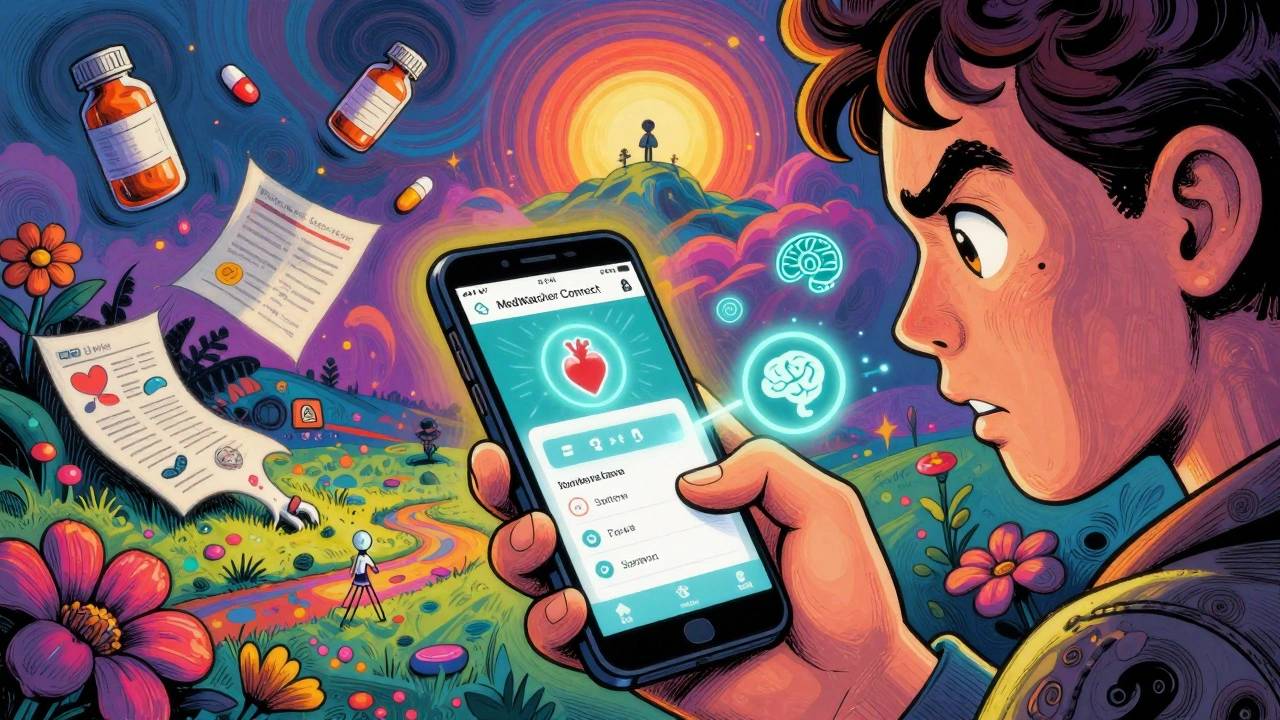
Bring All Your Medications to Every Appointment
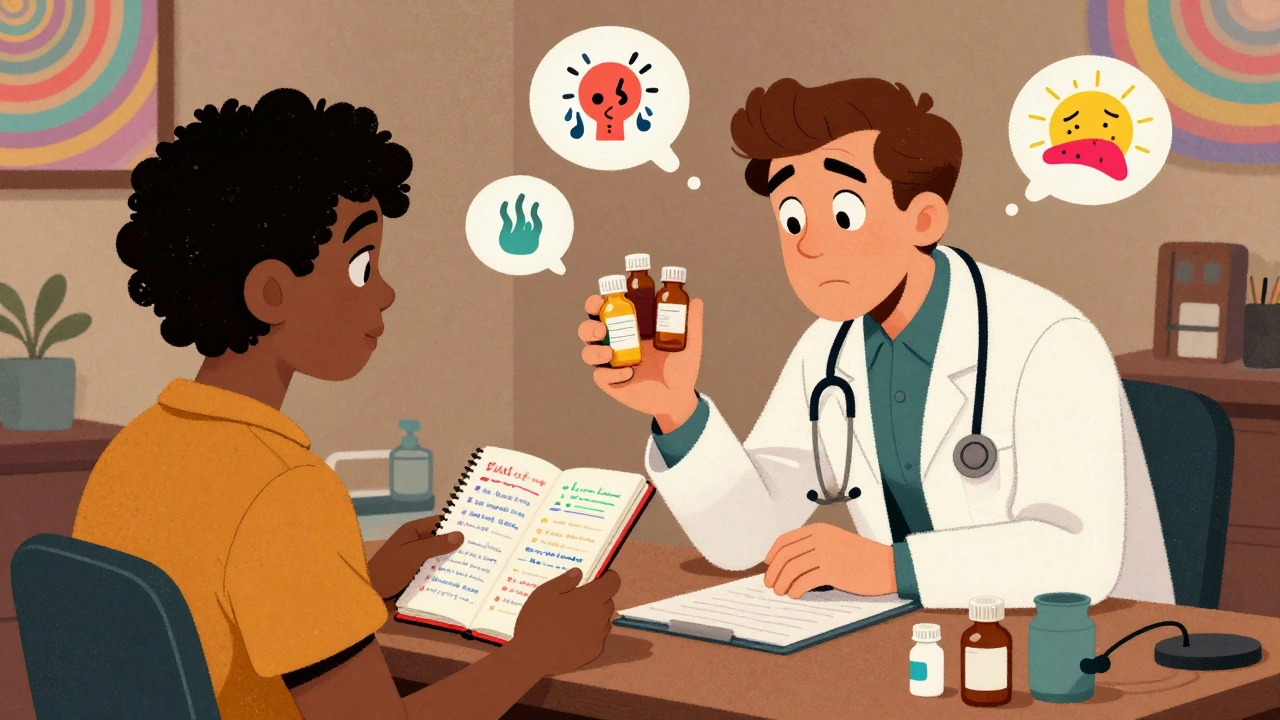
Don’t just list them. Bring them. Literally. The actual bottles. Even the vitamins. Even the herbal teas you think don’t count. Why? Because doctors often don’t know what you’re taking. Or they forget. Or they assume you’re taking it correctly. A 2023 study from UCSF found that patients who brought their meds to appointments were 32% less likely to stop a drug unnecessarily-and 48% more likely to report side effects accurately. You don’t need to organize them. Just dump them on the table. Say: “Here’s everything I’m taking.” That simple act changes the conversation. It shows you’re serious. It tells your doctor you’re not guessing.What If Your Doctor Dismisses You?
Sometimes, they don’t listen. Sometimes, they say, “That’s normal.” Or “It’ll pass.” Or “Lots of people feel that.” That’s not okay. One patient on PatientsLikeMe shared that after telling her cardiologist her blood pressure medicine caused severe leg cramps, he said, “It’s common.” She stopped taking it. Two weeks later, she had a mini-stroke. If your doctor brushes you off, say this: “I understand you think it’s common, but it’s not common for me. I need to figure out what’s causing this. Can we try a different option-or refer me to someone who can help?” If they still don’t respond, ask for a second opinion. Or ask for a referral to a pharmacist who specializes in medication reviews. Many hospitals offer free med reviews. You don’t need a referral.The Bigger Picture: Why This Matters Beyond Your Appointment
When you speak up, you’re not just helping yourself. You’re helping the system. The FDA only gets 1 to 10% of all side effects reported. That means most drug safety data is incomplete. When you report a side effect-even if it seems small-you’re adding a piece to a puzzle that protects millions. In September 2023, the FDA launched MedWatcher Connect, a new tool that lets you report side effects directly from your phone. It takes two minutes. You answer a few questions. You get a personalized risk summary. And your report goes straight to the FDA. In the first 30 days, over 12,000 people used it. That’s nearly four times the number of reports they used to get in a month. Your voice is part of that change.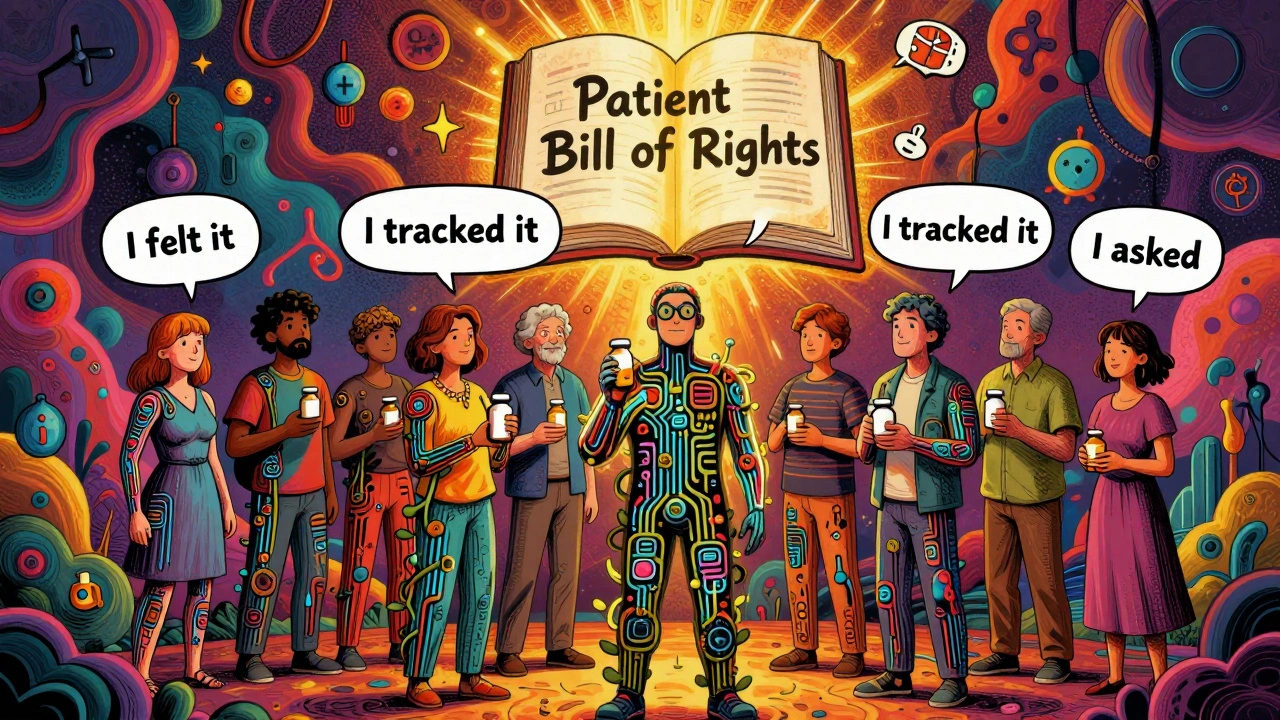
It’s Not About Being Loud. It’s About Being Consistent.
You don’t need to be aggressive. You don’t need to argue. You just need to show up prepared. Track your symptoms. Ask clear questions. Bring your meds. Report your side effects. It takes about 7 minutes a day to keep a simple log. That’s less time than scrolling through social media. But the payoff? Better health. Fewer ER visits. More control over your body. And if you’re over 65? There’s a free online course from the National Council on Aging called “Speaking Up About Medications.” Over 47,000 people have taken it. Participants saw a 63% increase in confidence to speak up. You can find it at ncoa.org.Final Thought: You’re Not Asking for a Favor. You’re Claiming Your Right.
Since 1973, patients in the U.S. have had a Bill of Rights. It says you have the right to know your diagnosis. The right to be informed about treatment options. The right to refuse treatment. And the right to be heard. Speaking up about side effects isn’t being difficult. It’s exercising your right. It’s how safety improves. It’s how medicine gets better. And it’s how you get the care you deserve.What should I do if I think a medication is causing side effects?
First, track the symptoms: when they started, how often they happen, and how severe they are (use a 0-10 scale). Then, check reliable sources like MedlinePlus to see if your symptoms match known side effects. Don’t stop the medication without talking to your doctor. Instead, bring your notes and all your meds to your next appointment and ask: “Could this be linked to my medication? What are my options?”
How do I know if a side effect is serious enough to report?
If it’s new, unexpected, and affecting your daily life-like dizziness that makes you fall, chest pain, sudden confusion, or swelling-it’s serious enough to report. Even if it seems minor, like mild nausea or a rash, report it. The FDA’s MedWatcher Connect tool lets you report anything. Small reports add up. They help identify patterns that might not show up in clinical trials.
Can I stop taking a medication if the side effects are bad?
Never stop a medication suddenly without talking to your doctor-especially for blood pressure, antidepressants, or seizure drugs. Stopping abruptly can cause dangerous withdrawal effects. Instead, say: “I’m having side effects. Can we adjust the dose, switch to something else, or taper off safely?” Your doctor can help you stop safely if needed.
What if my doctor says my side effects are “all in my head”?
That’s not acceptable. Side effects are real, even if they’re hard to measure. Say: “I’m not asking you to believe me-I’m asking you to help me figure out what’s happening. Can we try a different medication or refer me to a specialist?” If they refuse, ask for a second opinion. You have the right to care that listens.
Are there tools that can help me track side effects?
Yes. The FDA-approved Medisafe app lets you log symptoms, set reminders, and share reports with your doctor. You can also use free tools like Google Keep or Apple Notes. The key isn’t the tool-it’s consistency. Write down what you feel, when, and how bad it is. Even a paper journal works. The goal is to turn vague feelings into clear data.
Why do doctors sometimes ignore side effect reports?
Often, it’s not intentional. Appointments are short-around 13 minutes on average. Doctors are overwhelmed. But they’re also trained to focus on lab results and diagnoses, not patient experience. That’s changing. The American Medical Association now requires physicians to ask about side effects during every new prescription. By 2025, this will be standard practice. Until then, you have to lead the conversation.
Lydia Zhang 1.12.2025
I just ignore my meds when they make me feel weird. Who has time to journal everything?
Irving Steinberg 1.12.2025
Bro this is so true 😍 I used to think my brain fog was just aging but turns out it was the statin. Changed it and now I'm basically a new person. Stop suffering in silence. Your doctor doesn't know what you're feeling unless you tell them. And no, 'I feel bad' doesn't count.
Kay Lam 1.12.2025
I've been telling people for years that the system is broken because doctors are overworked and underpaid and patients are rushed and nobody has the time to actually listen but here's the thing it's not just about the doctor it's about the culture of silence we've all been trained to accept like it's normal to feel awful and just keep taking the pill because what else are you gonna do and honestly if you're not tracking your symptoms you're not really participating in your own care you're just letting things happen to you and that's not living that's surviving and nobody should settle for surviving when they could be thriving with a little bit of awareness and consistency and yeah it takes seven minutes a day which is less than checking Instagram but somehow we think scrolling is more important than our own health
Courtney Co 1.12.2025
I had this one doctor who told me my anxiety was 'just stress' and I believed him for six months until I collapsed in the grocery store. Now I bring my meds to every appointment and I scream if I have to. I'm not here to be polite. I'm here to live. If you're not doing this for yourself, do it for the people who love you and don't want to bury you.
Shashank Vira 1.12.2025
The Western medical paradigm remains fundamentally epistemologically deficient in its ontological treatment of patient phenomenology. One cannot reduce somatic experience to binary compliance metrics or pharmacological reductionism. The body is not a machine. The patient is not a data point. And yet, the system continues to treat us as such. This article, while well-intentioned, still operates within the very framework that perpetuates the alienation of the embodied self. We require a hermeneutic shift, not a checklist.
Jaswinder Singh 1.12.2025
You think this is hard? Try being on five meds and your doctor doesn't even know your name. I had a guy tell me my dizziness was 'just dehydration' after I lost 12 pounds in two weeks. I showed him my journal. He didn't even look. So I went to a pharmacist. Free review. Changed my whole regimen in 20 minutes. Stop waiting for permission to speak up. You're not asking. You're informing.
Bee Floyd 1.12.2025
I used to think I was just a hypochondriac until I started writing down the weird stuff. The tingling in my toes after the new pill. The way my stomach twisted like a knot every time I took the antidepressant. I didn't even realize I was documenting until I had a whole notebook full. When I brought it to my doc, she said 'Holy crap, why didn't you say this before?' Turns out, my brain fog wasn't 'just stress'-it was a drug interaction. I still journal. Not because I'm paranoid. Because I'm alive. And I didn't get there by being quiet.
Jeremy Butler 1.12.2025
The ethical imperative to advocate for one's physiological integrity is not merely a personal prerogative, but a societal obligation predicated upon the ontological primacy of the autonomous subject within the medical encounter. The systematic underreporting of adverse drug reactions constitutes a structural epistemic injustice, wherein the phenomenological experience of the patient is epistemologically marginalized by institutional logics optimized for efficiency over efficacy. Therefore, the act of documentation, when rendered consistent and precise, functions not as a form of complaint, but as a hermeneutic act of reclamation.