
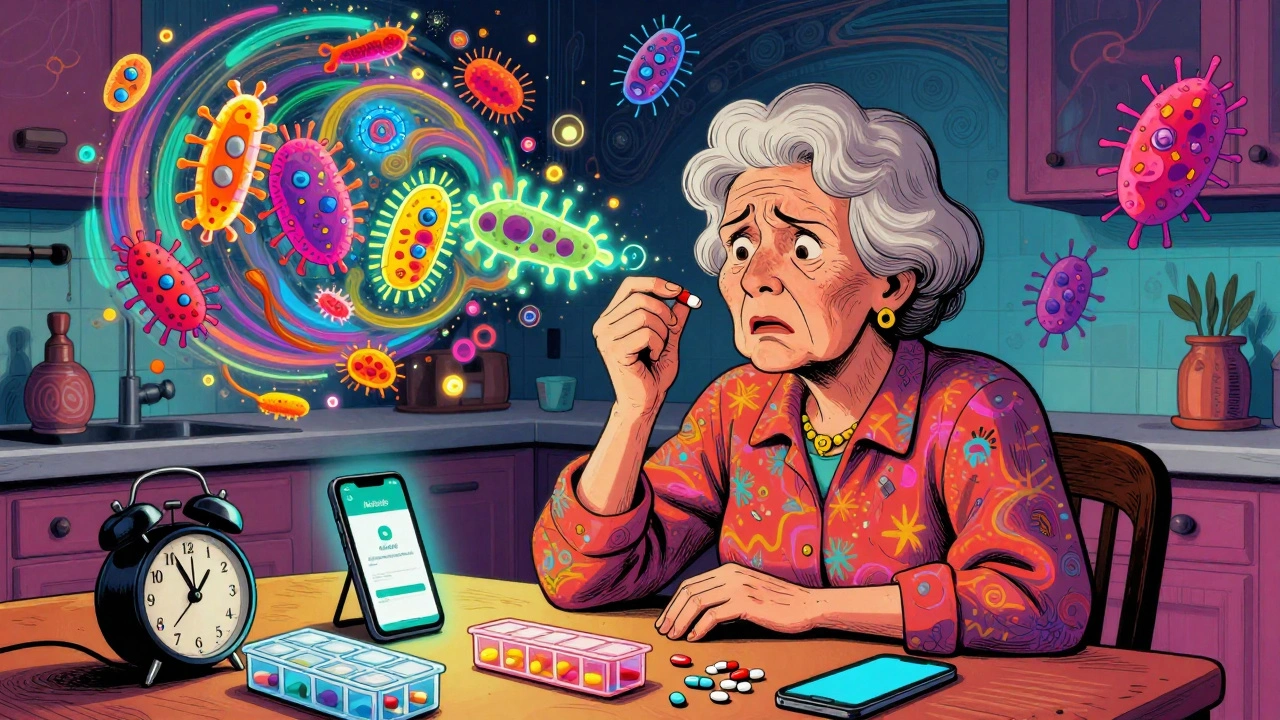
Every year, millions of people in Australia and around the world stop taking their antibiotics too soon because they feel better. That’s a mistake. And it’s not just about your own health-it’s about protecting everyone from superbugs that no drug can kill.
Antibiotics save lives. But when they’re used wrong-like skipping doses, stopping early, or tossing leftover pills in the toilet-they start working against us. The result? Antibiotic resistance. Bacteria evolve. They survive. And suddenly, a simple infection like a urinary tract infection or a skin abscess can become deadly. The World Health Organization calls this one of the top 10 global health threats. And most of it starts at home.
Why Finishing Your Antibiotic Course Isn’t Optional
You start your antibiotics. Day two: your fever’s gone. Day four: your cough’s gone. You feel fine. So you toss the rest. It makes sense-until it doesn’t.
Antibiotics don’t kill all the bacteria at once. They weaken the strongest ones first. The ones still hanging on? The ones that survived because you didn’t take the full dose? Those are the tough ones. The ones that can multiply and pass on their resistance genes. Studies show that stopping early increases your risk of a relapse by nearly 19%, and raises the chance of developing a resistant infection by 23-37%.
It’s not about being ‘overly cautious.’ It’s about biology. If your doctor prescribed 10 days of amoxicillin, you need to take it for 10 days-even if you’re feeling great on day six. Missing even one or two doses can drop the drug level in your blood below what’s needed to kill the last stubborn bacteria.
For seniors, who make up over a third of home antibiotic users, this is even more critical. Many are on multiple medications. A pill organizer with alarms isn’t a luxury-it’s a necessity. Apps like Medisafe or devices like Hero (which automatically dispense pills and send alerts) help caregivers track exactly when each dose is given. No guessing. No missed doses. No excuses.
What to Do When You’re Not Sure
What if you’re halfway through your course and you feel worse? Or you get a rash? Or your stomach is killing you?
Don’t stop. Don’t keep going blindly. Call your doctor or pharmacist.
Some side effects are normal-like mild nausea or diarrhea. Others aren’t. A severe rash, swelling, trouble breathing, or bloody stools? That’s an emergency. Go to the hospital. But if it’s just discomfort? Talk to your provider. They might switch you to a different antibiotic, or adjust the dose. But they won’t know you’re struggling unless you tell them.
There’s also something called an ‘antibiotic timeout.’ In hospitals, doctors re-evaluate after 48-72 hours to see if the drug is still needed. At home, you can do the same. After two days, ask yourself: Is the infection improving? Are symptoms getting better? If yes, keep going. If no, call your doctor. Don’t assume it’s working just because you took the pills.
How to Dispose of Leftover Antibiotics-The Right Way
Leftover antibiotics? Don’t save them. Don’t give them to a friend. Don’t flush them.
Flushing pills sends chemicals into waterways. A 2022 study found antibiotic residues in 63% of U.S. water sources near cities. These traces don’t just disappear. They help bacteria in rivers, soil, and even drinking water become resistant. That’s not science fiction-it’s happening right now.
Keeping leftover antibiotics for ‘next time’ is even more dangerous. You might not have the same infection. You might be taking a different antibiotic than what’s needed. Or worse-you might be giving your child a drug meant for an elderly person. That’s how serious infections turn fatal.
Here’s what to do instead:
- Check if your pharmacy has a take-back program. Many Australian pharmacies now offer free, secure disposal bins for unused meds.
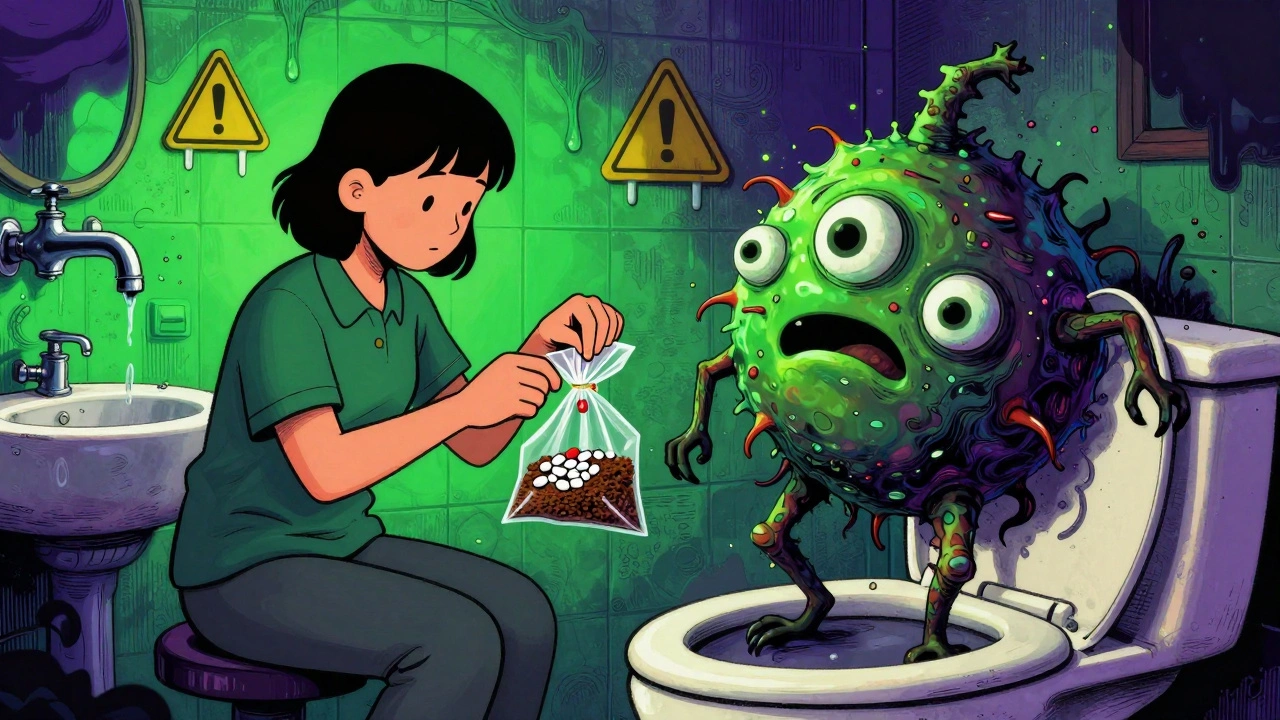
- If no take-back is available, mix the pills with something unappetizing-used coffee grounds, kitty litter, or dirt. Put them in a sealed plastic bag, then throw them in your regular trash. This makes them unappealing to kids or pets and prevents them from being dug out.
- Remove personal info from the bottle before recycling it. But don’t rinse the bottle before throwing it out-residue could still contaminate recycling streams.
Don’t pour antibiotics down the sink. Don’t bury them in the garden. Don’t leave them in the medicine cabinet. Every time you do, you’re adding to the problem.
Why Home Care Is the Missing Link in Antibiotic Stewardship
Hospitals have teams of pharmacists, infection control specialists, and electronic alerts to make sure antibiotics are used right. At home? You’re on your own.
Only 12% of home care settings have formal protocols for checking if antibiotics are still needed after a few days. In nursing homes, that number is 78%. And yet, 30% of all antibiotic use happens in homes. That’s a huge gap.
Family caregivers often don’t know what to look for. A 2023 survey found that 43% of home antibiotic-related adverse events went unnoticed until it was too late. That’s because symptoms like confusion, dizziness, or mild diarrhea can be mistaken for normal aging-especially in older adults.
But here’s the good news: home care has an advantage. You know your loved one better than any nurse ever could. You notice when they’re less alert. When they’re not eating. When their mood changes. That’s valuable data. Use it. Call the doctor if something feels off-even if it’s not a classic ‘infection’ symptom.
What’s Changing-And What’s Coming
Things are starting to shift. In October 2024, AALLCare released new guidelines specifically for seniors and their caregivers in home settings. It’s the first time a major organization laid out clear, practical steps for managing antibiotics at home.
The CDC is also preparing its first-ever Home Care Antibiotic Stewardship Core Elements, expected in late 2025. That means standardized training, checklists, and support tools will soon be available to families.
Meanwhile, telehealth is stepping in. Johns Hopkins piloted a program where nurses check in with home patients via video after 48 hours to ask: Are you improving? Any side effects? Do you still need this drug? The result? A 28% drop in unnecessary antibiotic days.
And it’s not just about saving money or reducing waste. It’s about saving lives. Every time you finish your course and dispose of leftovers properly, you’re helping stop the next superbug before it starts.
Real Talk: What Caregivers Are Saying
On Reddit’s r/HomeCare forum, one user wrote: ‘My mum takes seven meds. I set 12 alarms a day. Some days I cry just trying to keep up.’
Another said: ‘I kept my dad’s leftover amoxicillin for three years. Last winter, he got sick again. I gave him the old pills. He ended up in the hospital with a resistant infection.’
These aren’t rare stories. They’re common. And they’re preventable.
Here’s what works:
- Use a pill organizer with alarms (42% of successful caregivers use them).
- Set phone reminders for every dose-don’t rely on memory.
- Keep a simple log: ‘Day 3: took all doses. No rash. Energy up.’
- Call the doctor before using any leftover antibiotics-even if it’s the same name.
- Dispose of unused pills the same day you realize you won’t need them.
You don’t need to be a nurse. You just need to be consistent.
Final Thought: You’re Not Just Taking Pills. You’re Fighting a Global Threat.
Antibiotic resistance doesn’t care if you’re young or old. Rich or poor. Healthy or sick. It spreads through the air, the water, the food. And it starts with a single missed dose-or a pill flushed down the toilet.
Finishing your antibiotic course isn’t about following rules. It’s about being part of the solution. Disposing of leftovers properly isn’t about being neat. It’s about protecting the next generation’s ability to survive an infection.
You don’t need to be a doctor. You don’t need to understand microbiology. You just need to do two things:
- Take every pill. Every time. Until they’re gone.
- Throw away what’s left-safely.
That’s it. Simple. Powerful. Life-saving.
What happens if I stop my antibiotics early?
Stopping antibiotics early can leave behind the toughest bacteria, which then multiply and become resistant to the drug. This increases your risk of the infection coming back-and makes it harder to treat next time. Studies show incomplete courses raise the chance of resistant infections by 23-37%.
Can I give my leftover antibiotics to someone else?
Never. Antibiotics are prescribed for a specific infection, at a specific dose, for a specific person. What worked for you might not work for someone else-and could even be dangerous. Giving away antibiotics contributes to misuse and resistance. Always dispose of unused pills properly.
Is it safe to flush antibiotics down the toilet?
No. Flushing antibiotics pollutes waterways and contributes to environmental resistance. Drug residues have been found in 63% of U.S. water sources near cities. Instead, mix unused pills with coffee grounds or kitty litter, seal them in a bag, and throw them in the trash.
How do I remember to take my antibiotics on time?
Use a pill organizer with alarms, or a smartphone app like Medisafe. Set reminders for every dose-even if you feel fine. For seniors or caregivers managing multiple medications, devices like Hero (which dispense pills automatically) have proven effective. Don’t rely on memory.
What should I do if I miss a dose?
If you miss a dose, take it as soon as you remember-if it’s within a few hours of the scheduled time. If it’s close to the next dose, skip the missed one and go back to your regular schedule. Don’t double up. Always check with your pharmacist if you’re unsure.
Are there free resources to help manage antibiotics at home?
Yes. The CDC offers free Home Care Stewardship Toolkit materials (expected Q1 2025), and AALLCare’s October 2024 guidelines provide clear steps for caregivers. Many pharmacies also offer free medication reviews and disposal bins. Ask your pharmacist-they’re trained to help.
Next time you pick up a prescription for antibiotics, don’t just think about getting better. Think about what happens after. Your choices at home matter-more than you know.
Yasmine Hajar 2.12.2025
Finally someone gets it. I used to toss my mom’s leftover antibiotics like trash-until she got septic from a UTI that wouldn’t quit. Now I use a pill organizer with alarms, and we drop old meds at the pharmacy. Simple. Life-saving. No drama.
Stop pretending it’s ‘just one pill.’ It’s not. It’s the start of a superbug that could kill your grandkid someday.
Jake Deeds 2.12.2025
Oh please. You’re treating this like we’re all just lazy peasants who can’t handle science. The truth? Most antibiotics are overprescribed in the first place. Why are we being guilt-tripped for not finishing a course that was prescribed for a viral infection? This isn’t stewardship-it’s pharmaceutical propaganda.
And don’t even get me started on ‘Hero’ devices. That’s just another Silicon Valley scam for overmedicated boomers.
val kendra 2.12.2025
My grandma takes 12 pills a day. I set 8 alarms. She forgets. I forget. We both panic. But we use Medisafe now. No more guessing. No more ‘was it yesterday or today?’
Also-coffee grounds + sealed bag = genius. I did that with my dad’s leftover amoxicillin last month. No more floating pills in the toilet. No more ‘maybe I’ll need this later.’ Just trash. Done.
It’s not hard. Just consistent. And if you’re a caregiver? You’re already a superhero. Don’t let anyone make you feel guilty for not being perfect.
John Filby 2.12.2025
Just wanted to say thank you for this. I’m a med student and I’ve seen how many people flush antibiotics. Like… why? 😔
My cousin gave his sister his leftover cipro because she had ‘the same symptoms.’ She ended up in the ER with C. diff. It wasn’t funny. It was terrifying.
Also-yes to pill organizers. I got my mom one for Christmas. She cried. Said it felt like someone finally saw her struggle.
Ben Choy 2.12.2025
Just moved to the UK and found out pharmacies here have free disposal bins. No joke-I cried. Back home in the US, you have to hunt for a drop-off like it’s a secret club.
Also, ‘antibiotic timeout’ at home? Brilliant idea. I’m telling my nurse about it next visit. Maybe they’ll start asking us, ‘How’s the infection doing?’ instead of just handing out scripts like candy.
Joe Lam 2.12.2025
Let me guess-you also think vaccines are a government plot and 5G causes autism? This is the same fear-mongering nonsense dressed up as ‘public health.’ Antibiotics don’t create superbugs. Overuse in factory farms does. But hey, blame grandma for not taking her pills. Easier than holding Big Pharma accountable.
Also-flushing pills? Please. The real pollution is in the runoff from industrial livestock operations. Your ‘home stewardship’ is a distraction.
Rachel Bonaparte 2.12.2025
They’re lying to us. All of it. The WHO? The CDC? AALLCare? They’re all in bed with Big Pharma. Why do you think they’re pushing ‘finish your course’ so hard? Because they make billions off repeat prescriptions. And now they want you to buy expensive pill dispensers too?
My uncle took antibiotics for a tooth infection. He felt better in 3 days. He stopped. He’s fine. No superbug. No hospital. Just common sense.
Meanwhile, the real threat? Fluoride in the water. Glyphosate in the bread. The government is poisoning us slowly-and now they want you to feel guilty for not swallowing their pills?
Scott van Haastrecht 2.12.2025
This post is a masterpiece of emotional manipulation. You take a legitimate public health issue and turn it into a moral panic wrapped in a ‘you’re saving the world’ narrative.
Let’s be real: 90% of antibiotic prescriptions in primary care are unnecessary. You’re blaming the patient for a system designed to overprescribe. You’re not educating-you’re gaslighting.
And don’t even get me started on the ‘coffee grounds’ disposal method. That’s just a Band-Aid on a bullet wound. The real solution? Stop prescribing antibiotics like they’re candy. But no, let’s make the elderly feel guilty instead.
jagdish kumar 2.12.2025
Life is a cycle. Pills come. Pills go. Why fight it?
Resistance is natural. Evolution is not a conspiracy. It is simply… what is.
Stop trying to control nature. Let the bacteria win. They’ve been here longer than us.
zac grant 2.12.2025
As a clinical pharmacist, I’ve seen the data. Incomplete courses = higher relapse rates. Full courses = lower resistance transmission. It’s not opinion. It’s microbiology.
And yes-flushing meds is a silent environmental disaster. We’ve detected azithromycin in trout in the Columbia River. That’s not a metaphor. That’s a lab report.
Also: Hero device? Worth every penny for caregivers. I’ve seen families go from 3 missed doses a week to zero. That’s not tech-it’s dignity.
michael booth 2.12.2025
It is imperative that all individuals who are prescribed antimicrobial agents adhere strictly to the therapeutic regimen as directed by the prescribing clinician.
Failure to complete the prescribed course of therapy may result in the selection of resistant bacterial strains, thereby compromising both individual and public health outcomes.
Furthermore, the disposal of pharmaceuticals via domestic plumbing constitutes a significant environmental biohazard, and is therefore categorically inadvisable.
It is recommended that unused medications be returned to authorized collection points, or, in the absence thereof, rendered non-retrievable through physical dilution and binding with inert, unpalatable substrates prior to disposal in municipal solid waste.
Compliance with these protocols is not optional. It is a civic responsibility.
Carolyn Ford 2.12.2025
Oh, so now I’m a monster because I kept my leftover amoxicillin for ‘just in case’? What if I get sick and can’t afford a new prescription? What if I’m uninsured? What if I’m a single mom working two jobs and your perfect little pill organizer isn’t even in my budget?
You talk about ‘saving lives’-but you never mention that antibiotics cost $80 without insurance. You never mention that 40% of Americans skip meds because they can’t afford them.
This isn’t stewardship. This is class warfare wrapped in a lab coat.
Rudy Van den Boogaert 2.12.2025
My sister-in-law just finished her 10-day course. She didn’t feel great on day 5-got a weird rash. Called her doc. They switched her to a different one. No guilt. No panic. Just communication.
That’s the real takeaway here: Don’t guess. Don’t self-diagnose. Don’t assume. Talk to someone who knows.
And yeah-dispose of the old ones. Don’t keep them. Even if it’s ‘the same medicine.’ It’s not the same if it’s old, or for someone else, or for a different infection.
Simple. But hard. And worth it.
Gillian Watson 2.12.2025
My mum’s in a care home. They’ve got a system: every dose is logged, witnessed, and signed off. No guesswork. No skipped pills. No leftovers.
Why can’t home care be like that? We treat elders like they’re broken machines that need fixing-instead of people who need support.
It’s not about discipline. It’s about dignity. And if we’re serious about stewardship, we need to fund home care like we fund hospitals.
Jordan Wall 2.12.2025
LOL the ‘Hero’ device?? I mean… it’s cute? But also… $300?? Who’s gonna pay for that? And why are we trusting a startup that probably has a VC in the background pushing this? 🤔
Also-‘mix with kitty litter’? Are we seriously suggesting we turn our meds into a litter box? That’s just… weird. And gross. 🤮
Also, why are we blaming individuals? The real issue is agribusiness and hospital overprescribing. This feels like a distraction. Like… ‘here, fix your pill bottle while the system burns.’
Pavan Kankala 2.12.2025
Antibiotics are just a tool. Like a hammer. You don’t use a hammer to cut paper. You don’t use antibiotics for a virus. But they told you to. So now you feel guilty? That’s not your fault.
They lied. They always lie. The system is broken. Your pill bottle is not the problem.
Martyn Stuart 2.12.2025
I’ve worked in rural pharmacies for 18 years. I’ve seen the same faces come back with the same infections-because they kept the old pills. Or flushed them. Or gave them to their neighbor.
Here’s what we do now: We hand out free, pre-labeled disposal bags with every antibiotic script. We put a QR code on the bottle that links to a video of a nurse explaining how to use them.
And we don’t shame people. We just show up. Again. And again.
It’s not about perfection. It’s about showing up. And that’s what this post is really about.
Jessica Baydowicz 2.12.2025
I used to think this was boring. Then my kid got pneumonia. We had to give her antibiotics for 14 days. She threw up. She cried. She begged to stop. I almost did.
But I didn’t.
And now? She’s running around like a maniac. And I’m the one who didn’t give up.
So yeah-I’m not a scientist. I’m a mom. And I’m proud of finishing the damn course. And I’m not flushing a single pill. Not ever again.
Thank you for saying this out loud. I needed to hear it.
Joe Lam 2.12.2025
Oh, so now you’re a hero for not flushing pills? What about the 500,000 tons of antibiotics dumped into rivers by pharmaceutical factories every year? You think your coffee grounds are making a difference? You’re not saving the world-you’re performing virtue signaling.
Go protest a factory. Don’t lecture your grandma.