
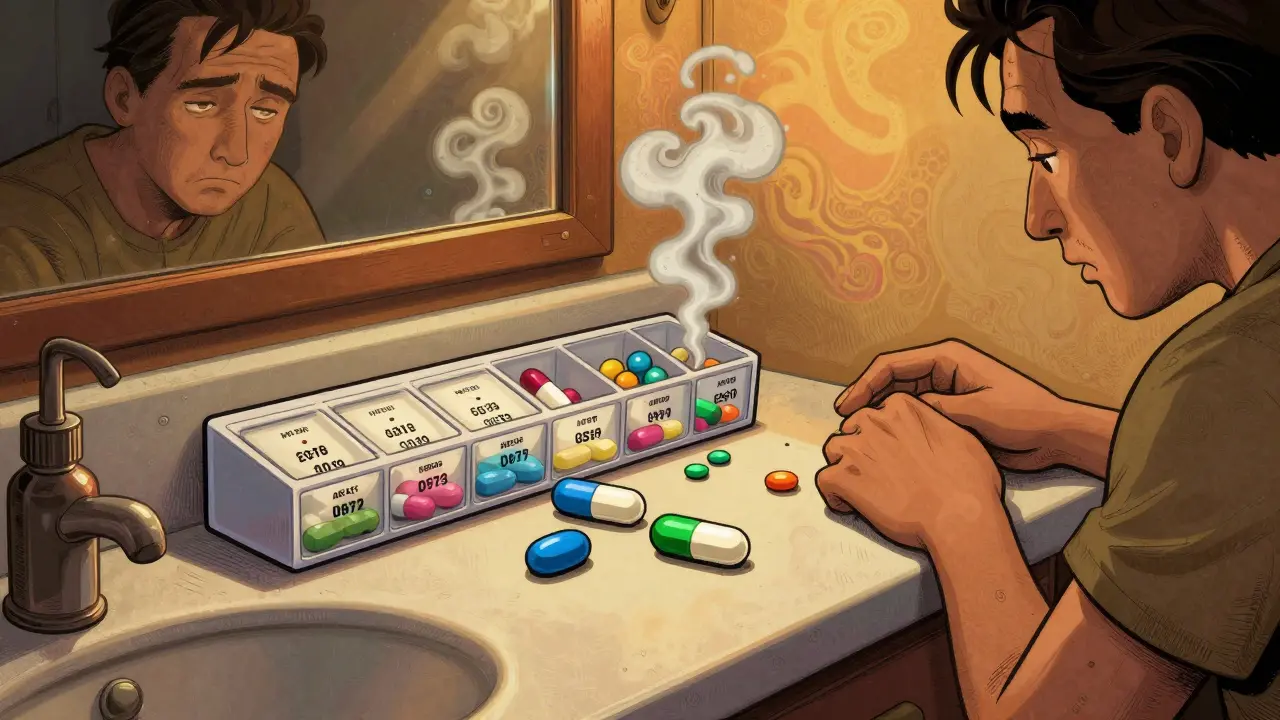
Imagine you’re on three different pills for high blood pressure. One’s blue, one’s white, one’s green. You have to remember which one to take when, and your refill dates don’t line up. Now imagine a single pill that does the same job-same ingredients, same effect, but just one to swallow. That’s the promise of fixed-dose combinations (FDCs). But in many cases, doctors and patients skip the FDC entirely. Instead, they take the same drugs, but as separate generics. This isn’t a mistake. It’s called a de facto combination.
What Exactly Is a De Facto Combination?
A de facto combination happens when a patient takes two or more separate generic medications that, together, match the exact active ingredients and doses found in an approved FDC. For example, instead of taking a single pill with amlodipine and valsartan, the patient gets two pills: one with 5mg amlodipine and another with 80mg valsartan. The outcome is the same-blood pressure control-but the delivery method is completely different. This isn’t some loophole or off-label hack. It’s legal, common, and often intentional. The difference? FDCs are tested as a unit. The manufacturer had to prove the two drugs work well together in the same tablet: they don’t degrade each other, they’re absorbed properly at the same time, and the combo actually improves outcomes over taking them separately. De facto combinations? No such testing. They’re just two pills put together by a doctor’s prescription.Why Do Doctors Choose Separate Generics?
The biggest reason? Flexibility. In hypertension, diabetes, or HIV treatment, patients don’t all need the same dose. One person might need 10mg of drug A and 20mg of drug B. Another might need 5mg of A and 40mg of B. FDCs come in fixed ratios-like 5/20 or 10/40. If your ideal dose doesn’t match one of those combos, you’re stuck. Either take a higher dose than you need, or switch to separate generics. A 2022 study in the Journal of Managed Care & Specialty Pharmacy found that 67% of type 2 diabetes patients require personalized dosing. Most FDCs for metformin and sitagliptin only come in a few standard ratios. So doctors turn to separate generics to fine-tune treatment. Same for kidney patients. If your kidneys can’t handle a full dose of one component, splitting the pills lets you reduce just that one. Cost is another factor. In the U.S., some FDCs are still branded or priced higher, even when generics exist. A 2022 report from the Generic Pharmaceutical Association showed that 34% of combination therapies are still prescribed as separate generics-often because the individual pills cost less. In India, where FDCs were banned for lacking medical justification, many doctors switched to separate generics out of necessity. Even in Australia, where generics are heavily subsidized, some patients find that buying two separate $5 scripts is cheaper than one $12 FDC.The Hidden Risks of Splitting Pills
It sounds smart. But here’s the catch: you’re bypassing safety checks. FDCs go through rigorous testing. The FDA and EMA require proof that the combination doesn’t cause unexpected interactions, that the drugs stay stable together in the tablet, and that their absorption rates are predictable. De facto combinations? None of that. You’re assuming two safe drugs will behave the same way when taken together. But that’s not always true. A 2020 FDA analysis found that 12.7% of generic drugs have clinically meaningful differences in how they’re absorbed compared to the original brand. If you’re combining two generics, you could be mixing two versions with different release profiles. One might be immediate-release, the other extended. That could lead to spikes or dips in drug levels-risking side effects or reduced effectiveness. Then there’s adherence. Every extra pill you take reduces your chance of sticking to the regimen. A study published in PubMed found that each additional pill cuts adherence by about 16%. Patients on FDCs are 22% more likely to take their meds consistently than those on separate pills. Real stories back this up. On Reddit, one user wrote: “My doctor switched me from a single Amlodipine/Benazepril pill to two separate ones to save $15 a month. I missed doses twice because I forgot which blue pill was which.” Another patient on PatientsLikeMe said: “I used to take one pill. Now I have five. I get confused. My husband has to organize my pillbox.”
When De Facto Combinations Make Sense
This isn’t all bad. There are real cases where separate generics are the better choice. Think of someone with advanced kidney disease. They need a low dose of one drug but a normal dose of another. No FDC exists for that combo. Or someone with HIV who needs to adjust one component after a side effect. FDCs lock you in. Separate pills give you control. A 2023 Drugs.com review from a diabetic patient said: “My doctor put me on separate Metformin and Sitagliptin because the FDC dose was too high for my kidneys. My A1c is now 6.2%-my best ever.” That’s the sweet spot: precision outweighs convenience. Pharmacists also see value. A 2022 survey of 1,532 U.S. pharmacists found that 58% believed de facto combinations were appropriate when dose adjustments were needed. The key word? Appropriate. Not default. Not lazy. Justified.How to Manage De Facto Combinations Safely
If you’re on separate generics, don’t assume it’s safe just because the pills are FDA-approved individually. Here’s how to reduce risk:- Use a pill organizer with clear labels. Color-coding helps-blue for drug A, red for drug B.
- Synchronize refills. Ask your pharmacy to align your refill dates so you never run out of one pill while still having another.
- Ask your pharmacist if the generics you’re taking are from the same manufacturer. Different brands can have different release rates.
- Track your doses. Use a simple app or calendar. Missing one pill in a combo regimen can throw off your whole treatment.
- Ask your doctor: “Is there an FDC that could work for me?” Sometimes, a newer combo exists that wasn’t available before.

The Future: Can We Have Both Flexibility and Simplicity?
The industry is starting to respond. Companies like AstraZeneca are patenting modular FDCs-tablets that can be split or adjusted without losing stability. AI-driven drug discovery is identifying new combinations that could be turned into next-gen FDCs with adjustable dosing. Regulators are watching too. The FDA issued a safety alert in January 2023 after 147 adverse events were linked to untested combinations. The EMA is running a multi-year study on off-label combinations, with results expected by late 2024. The WHO’s 2023 Essential Medicines List now includes guidance on when separate components are preferable to FDCs. It’s not a blanket ban on de facto combinations-it’s a call for evidence-based use.Bottom Line: It’s Not About Right or Wrong
De facto combinations aren’t inherently dangerous. But they’re not inherently better either. They’re a tool. And like any tool, they’re only safe when used with awareness. If you’re on multiple pills and feeling overwhelmed, ask your doctor: “Could an FDC work for me?” If you’re on an FDC and struggling with side effects or dosing, ask: “Can we switch to separate generics for more control?” The goal isn’t fewer pills. It’s the right pills, taken correctly. Sometimes that means one. Sometimes it means two. But never assume-always ask.Are de facto combinations legal?
Yes, they’re completely legal. Doctors can prescribe any FDA- or EMA-approved generic drug for any condition, even if it’s not officially labeled for that use. Taking separate generics to mimic an FDC is a common, accepted practice in clinical medicine.
Do de facto combinations cost less than FDCs?
It depends. In some markets, especially the U.S., individual generics can be cheaper than branded FDCs. But in countries with strong generic pricing like Australia or the UK, FDCs are often priced similarly or even lower than buying two separate generics. Always check with your pharmacy. Sometimes, the FDC is covered under a single co-pay, making it cheaper overall.
Can I switch from an FDC to separate generics on my own?
No. Never change your medication regimen without talking to your doctor or pharmacist. Even if the ingredients are the same, the way they’re absorbed can differ between formulations. Your doctor needs to assess whether the switch is safe for your health condition and kidney/liver function.
Why don’t all FDCs come in multiple doses?
Developing multiple versions of an FDC is expensive. Manufacturers need to run new clinical trials and stability tests for each dose ratio. For drugs with limited use or low profit potential, it’s not worth the cost. That’s why many FDCs only come in one or two fixed doses.
Are there any FDCs that should never be split?
Yes. Any FDC labeled as extended-release, enteric-coated, or modified-release should never be split or crushed. Doing so can release the full dose at once, causing dangerous side effects. Always check the label or ask your pharmacist if the pill is safe to split.
Paul Ong 1.01.2026
One pill is easier. I don't care what the science says if I forget half my meds anyway.
Todd Nickel 1.01.2026
I've been on a de facto combo for three years now-metformin, sitagliptin, and empagliflozin, all separate. My endo switched me because the FDCs didn't have the right ratios for my kidney numbers. I use a pill organizer with color-coded slots and sync refills through CVS. It's a system, not a hassle. The real issue isn't the pills-it's that doctors don't explain why they're doing it. I had no idea the absorption rates could differ between generics until I read this. Now I ask every time.
Lee M 1.01.2026
They say FDCs are safer but they're just corporate traps. Big Pharma doesn't want you adjusting doses-they want you locked in. Separate generics give you power. The system wants you passive. Don't let them take your control.
Heather Josey 1.01.2026
I appreciate how this breaks down the real trade-offs-not just 'one pill good, multiple pills bad.' My mom was on separate meds for years and struggled with adherence until we got her a PillPack box. She said it felt like someone finally cared enough to make it easy for her. That’s the real win-not the number of pills, but the support behind them.
Richard Thomas 1.01.2026
There’s a deeper philosophical question here, one that extends beyond medicine. We live in a world that optimizes for efficiency-single pills, streamlined processes, standardized solutions. But human biology isn’t standardized. We are not widgets on an assembly line. The de facto combination is, in a way, a quiet rebellion against the illusion of one-size-fits-all. It’s the patient saying, ‘I need something different,’ and the doctor listening. It’s messy. It’s inconvenient. But it’s honest. The FDC is a promise of simplicity. The separate pills are an acknowledgment of complexity. And sometimes, honesty is the only thing that keeps us alive.
Liam George 1.01.2026
Did you know the FDA doesn’t require bioequivalence testing between different generic manufacturers for combo drugs? So you could be taking two generics from two different companies, each with different fillers and release profiles, and the FDA doesn’t even track that. They’re just trusting random pills to behave the same. And you call this healthcare? This is a regulatory loophole dressed up as patient choice. They’re letting you gamble with your life because it’s cheaper. Wake up.
Donna Peplinskie 1.01.2026
My brother’s on a de facto combo for hypertension, and he’s been doing great-but he didn’t know he was supposed to ask his pharmacist if the generics were from the same batch. He just grabbed whatever was cheapest. I sat down with him, got him a pillbox, and we called his pharmacy. Turns out, one was extended-release and the other wasn’t-he had no idea. We switched to the same brand. He’s been stable for six months now. This isn’t just about pills-it’s about knowing how to ask for help.
Bill Medley 1.01.2026
De facto combinations are clinically valid when individualized dosing is required. They are not inherently inferior. Risk is mitigated through pharmacist involvement, patient education, and adherence tools. The goal remains optimal therapeutic outcome, not pill count reduction.
Alex Warden 1.01.2026
Why are we even talking about this? Just take the damn one pill. Americans overcomplicate everything. In my country, we just take what the doctor gives us. No fuss. No apps. No pill boxes. One pill. Done. You want control? Get a job that pays more so you can afford the branded version. Stop making medicine a DIY project.