

Most people think stomach pain is just a bad meal or too much coffee. But if your discomfort lingers, comes with nausea, or shows up without any clear trigger, it could be something deeper: gastritis. It’s not just an upset stomach. It’s inflammation of the stomach lining - the same barrier that keeps your digestive acids from eating through your stomach wall. When that lining gets damaged, pain, bloating, and even bleeding can follow. And in most cases, the culprit isn’t stress or spicy food. It’s a tiny bacterium called Helicobacter pylori.
What Exactly Is Gastritis?
Gastritis means your stomach lining is inflamed. Think of it like a sunburn, but inside your gut. The stomach lining is supposed to be tough - it’s coated in mucus to protect it from strong acids and enzymes that break down food. When that protection breaks down, acid starts to irritate the tissue underneath. That’s gastritis. There are two main types: erosive and nonerosive. Erosive gastritis means there are actual breaks or sores in the lining. These can bleed, which is why some people notice black, tarry stools or even vomit that looks like coffee grounds. Nonerosive gastritis doesn’t show visible damage, but the cells underneath are still inflamed. It’s quieter, often symptom-free, and can go on for years without anyone noticing - until it leads to something worse, like an ulcer or even stomach cancer. About 70% to 90% of stomach ulcers are caused by H. pylori. That’s the same bacteria discovered by two Australian scientists in 1982, Barry Marshall and Robin Warren. They proved it wasn’t stress that caused ulcers - it was this little spiral-shaped germ living right in the stomach. They won the Nobel Prize for it in 2005. Today, we know H. pylori infects nearly half the world’s population. In Australia, around 20-30% of adults carry it, and it’s the number one cause of chronic gastritis.How Do You Know If You Have It?
Symptoms vary wildly. Some people feel a burning pain right under the breastbone, especially when their stomach is empty. Others get bloated, nauseous, or feel full after eating just a bite. Vomiting and loss of appetite are common too. But here’s the catch: up to half of people with chronic gastritis have no symptoms at all. That’s why it often goes undiagnosed until something serious happens. Red flags you shouldn’t ignore:- Black, sticky stools (that’s digested blood)
- Vomiting blood or material that looks like coffee grounds
- Unexplained fatigue, dizziness, or shortness of breath (signs of anemia from slow bleeding)
- Weight loss without trying
What’s Really Causing Your Gastritis?
H. pylori is the big one. It’s responsible for 70-85% of chronic cases. The bacteria cling to the stomach lining, survive the acid, and trigger a slow-burning inflammation. Over time, this can thin the lining, reduce acid production, and even change the cells - a process called atrophy. That’s a known step toward stomach cancer. But H. pylori isn’t the only player. Regular use of NSAIDs - like ibuprofen, naproxen, or even low-dose aspirin - causes about 25-30% of gastritis cases. These drugs block protective chemicals in the stomach lining. Long-term use? That’s a recipe for damage. Alcohol? Heavy drinking (more than 30g a day - that’s about 2 standard drinks) doubles your risk. Smoking slows healing and makes inflammation worse. Stress alone doesn’t cause gastritis, but it can make existing inflammation flare up. Then there’s autoimmune gastritis - rare, but serious. Your immune system accidentally attacks the cells that make stomach acid and intrinsic factor (needed to absorb vitamin B12). This type mostly affects older adults and people with other autoimmune conditions like Hashimoto’s thyroiditis. Left untreated, it leads to B12 deficiency, nerve damage, and anemia.How Is It Diagnosed?
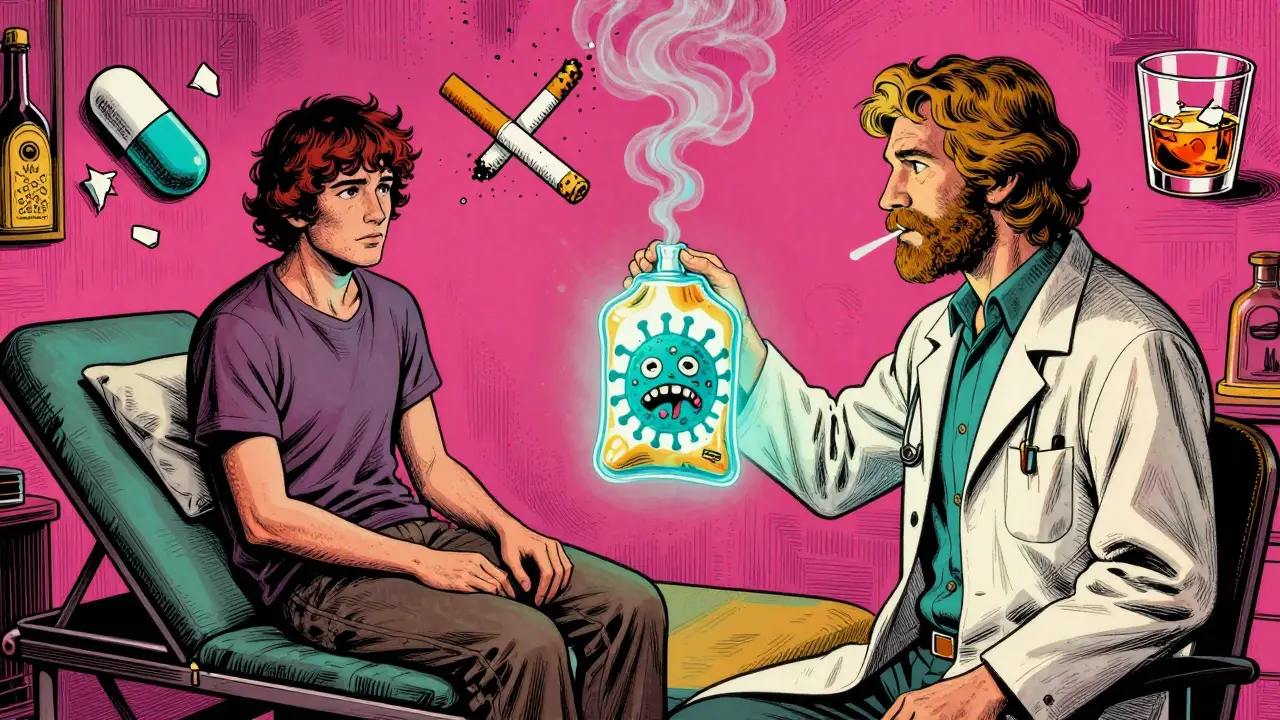
You can’t diagnose gastritis by feeling your stomach. You need tests. The gold standard is an endoscopy. A thin, flexible tube with a camera goes down your throat so the doctor can see your stomach lining. If they spot redness, swelling, or sores, they’ll take tiny tissue samples (biopsies) to test for H. pylori and check for cell changes. But not everyone needs an endoscopy. For suspected H. pylori, non-invasive tests work well:- Urea breath test: You drink a solution, then breathe into a bag. If H. pylori is present, it breaks down the solution and releases carbon dioxide you can detect. It’s 95% accurate.
- Stool antigen test: Checks for H. pylori proteins in your poop. Simple, cheap, reliable.
- Blood test: Looks for antibodies, but it can’t tell if the infection is current or past. Not ideal for confirming treatment success.
How Is H. pylori Treated?
Treating H. pylori isn’t just about feeling better. It’s about preventing ulcers, bleeding, and cancer. Eradication therapy is a two-pronged attack: kill the bacteria and calm the inflammation. The standard is triple therapy: a proton pump inhibitor (PPI) like omeprazole or esomeprazole, plus two antibiotics - usually amoxicillin and clarithromycin - taken together for 10 to 14 days. Success rates? Around 80-90%… if you’re in a place where clarithromycin resistance is low. Here’s the problem: resistance is rising. In the U.S., clarithromycin resistance jumped from 10% in 2000 to 35% in 2023. In Sydney, it’s around 25%. That means triple therapy fails more often than it works. Newer options are changing the game:- Bismuth quadruple therapy: PPI + bismuth + metronidazole + tetracycline. Used in high-resistance areas. Success rate: 85-92%.
- Concomitant therapy: All four drugs taken together for 10 days. Works well even with resistance.
- Vonoprazan: A new acid blocker (FDA-approved in 2022) that’s stronger and longer-lasting than PPIs. In trials, it boosted H. pylori cure rates to over 90%, even after two failed treatments.
What About the Medications?
Even if you don’t have H. pylori, you still need to reduce stomach acid to let the lining heal. That’s where PPIs come in. Omeprazole, pantoprazole, lansoprazole - these are the go-to drugs. They block acid production at the source. Most people feel better within a week. But here’s the catch: long-term PPI use can backfire. About 40% of people who stop after months or years get rebound acid hypersecretion - their stomach overproduces acid, making symptoms worse. That’s not a relapse. It’s your body overcompensating. If you’ve been on PPIs for more than 3 months, don’t quit cold turkey. Work with your doctor to taper off slowly. Sometimes switching to H2 blockers like famotidine helps during the transition. For NSAID-induced gastritis, the first step is stopping the drug. If you need pain relief, switch to acetaminophen. If you can’t stop NSAIDs (like for arthritis), take them with food and use a PPI long-term to protect your stomach.What Can You Do at Home?
Medications help, but lifestyle changes are just as important:- Avoid alcohol: Cut it out completely during treatment. Studies show symptom severity drops by 60% within two weeks.
- Quit smoking: Smoking delays healing by 35%. It’s not just about cancer - it’s about your stomach lining recovering.
- Eat smaller meals: Large meals stretch the stomach and increase acid pressure. Try five small meals instead of three big ones.
- Avoid trigger foods: Spicy, fried, or acidic foods won’t cause gastritis, but they can irritate an already inflamed lining. Pay attention to what makes you feel worse.
- Manage stress: Yoga, breathing exercises, walking - anything that lowers cortisol helps. Stress doesn’t cause gastritis, but it slows healing.
What Happens After Treatment?
You finish your antibiotics. You feel better. You think you’re done. But you’re not. You need to confirm the bacteria is gone. That’s why a urea breath test or stool test is done 4 weeks after finishing treatment. Why wait? Because the bacteria can be temporarily suppressed by the meds, and testing too soon gives false negatives. If the test is still positive? You’ll need a second-line therapy - usually bismuth quadruple or vonoprazan-based. About 10-15% of people need two rounds to clear it. And if you had atrophic gastritis or intestinal metaplasia (cell changes), you’ll need ongoing monitoring. Your doctor might recommend a repeat endoscopy in 3-5 years to check for early signs of cancer.Why This Matters More Than You Think
Gastritis isn’t just a nuisance. It’s a silent risk factor for stomach cancer. H. pylori infection increases your risk by 6 to 8 times. But here’s the good news: treating it cuts that risk in half. In countries like Japan and South Korea, where stomach cancer is common, they screen everyone over 40 for H. pylori. If positive, they treat it - no symptoms needed. Australia doesn’t do population-wide screening yet, but if you’re over 50, have a family history of stomach cancer, or come from a high-prevalence region (Southeast Asia, Eastern Europe, parts of Africa), ask your doctor about testing. The bottom line? Gastritis is treatable. H. pylori is curable. But you need the right test, the right treatment, and the right follow-up. Don’t let a simple stomach ache turn into something serious because you assumed it was "just indigestion."Can gastritis go away on its own?
Sometimes, yes - especially if it’s acute and caused by a one-time event like heavy drinking or NSAIDs. But if it’s chronic, especially from H. pylori, it won’t go away without treatment. Left untreated, it can lead to ulcers, bleeding, and even increase your risk of stomach cancer. Don’t wait for it to "fix itself."
Is H. pylori contagious?
Yes. It spreads through contaminated food, water, or saliva. Close contact - like sharing utensils, kissing, or eating food prepared by someone with poor hygiene - can transmit it. It’s more common in crowded living conditions and areas with limited clean water. Most people get it in childhood.
Do I need to get tested again after treatment?
Absolutely. About 1 in 5 people still have H. pylori after treatment. A follow-up test (breath or stool) 4 weeks after finishing antibiotics confirms whether the bacteria are gone. Without confirmation, you won’t know if you need another round of treatment.
Can I take antacids instead of PPIs?
Antacids like Tums or Rolaids give quick, short-term relief but don’t heal the lining. They’re not strong enough to treat gastritis long-term. PPIs reduce acid production at the source, which allows the stomach to repair itself. For healing, you need PPIs - antacids are just for temporary comfort.
Why do I feel worse after stopping my PPI?
That’s called rebound acid hypersecretion. When you stop a PPI after long-term use, your stomach temporarily overproduces acid because it’s been suppressed. It’s not a relapse of gastritis - it’s your body adjusting. The fix? Taper off slowly with your doctor’s help, not quit cold turkey. Switching to an H2 blocker like famotidine during the transition can help.
Is there a vaccine for H. pylori?
No, not yet. Several vaccines are in early trials, but none are approved for use. Prevention is still about hygiene: clean water, proper food handling, and avoiding sharing utensils with someone who has active infection. If you’re in a high-risk group, testing and treatment are your best defenses.
Faith Wright 11.01.2026
lol america still thinks stomach bugs are some new fad disease bro H pylori been around since cavemen we just finally got smart enough to notice it. you think your coffee is the problem? nah its the dirty water your great grandparents drank. we need to stop coddling people with PPIs and start fixing the root cause. also stop calling it gastritis like its a spa treatment its just your gut screaming for clean water and less sugar.
Sonal Guha 11.01.2026
The data shows 70 to 90 percent of ulcers are linked to H pylori but the real issue is diagnostic inertia. Most GIs still default to PPIs first. No breath test no stool antigen just empiric treatment. That’s why resistance is rising. Also the WHO classifies H pylori as a class I carcinogen yet screening programs are nonexistent outside Japan and South Korea. Why? Profit. PPIs are billion dollar drugs. Eradication is cheap. The system is rigged.
Jessica Bnouzalim 11.01.2026
I had this for YEARS and thought it was just stress... then I started getting black stools and thought I was dying??!! I went to my doc and they were like 'oh yeah probably H. pylori' like it was no big deal. I was so mad. I did the breath test, did the 14-day triple therapy, and then BOOM-felt like a new person. But I almost didn’t follow up because I felt fine. DON’T DO THAT. Get tested again. Seriously. I cried when the second test came back negative. It’s not just a stomach thing-it’s your whole body breathing easier.
Rebekah Cobbson 11.01.2026
I’m so glad someone finally broke this down without fear-mongering. I used to take ibuprofen for my back pain every day. Didn’t think twice. Then I got diagnosed with erosive gastritis and had to stop cold turkey. It was brutal. But switching to acetaminophen and starting a PPI? Life-changing. I didn’t know stress didn’t cause this-I thought I was just 'anxious and sensitive.' Turns out I just needed a doctor who knew what to test for. Thank you for writing this.
TiM Vince 11.01.2026
I grew up in rural Nigeria. My mom used to boil water for tea every morning, even in the dry season. She said, 'If you don’t boil it, your belly will cry.' I didn’t understand then. Now I know-she was protecting me from H. pylori. Most of my cousins in the city got ulcers by 25. We didn’t have antibiotics back then, but we had clean water habits. Maybe the real cure isn’t in the pill bottle-it’s in the way we live.
gary ysturiz 11.01.2026
This is the kind of post that saves lives. Seriously. I’m a nurse and I’ve seen too many people ignore stomach pain because they think it’s 'just acid.' If you’ve been on PPIs for more than 3 months and feel worse when you stop-you’re not broken. Your body’s just reacting. Talk to your doc about tapering. Don’t quit cold turkey. And if you’re over 50? Get tested. It’s not scary. It’s just smart.
Bryan Wolfe 11.01.2026
Just wanted to say THANK YOU for mentioning probiotics! I took Saccharomyces boulardii with my antibiotics and didn’t get a single case of diarrhea. My gut was so grateful. I didn’t even know that was a thing until I read this. Also-yes, smoking slows healing. I quit cold turkey after my diagnosis and my stomach stopped feeling like it was on fire. It’s not magic. It’s just biology. You can heal.
Audu ikhlas 11.01.2026
USA so weak. In my country we dont test for H pylori we just drink boiled ginger and garlic. If you cant handle your stomach you shouldnt eat. Stop buying drugs. Stop trusting doctors. Real men dont take PPIs. We eat spicy food and laugh. You think your stomach is weak? It’s your mind that’s weak. H pylori? That’s just nature filtering the weak. You want to live? Fight. Don’t test.
Faith Wright 11.01.2026
Lmao audu just said real men don’t take PPIs. Bro your 'boiled ginger' isn’t killing H. pylori. Your stomach’s just screaming in silence. I’ve seen your type before-thinks ignorance is strength. You’re not tough. You’re a walking ulcer waiting to bleed.