
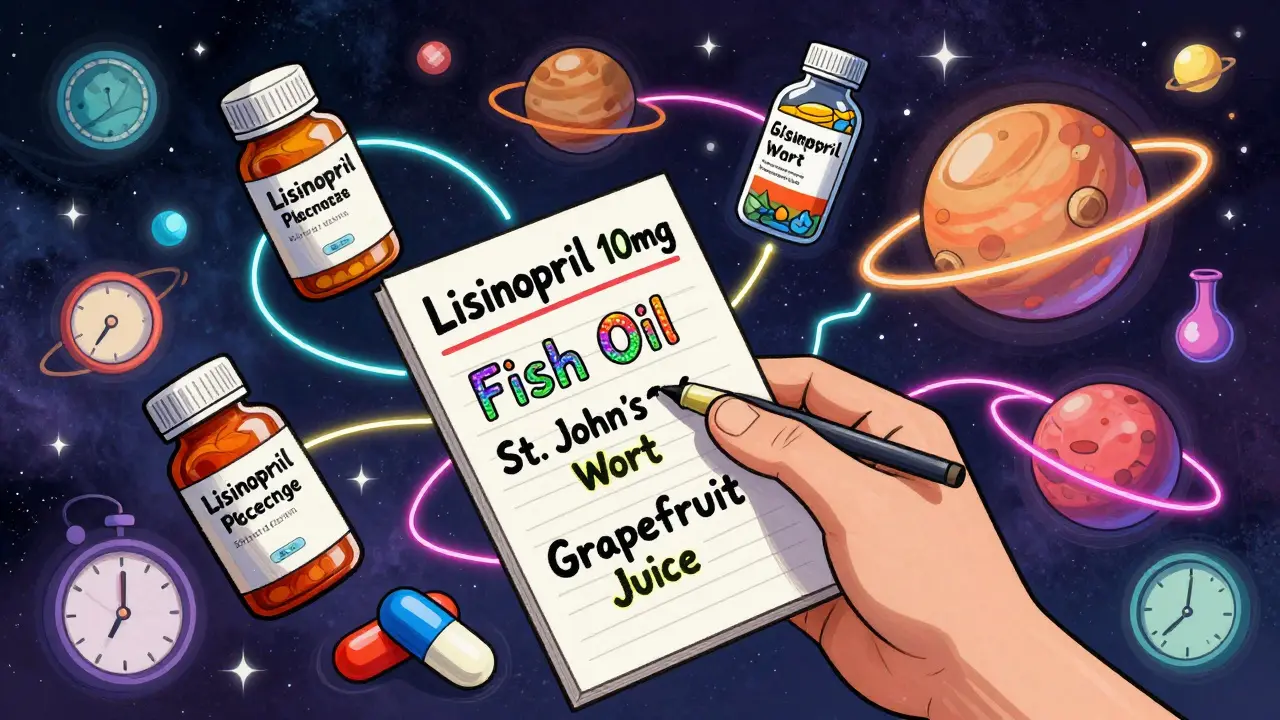
Every year, tens of thousands of people end up in the hospital-not because of an accident or illness, but because of a simple mistake: someone didn’t know what medications they were taking, or worse, their doctor didn’t either. Drug interactions don’t always cause obvious symptoms right away. Sometimes, they quietly build up over weeks until something serious happens-dizziness, bleeding, kidney damage, or worse. The good news? This is one of the most preventable problems in healthcare. And it starts with one thing: a complete, up-to-date medication list.
What Makes a Medication List Complete?
A medication list isn’t just a note in your phone that says “blood pressure pill.” That’s not enough. A real, useful list includes every single thing you take, every day, in exact detail. That means:- Brand and generic names-for example, “Lisinopril 10 mg” (generic) or “Zestril 10 mg” (brand)
- Dosage and frequency-how much and how often? “Take 500 mg twice daily”
- Route of administration-is it swallowed, injected, applied to the skin? Most are oral, but not all
- Why you take it-“for high blood pressure,” “for arthritis pain,” “for sleep”
- Start date-when did you begin? This helps your doctor spot patterns
- Prescribing provider-who wrote the script? Your GP? Cardiologist? Psychiatrist?
- Special instructions-“take on empty stomach,” “avoid grapefruit,” “take with food”
And here’s what most people forget: over-the-counter meds, vitamins, and supplements. Tylenol. Ibuprofen. Fish oil. Vitamin D. St. John’s Wort. Turmeric. Even herbal teas. These aren’t “just natural”-they can react with your prescriptions in dangerous ways. The FDA found that 30% of serious drug interactions involve something you can buy without a prescription. If you take it, it goes on the list.
Why Your Doctor Might Not Ask for It
You might think, “My doctor knows what I’m on.” But they don’t. Not really. A 2023 study from the National Institutes of Health found that electronic health records capture less than half of the over-the-counter medications and supplements patients take. Why? Because most doctors assume you’ll tell them-if you think it matters.Here’s the hard truth: 63% of healthcare providers don’t routinely ask for a full medication list. They’re busy. They assume you’ve already told them. They might glance at the list in the system and assume it’s complete. But if you didn’t mention your daily magnesium supplement or your weekend ibuprofen for back pain, it’s not in there.
Don’t wait to be asked. Bring your list to every appointment-every time. Hand it to the nurse as you check in. Say, “I’ve updated my medication list. Can we go over it together?” That simple step cuts your risk of a bad interaction by up to 50%.
What Works Best: Paper, Phone, or Pharmacy?
There’s no single perfect way to keep your list. But some methods are far more reliable than others.Paper lists in your wallet-the old-school method. They’re simple, don’t need batteries, and you can hand them to an ER doctor in seconds. But they’re outdated fast. A 2022 study found only 62% accuracy in emergency situations because people forget to update them.
Smartphone apps-like Medisafe or MyMeds. These are great if you’re tech-savvy. They can remind you when to take pills, track refills, and even alert you to potential interactions. Studies show users who stick with them have 76-83% better adherence. But 23% of adults over 65 don’t own a smartphone. And if your phone dies, your list is gone.
Pharmacy systems-this is the hidden powerhouse. If you use one pharmacy for all your prescriptions, they track everything you’re on. Their systems flag dangerous combinations before you even walk out the door. The FDA says these systems catch 92% of major interactions. That’s higher than any EHR system. And pharmacists are trained to spot what doctors miss.
The winning strategy? Use all three. Keep a digital list on your phone. Print a copy and keep it in your wallet. And make sure you refill everything at the same pharmacy. That way, you’ve got backup after backup.
The Hidden Danger: Supplements and Herbal Products
Many people think “natural” means “safe.” That’s not true. St. John’s Wort, a popular herbal supplement for mood, can make blood thinners like warfarin useless. That means you could get a clot and not even know it. Grapefruit juice can turn a simple cholesterol pill into a toxic overdose. Even common vitamin C in high doses can interfere with certain cancer drugs.Don’t assume your doctor knows what you’re taking. Even if you say “I take vitamins,” they won’t know which ones. “Vitamin D” isn’t enough. Say “Vitamin D3 2000 IU daily.” Write down the brand if you remember it. If you take a multivitamin, list it as “Centrum Silver Daily Multivitamin.” Details matter.
One Reddit user, “MedSafetyMom,” shared how she saved her husband’s life by bringing his full list to a new cardiologist. He was on warfarin, and his naturopath had recommended St. John’s Wort for “low mood.” Three specialists had missed it. The cardiologist spotted it immediately and stopped it before a stroke happened.
How to Keep It Updated (Without Going Crazy)
The biggest reason lists fail? They get outdated. People forget. Life gets busy. Here’s how to make it stick:- Update within 24 hours-every time you start, stop, or change a medication, update your list. Set a phone reminder: “Update meds” at 8 PM every night.
- Take a photo-snap a picture of every pill bottle when you get a new prescription. Save it in a folder labeled “Medications.” That way, you always know the exact name and dose.
- Review every month-set a calendar alert: “Medication Check.” Sit down with your list and your pill organizer. Cross off anything you stopped. Add anything new.
- Involve someone-if you’re over 65 or managing multiple conditions, ask a family member to help. Two sets of eyes catch more mistakes.
Some people use color-coded pill boxes. Others use weekly pill dispensers with alarms. The goal isn’t perfection-it’s consistency. Even if you only update your list once a week, you’re doing better than 70% of patients.
What to Say to Your Doctor
Don’t just hand over the list and sit quietly. Ask questions. Here are three phrases that make a difference:- “Could any of these medications interact with each other?”-This forces them to look beyond individual prescriptions and see the big picture.
- “Should I avoid any foods or supplements while taking these?”-Grapefruit, dairy, alcohol, leafy greens-these all matter.
- “Is this still necessary?”-Many people take medications long after they’re needed. A 2023 JAMA study found that 28% of older adults were still on drugs they’d stopped needing years ago.
Don’t be afraid to push back. If your doctor brushes you off, say, “I’ve had bad reactions before, so I want to be sure.” Most providers will appreciate your diligence.
When You See Multiple Specialists
If you see a cardiologist, a rheumatologist, and a neurologist, things get messy. Each one writes prescriptions without knowing what the others have ordered. That’s where polypharmacy becomes dangerous.Experts recommend designating one provider as your “medication coordinator.” Usually, that’s your primary care doctor. Tell them: “I’m seeing three specialists. Can you be the one who reviews all my meds together?” Ask them to coordinate with your pharmacist. This single step can cut your risk of duplicate prescriptions and dangerous combinations by more than half.
What Happens When You Don’t Do This
The numbers are terrifying. Adverse drug reactions cause over 100,000 deaths in the U.S. every year. That’s more than car accidents or breast cancer. Most of these aren’t accidents-they’re preventable.One 2022 study found that 52% of medication errors happened because the list was outdated. Another found that 37% of errors were because someone left out an over-the-counter drug. And 22% were because the dose was wrong.
It’s not about being perfect. It’s about being proactive. If you’ve ever been in the ER with a list in hand and the doctor said, “Thank you for bringing this,” you know how powerful it is.
Final Checklist: Your Medication List Survival Kit
Before your next appointment, make sure you have:- A printed copy (in your wallet or purse)
- A digital copy (on your phone, backed up to the cloud)
- Photos of all pill bottles (saved in a folder)
- The name and number of your main pharmacy
- Answers to these three questions: What’s this for? When did I start? Should I avoid anything?
Medication safety isn’t something you do once. It’s something you do every day. It’s not about remembering every detail-it’s about building a habit. And that habit? It can save your life.
What if I don’t know the exact name of my medication?
Take a photo of the pill bottle or box. Most pharmacies and doctors can identify medications from the imprint code, color, and shape. If you can’t get a photo, write down everything you remember: color, shape, letters on the pill, what it’s for, and how often you take it. Even partial info is better than nothing.
Do I need to list vitamins and supplements even if I don’t take them every day?
Yes. Even occasional use can cause interactions. If you take fish oil once a week for heart health, or turmeric when your joints hurt, include it. The risk isn’t just from daily use-it’s from how your body reacts over time.
Can I trust my electronic health record to keep my list updated?
No-not fully. EHRs capture prescription medications well, but they miss over-the-counter drugs, supplements, and herbal products in over half the cases. Your list should always be your own, not just what’s in the system.
How often should I update my medication list?
Update it within 24 hours of any change-new prescription, stopped pill, changed dose. Do a full review every month. If you’re seeing multiple doctors, review it before every appointment.
Is it safe to share my medication list with a new doctor?
Yes. Doctors are required to protect your health information under privacy laws. Sharing your list helps them keep you safe. If you’re uncomfortable, ask how they store the information. Most use secure, encrypted systems.
What if my pharmacist says a medication I’m taking is unsafe?
Don’t stop taking it on your own. Ask your pharmacist to call your doctor. Pharmacists can suggest safer alternatives or adjusted doses. But only your prescriber can officially change your prescription. Let them work together.
If you’re managing five or more medications, you’re not alone. Nearly 40% of adults over 65 are in the same boat. The system isn’t perfect-but your list can be. Keep it current. Share it often. And never assume someone else is watching out for you. You’re the only one who knows every pill you’ve taken.
Kunal Kaushik 2.02.2026
This is the kind of post that makes me actually feel hopeful about healthcare. I've been keeping a meds list since my grandma had that bad reaction last year. Just a simple Google Doc with photos of bottles. It's not glamorous, but it saved her from a hospital trip last month.
Small habits > perfect systems.
pradnya paramita 2.02.2026
Pharmacovigilance protocols are often underutilized in outpatient settings. The FDA's MedWatch data indicates that 68% of preventable ADRs stem from incomplete pharmacotherapy reconciliation. A structured medication reconciliation workflow, ideally integrated with e-prescribing systems and pharmacy dispensing logs, reduces polypharmacy risks by 41% (per JAMA 2023 meta-analysis).
Consider leveraging CDS tools like Lexicomp or Micromedex for real-time interaction alerts.
Daz Leonheart 2.02.2026
You're right. This isn't about being perfect. It's about being consistent. I started doing this after my dad almost got admitted for a bad interaction with his fish oil and blood thinner. Now I update mine every Sunday night. It takes 5 minutes. It's worth it.
Mandy Vodak-Marotta 2.02.2026
I used to think supplements were harmless until my mom went to the ER after mixing turmeric with her new anticoagulant. They didn’t even know she was taking it because she said 'oh I just take that one pill for inflammation' and didn't think it counted.
Now I make her write down every single thing-down to the brand of her gummy vitamins. I even print it out and put it in her purse. She rolls her eyes but she does it. I'm not letting this happen again.
Jamillah Rodriguez 2.02.2026
They don't want you to know this but pharmacies are paid to push pills. Your 'safe' pharmacist is just another cog in the machine. That '92% detection rate'? It's because they're incentivized to refill, not to question. Don't trust them. Trust your own list.
Zachary French 2.02.2026
Let me elucidate, with scholarly precision, the fallacious underpinnings of this 'medication list' paradigm. The notion that a layperson can accurately catalog pharmacokinetic interactions is not merely naive-it is epistemologically untenable. You cannot discern CYP450 enzyme inhibition from a photo of a pill bottle.
Moreover, the FDA's '92%' statistic is cherry-picked from controlled pharmacy environments-where pharmacists are trained clinicians-not from the average Joe scribbling on a napkin. This is performative safety theater.
Real medicine requires pharmacogenomic testing, not Pinterest boards of pill photos.
Janice Williams 2.02.2026
Of course you're supposed to bring a list. But do you think your doctor actually reads it? They glance at it for 3 seconds while scrolling through their email. You're not saving lives-you're performing emotional labor for a broken system that doesn't care.
Caleb Sutton 2.02.2026
This is how they get you. First, they make you write down your meds. Then they track you. Then they start denying your prescriptions because 'you're on too many things.' This is step one of the medical surveillance state.
Rachel Kipps 2.02.2026
I’ve been doing this for years, and it’s been a lifesaver. I use a note app and share it with my daughter. I misspell a lot of things though-like 'lisinopril' as 'lisinopiril'-but she knows what I mean. Better than nothing, right?
Wendy Lamb 2.02.2026
My mom had a stroke last year because her doctor didn't know she was taking St. John’s Wort. We found out because I had the list. She’s fine now. Don’t wait for a disaster to start. Just do it.
Coy Huffman 2.02.2026
It’s funny how we treat our bodies like machines we’re supposed to fix ourselves. We’re told to track every pill, every drop, every herb-like if we just log it right, the system will finally work for us.
But what if the system isn’t broken? What if it’s just designed to make us feel responsible for its failures?
I still make the list. I still hand it over. But I also ask: why am I the one holding the burden of this safety net?
Susheel Sharma 2.02.2026
The entire premise is bourgeois. You expect the working class to meticulously document every supplement while the pharmaceutical industry lobbies to suppress pharmacovigilance reporting?
Meanwhile, the top 1% get personalized genomic medicine.
This post is a distraction. A placebo for moral responsibility. Fix the system. Don't ask the patient to be a pharmacist.
Roshan Gudhe 2.02.2026
I grew up in a village where people didn't have phones or pharmacies. We used to write medicine names on banana leaves and pass them to the traveling nurse.
That's the real version of this list. Simple. Human. Alive.
Maybe we don't need apps. Maybe we just need to remember: your body speaks. You're the only one who hears it clearly. Write it down-not for the doctor. For yourself.
Prajwal Manjunath Shanthappa 2.02.2026
The author’s conflation of 'natural' with 'safe' is a dangerously reductive trope-particularly egregious in the context of herbal pharmacology, where bioactive compounds such as hypericin and furanocoumarins exhibit well-documented, dose-dependent CYP3A4 modulation.
Furthermore, the assertion that 'any partial information is better than nothing' is empirically unsound; incomplete data introduces confounding bias into clinical decision-making, thereby increasing risk.
One must question: is this advice intended for the medically literate-or the dangerously overconfident?
Samuel Bradway 2.02.2026
I used to think I was fine until my dad had a bleed because he was taking ibuprofen with his blood thinner. He didn't even think it counted because it was 'just Advil.'
Now I keep his list on my phone. I update it after every doctor visit. I don't care if it's perfect. I care that he's still here.