
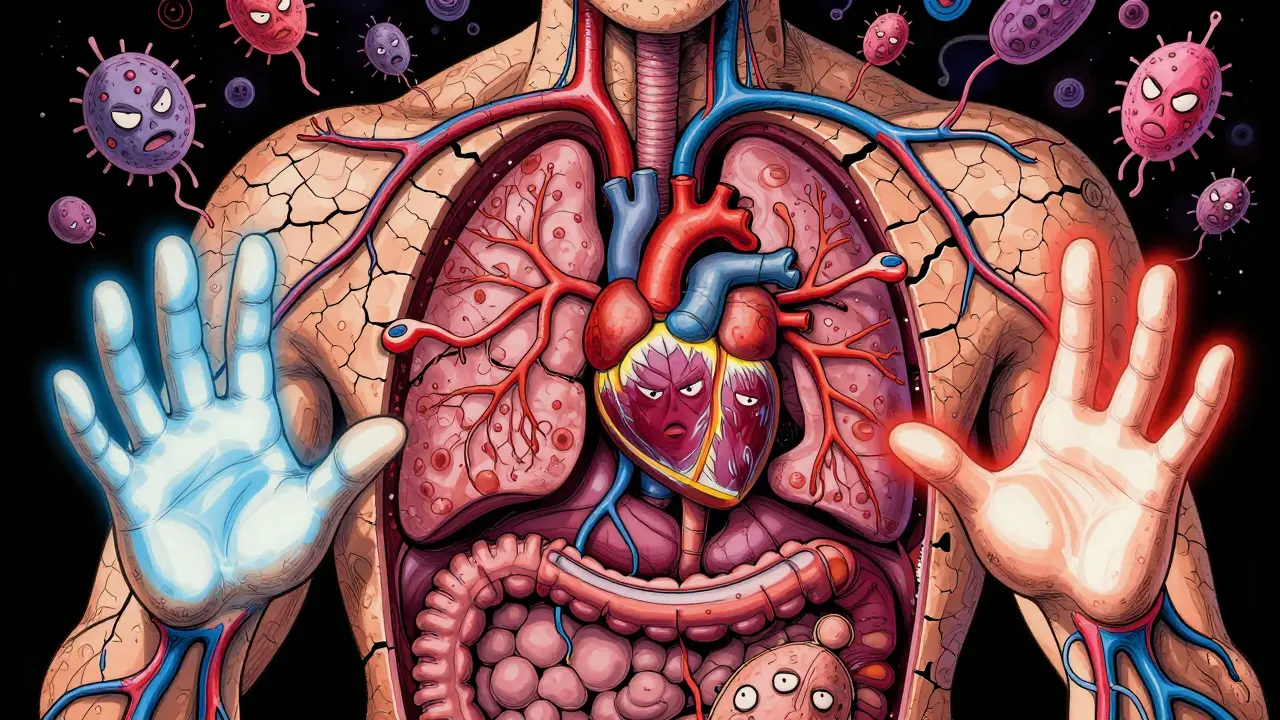
Scleroderma isn't just a skin condition. It's a full-body storm where the immune system turns against the body, triggering excessive collagen production that turns soft tissues into hardened, inflexible masses. This rare autoimmune disease, also called systemic sclerosis, affects about 300 people per million globally, with most cases appearing between ages 30 and 50. Women are four times more likely to develop it than men. Unlike common autoimmune disorders like lupus or rheumatoid arthritis, scleroderma doesn’t just cause inflammation-it builds scar tissue inside the skin, lungs, heart, kidneys, and gut. And there’s no cure yet.
What Happens Inside the Body With Scleroderma?
At its core, scleroderma is a three-part problem: autoimmunity, blood vessel damage, and fibrosis. The immune system mistakenly attacks healthy cells, triggering inflammation. That inflammation damages tiny blood vessels, especially in the fingers and toes, leading to Raynaud’s phenomenon-where fingers turn white, then blue, then red when exposed to cold. This happens in 90% of patients, often years before other symptoms appear.
Then comes the fibrosis: the body overproduces collagen, the protein that normally gives structure to skin and connective tissues. Instead of helping, this excess collagen thickens and hardens the skin, making it tight and shiny. It also builds up in internal organs. In 80% of cases, the lungs develop scarring (pulmonary fibrosis), making breathing harder. In 30-45%, the heart muscle thickens or develops irregular rhythms. Around 10-15% face kidney damage that can spike blood pressure dangerously fast. The digestive tract gets hit too-90% of patients have trouble swallowing, acid reflux, or bowel issues because the muscles in the esophagus and intestines stiffen and lose movement.
Two Main Types, Very Different Paths
Scleroderma splits into two major forms. Localized scleroderma (morphea) only affects the skin in patches. It’s rare, usually not life-threatening, and doesn’t spread internally. Systemic scleroderma is the dangerous one. It has two subtypes: limited and diffuse.
Limited cutaneous systemic sclerosis progresses slowly, often over 10 to 20 years. It typically starts with Raynaud’s, then skin thickening on fingers, face, and forearms. Patients often develop anti-centromere antibodies, which are linked to lower risk of severe lung or kidney damage. But this form still carries a high risk of pulmonary arterial hypertension-a deadly pressure buildup in the lungs’ arteries. It’s the leading cause of death in scleroderma, responsible for 30-40% of fatalities.
Diffuse cutaneous systemic sclerosis hits harder and faster. Skin thickening spreads quickly over the trunk, arms, and legs within the first 3-5 years. These patients often test positive for anti-Scl-70 (topoisomerase I) antibodies, which signal higher risk of lung scarring. They also face a greater chance of kidney crisis and faster decline. Ten-year survival rates are 55-70% for diffuse versus 75-85% for limited. The difference isn’t just speed-it’s how deeply the disease invades vital organs.
How Is It Diagnosed?
There’s no single blood test for scleroderma. Diagnosis is a puzzle made of symptoms, physical signs, and lab results. Doctors look for the classic triad: skin tightening, Raynaud’s phenomenon, and autoantibodies.
Antinuclear antibodies (ANA) are found in 95% of systemic sclerosis patients. But the real clues come from more specific markers:
- Anti-Scl-70 (topoisomerase I): Present in 30-40% of diffuse cases. Strongly linked to lung fibrosis.
- Anti-centromere antibodies (ACA): Seen in 20-40% of limited cases. Lower organ risk, higher risk of pulmonary hypertension.
- Anti-RNA polymerase III: Found in 15-25%. Associated with rapid skin progression and increased cancer risk.
Doctors also use imaging: high-resolution CT scans for lung scarring, echocardiograms to check heart and lung pressure, and pulmonary function tests to measure breathing capacity. Skin thickness is scored using the modified Rodnan skin score-a hands-on exam that rates 17 body areas on a scale of 0-3. A score above 15 often means diffuse disease.
Many patients wait 18 months and see 3.2 different doctors before getting diagnosed. Early symptoms like finger color changes or mild heartburn are dismissed as stress or aging. By the time skin hardens or breathing becomes labored, the disease has already taken root.
Why Treatment Is So Limited
There are no FDA-approved drugs designed specifically to stop scleroderma’s fibrosis. Most treatments are borrowed from other diseases. Immunosuppressants like mycophenolate or cyclophosphamide are used to calm the immune system, but they only help 40-50% of patients-and even then, they don’t reverse damage.
For lung fibrosis, the drug tocilizumab became the first FDA-approved therapy in 2021. It slows decline in lung function for some, but it’s not a cure. For pulmonary hypertension, medications like bosentan or riociguat help open blood vessels. For Raynaud’s, calcium channel blockers or nitroglycerin creams are common. Digital ulcers (open sores on fingers) require daily wound care, sometimes multiple times a week.
And here’s the hard truth: less than 30% of diffuse scleroderma patients show meaningful skin improvement after 12 months of treatment. Fibrosis is stubborn. Once collagen builds up, it’s nearly impossible to break down.
What Life With Scleroderma Really Looks Like
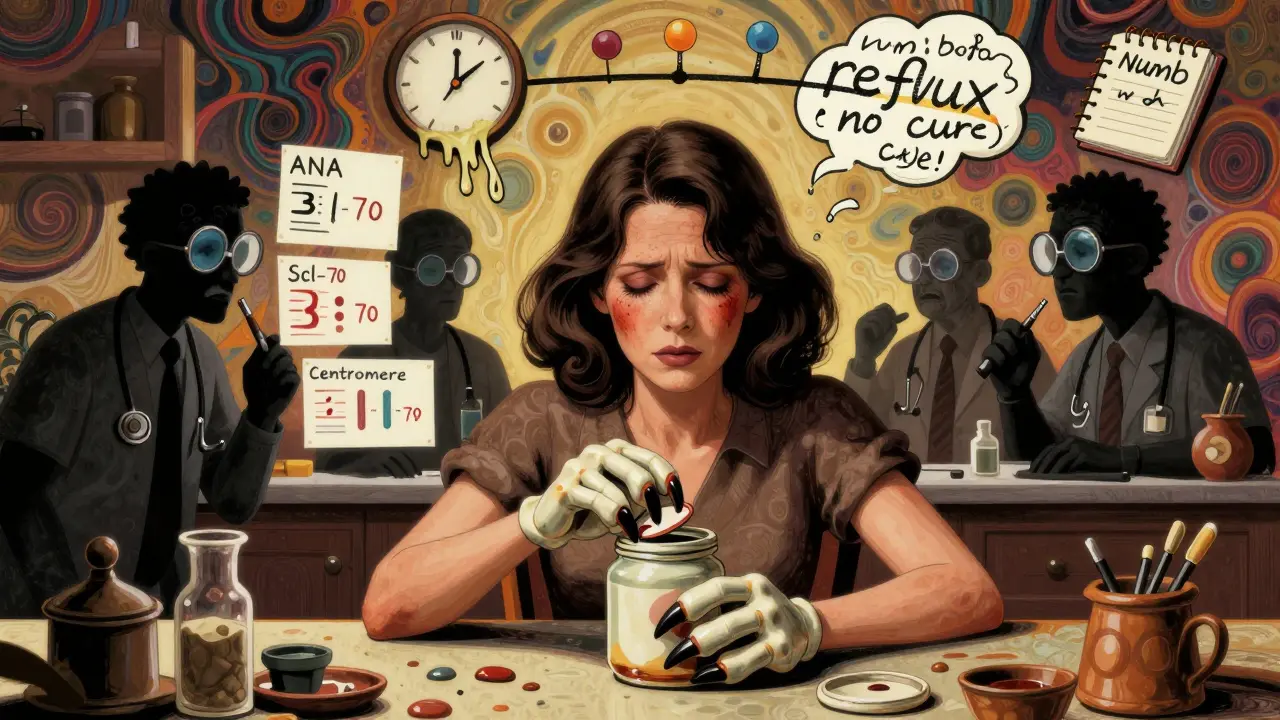
It’s not just medical-it’s daily survival. A 2023 patient survey found 78% struggle with hand contractures, making simple tasks like buttoning shirts or opening jars impossible without adaptive tools. Sixty-five percent rely on special grips, jar openers, or electric can openers just to eat.
Fatigue hits 70% of patients hard. It’s not just tiredness-it’s bone-deep exhaustion that doesn’t go away with rest. Eighty-two percent deal with gastrointestinal issues: nausea, bloating, reflux, constipation. Many take five or more medications a day just to manage digestion.
One woman in Sydney, diagnosed at 38, told her support group: “I used to run marathons. Now I can’t hold a coffee cup without my fingers going numb. I cry when I can’t hug my kids because my skin is too tight.”
Specialized care makes a difference. Patients at centers like Johns Hopkins or Stanford, who see a team of rheumatologists, pulmonologists, and gastroenterologists every three months, report 68% better symptom control than those seeing general rheumatologists. But only 35% of U.S. patients get this level of care. Many live hours from a scleroderma center and rely on local doctors who’ve never seen a case before.
Hope on the Horizon
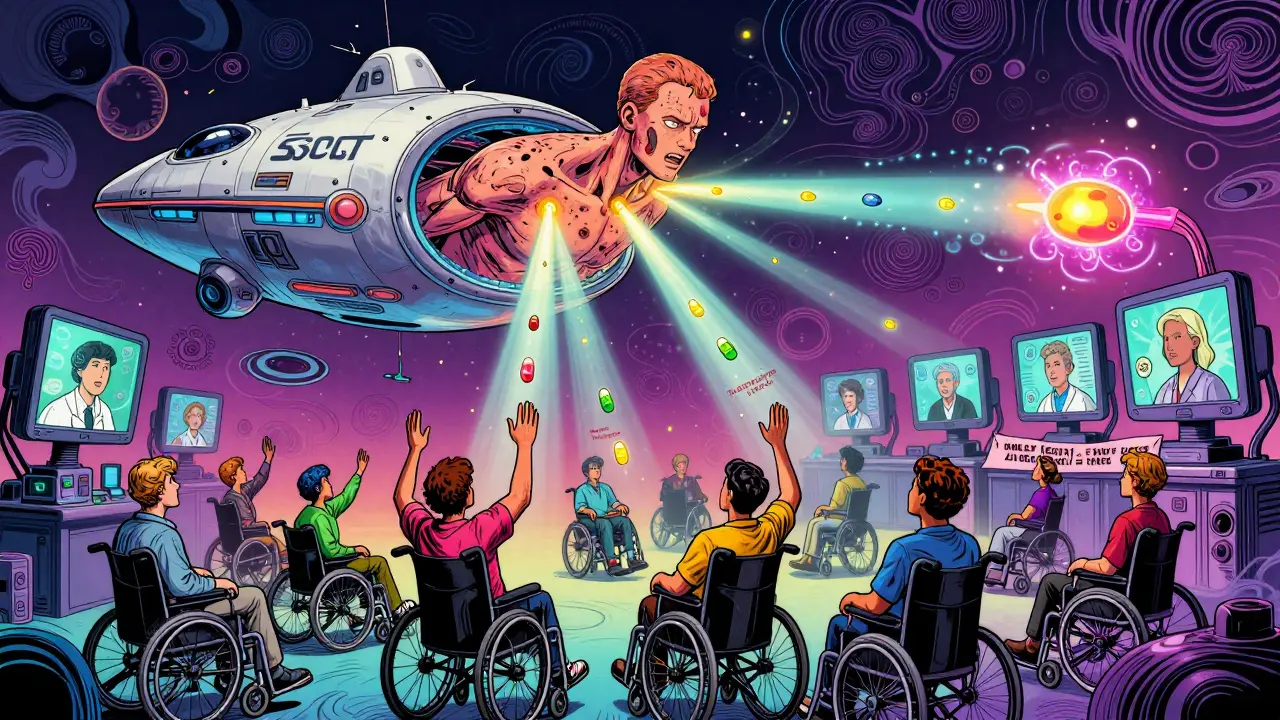
Research is accelerating. In 2023, the SCOT trial showed that autologous stem cell transplants-where a patient’s own immune system is wiped out and rebuilt-led to 50% improvement in skin scores after 4.5 years. It’s risky, but for severe diffuse cases, it’s the most promising option yet.
New drugs are in trials: B-cell depleting therapies, tyrosine kinase inhibitors for lung issues, and agents targeting specific fibrosis pathways. A blood biomarker called CXCL4, discovered in early 2024, may allow diagnosis before skin changes appear-potentially catching the disease years earlier.
Telemedicine is expanding access. Stanford’s 2024 program sends specialists to rural patients via monthly video visits. Early results show a 32% drop in hospitalizations. The Scleroderma Research Foundation just committed $15 million to fibrosis-targeted drugs. And in 2021, the FDA’s approval of tocilizumab proved that regulators are finally taking scleroderma seriously.
The future isn’t about finding one miracle drug. It’s about early detection, personalized treatment based on antibody profiles, and multidisciplinary care that treats the whole person-not just the skin or the lungs.
What You Can Do Now
If you have Raynaud’s that’s getting worse, unexplained skin tightness, or persistent fatigue with digestive problems, don’t wait. Ask for ANA testing and antibody panels. Keep a symptom log: note when your fingers change color, how hard your skin feels, what you eat, and how tired you feel. Bring this to a rheumatologist-even if they’ve never treated scleroderma before.
Find a center with a scleroderma program. Johns Hopkins, Stanford, University of Michigan, and Mayo Clinic all have dedicated teams. If you’re in Australia, look for major teaching hospitals with rheumatology departments that list scleroderma as a specialty.
Support groups matter. The Scleroderma Foundation and SPIN registry collect patient data that helps shape research. Sharing your story helps others get diagnosed faster.
Scleroderma is rare. But it’s real. And it’s not going away. The key isn’t just surviving it-it’s demanding better care, better drugs, and better understanding. Because if we wait for the next breakthrough, too many will already be gone.
Neil Thorogood 24.01.2026
So let me get this straight… our immune system’s like a rogue AI that got handed the blueprint for human anatomy and said ‘let’s make it *tougher*’? 😅
One minute you’re jogging, next you’re fighting to unclench your fingers enough to hold a coffee cup. And the worst part? The doctors are like ‘uh… try this rheumatoid arthritis drug?’
Meanwhile, the real MVPs are the patients using electric can openers like they’re Jedi tools. 🤖🥫
Someone needs to make a Marvel movie out of this. ‘Scleroderma: The Skin That Won’t Let Go.’
Also, if you’re reading this and have Raynaud’s? You’re not just cold-you’re living in a sci-fi horror flick.❄️✋
Jessica Knuteson 24.01.2026
The body is a machine that fails silently until it doesn’t.
Collagen isn’t the enemy. The immune system is the faulty firmware.
No cure because profit margins don’t align with rare diseases.
That’s the real fibrosis.
Robin Van Emous 24.01.2026
I just want to say how brave these patients are. It’s one thing to deal with pain, but it’s another to lose the ability to hug your kids or hold a spoon without it feeling like your skin is made of concrete.
And I really appreciate how the article breaks down the antibody types-it’s not just a label, it’s a roadmap for what’s coming next.
Also, I’m glad they mentioned telemedicine. For people in rural areas, that’s not a luxury-it’s a lifeline.
Thank you for writing this with so much care. I hope more doctors read this and stop dismissing Raynaud’s as ‘just being sensitive to cold.’
Every symptom matters. Every story matters. And we all need to do better.
Even if we’re not affected, we can still listen.
That’s how change starts.
Angie Thompson 24.01.2026
Okay but imagine your skin turning into a leather jacket that won’t unzip. 🤯
And your lungs? Like a pair of old sneakers filled with cement.
And the worst part? People think you’re just ‘tired’ or ‘stressed’ when you can’t lift your arms to brush your hair.
Also-Tocilizumab being approved? That’s HUGE. Like, finally someone said ‘hey, this disease isn’t just a footnote.’
And stem cell transplants? Wild. It’s like hitting reset on your immune system with a chainsaw.
But seriously, if you’re out there with this-your strength is supernova-level. 🌟
Also, if you’re a doc reading this: please, please learn about scleroderma. Don’t wait for the skin to harden to take it seriously.
And if you’re a caregiver? You’re a superhero. No cap.
Geoff Miskinis 24.01.2026
How quaint. Another American medical narrative wrapped in performative empathy and a $15 million ‘research’ grant that will mostly fund conference travel.
The real tragedy isn’t scleroderma-it’s the medical industrial complex’s ability to monetize suffering while offering negligible solutions.
Autologous transplants? A Hail Mary for the wealthy. The rest get ibuprofen and pity.
And don’t get me started on ‘support groups’-they’re emotional band-aids on a hemorrhage.
Real progress requires dismantling the entire paradigm, not posting a LinkedIn article with a ‘#SclerodermaAwareness’ hashtag.
Betty Bomber 24.01.2026
My aunt had this. Took 3 years to get diagnosed. They thought it was arthritis.
She stopped knitting because her fingers wouldn’t bend.
Now she uses voice-to-text to write letters to her grandkids.
She doesn’t complain.
But I cry every time I see her try to turn a doorknob.
So yeah. This article? Yeah. It’s real.
Mohammed Rizvi 24.01.2026
They say ‘no cure’ like it’s the end of the story.
But look at the data: stem cells gave 50% skin improvement. That’s not ‘hope.’ That’s a breakthrough.
And CXCL4 as a biomarker? That’s the real game-changer.
Early detection = early intervention = less damage.
So why aren’t we screaming this from rooftops?
Because medicine still treats rare diseases like side notes.
But the patients? They’re not waiting for permission to fight.
And honestly? We should be too.
eric fert 24.01.2026
Okay, so let me just unpack this whole thing because it’s… a lot.
First, the article says scleroderma is ‘a full-body storm’-which is poetic, sure, but also wildly inaccurate. It’s not a storm. Storms pass. This is a slow-motion collapse, like a building being repurposed into a concrete bunker while the tenants are still inside.
And the part about ‘women are four times more likely’? That’s not biology-it’s bias. We’ve spent centuries studying male physiology as default, and now when women get weird autoimmune symptoms, we slap a label on it and call it ‘rare’ instead of asking why the immune system is so damn sensitive in the first place.
And don’t even get me started on ‘support groups.’ They’re not communities-they’re echo chambers where people trade medication lists like trading cards.
And the ‘hope on the horizon’ section? Tocilizumab? A band-aid on a severed artery. Stem cell transplants? A high-risk gamble for people who’ve already lost everything else.
And yet the article ends with ‘demand better care’-as if the problem is just a lack of advocacy.
It’s not. The problem is that medicine is built on profit, not people. And until we stop treating rare diseases like niche markets and start treating them like human crises, we’re just rearranging deck chairs on the Titanic.
Also, I’ve seen three patients with this. One died at 42. One’s on oxygen. One can’t hold a pen.
And the FDA approved a drug that slows decline by 18%.
That’s not hope.
That’s resignation with a PowerPoint.