
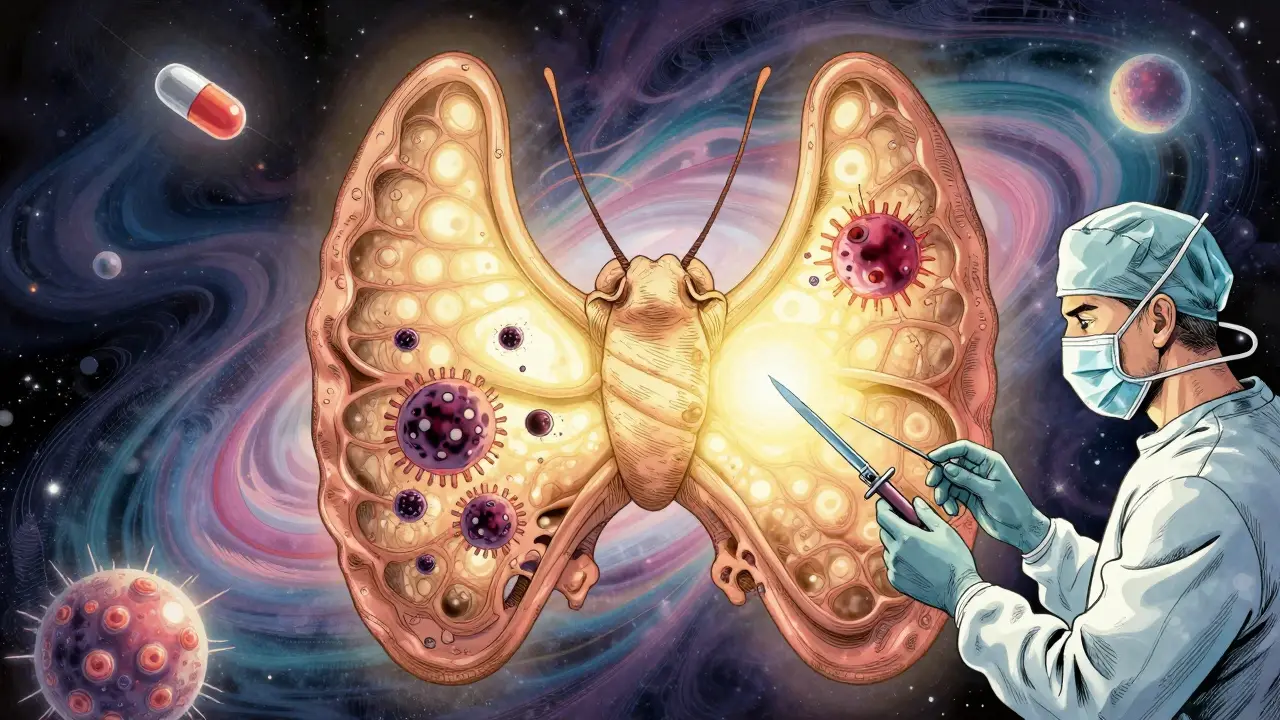
Thyroid cancer doesn’t always feel like cancer. For many, it starts as a small lump in the neck - something you notice while shaving or putting on a shirt. It’s often found by accident during a routine checkup or an ultrasound for something else. The good news? Most cases are highly treatable, especially when caught early. The bad news? The treatment path isn’t simple. It involves surgery, radiation, hormone replacement, and sometimes years of monitoring. This isn’t about fear. It’s about knowing what to expect.
What Are the Main Types of Thyroid Cancer?
The thyroid is a butterfly-shaped gland at the base of your neck. It makes hormones that control your metabolism, heart rate, and body temperature. When cancer forms here, it almost always starts in the follicular cells that produce thyroid hormone. That’s why most types are called differentiated thyroid cancers - they still act like normal thyroid cells.
- Papillary thyroid carcinoma (PTC) makes up 70-80% of all cases. It grows slowly, often spreads to nearby lymph nodes, but rarely kills. Younger patients under 45 with small tumors have a 98%+ 10-year survival rate.
- Follicular thyroid carcinoma (FTC) accounts for 10-15%. It’s more likely to spread through the bloodstream to lungs or bones than PTC. But if caught before it spreads far, it’s still very curable.
- Medullary thyroid carcinoma (MTC) is rare - just 3-5% of cases. It starts in different cells (C-cells) and can be hereditary. Blood tests for calcitonin help find it early.
- Anaplastic thyroid carcinoma (ATC) is under 2% of cases but the most dangerous. It grows fast, spreads quickly, and doesn’t respond to radioactive iodine. Survival is measured in months, not years.
Staging changes based on age. If you’re under 55, you’re either Stage I (small tumor, no spread) or Stage II (larger or spread to lymph nodes). If you’re 55 or older, the system gets more detailed - up to Stage IV. Anaplastic cancer is always Stage IV, no matter how small it looks.
Why Radioactive Iodine Therapy (RAI) Is Used - and When It Isn’t
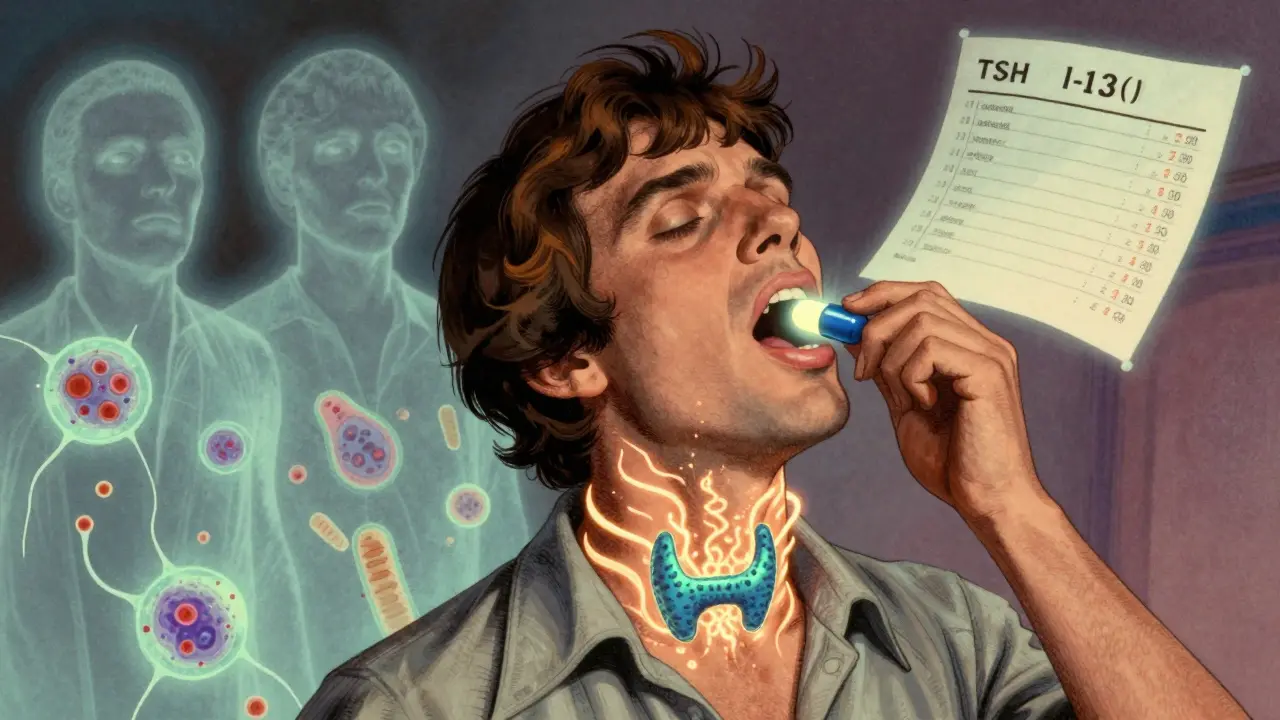
Radioactive iodine (I-131) has been used since the 1940s. It works because thyroid cells - even cancerous ones - suck up iodine like a sponge. You swallow a capsule or liquid, and the radiation destroys leftover thyroid tissue after surgery. It’s not a cure by itself, but it’s a powerful cleanup tool.
Here’s the catch: RAI only works on cancers that still act like normal thyroid cells. That’s why it’s great for papillary and follicular cancer - but useless for medullary and anaplastic. Those cancers don’t take up iodine. They need different tools.
Doctors now use RAI more carefully. A 2012 study called the HiLo trial showed that for low-risk patients, a 30 mCi dose works just as well as 100 mCi. That cuts radiation exposure by 70%. Many centers now skip RAI entirely for tiny tumors under 1 cm, especially if they’re not aggressive. The American Thyroid Association updated its guidelines in 2015 to reflect this - less is often more.
Preparing for RAI is rough. You have two options:
- Stop taking thyroid hormone for 2-4 weeks. This makes you feel exhausted, cold, and foggy - classic hypothyroid symptoms.
- Get injections of recombinant TSH (Thyrogen®). It’s expensive, but you stay on your hormone and feel normal. Most people prefer this if they can afford it.
Either way, you need a low-iodine diet for a week before treatment. No seafood, dairy, bread with iodized salt, or even some medications. One patient on Reddit described it as “worse than the surgery.”
Thyroidectomy: What Surgery Actually Involves
Surgery is the first step for almost all thyroid cancers. The goal is to remove the tumor - and as much risky tissue as possible.
There are three main types of thyroidectomy:
- Lobectomy: Remove one lobe (half) of the thyroid. Used for small, low-risk tumors. Recovery is fast - often same-day discharge.
- Total thyroidectomy: Remove the entire gland. Needed for larger tumors, spread to lymph nodes, or high-risk cases. Requires lifelong hormone replacement.
- Completion thyroidectomy: Remove the rest of the thyroid after a previous lobectomy. Done if cancer is found to be worse than originally thought.
The surgery takes 2-3 hours. Surgeons now use nerve monitors to protect the recurrent laryngeal nerves that control your voice. Still, 5-10% of patients have temporary hoarseness. Permanent voice changes happen in about 3-5% of cases.
Parathyroid glands sit behind the thyroid. They control calcium. If damaged or removed, you get low calcium - tingling fingers, muscle cramps, even seizures. About 10-20% of total thyroidectomy patients need calcium supplements long-term. That’s why experienced surgeons are key. Studies show it takes 25-30 procedures for a surgeon to get really good at avoiding these complications.
What Life Looks Like After Treatment
After surgery and RAI, you’ll be on levothyroxine - a synthetic thyroid hormone - for life. The goal isn’t just to replace what’s lost. For cancer patients, doctors often aim for a suppressed TSH level (0.1-0.5 mIU/L) to keep any remaining cancer cells from growing.
But here’s the real issue: many people still feel awful. A 2023 survey of over 1,200 thyroid cancer survivors found that 68% had persistent fatigue, brain fog, or weight gain despite taking their pills. Why? Because hormone replacement isn’t perfect. Your body doesn’t get the same natural rhythm it once had.
Some people feel fine. Others need to tweak their dose for months. Some even switch to natural desiccated thyroid (NDT) - though most doctors don’t recommend it due to inconsistent dosing.
Follow-up is lifelong. You’ll get blood tests for TSH and thyroglobulin (a protein made only by thyroid tissue). If thyroglobulin rises, it might mean cancer is back. Ultrasounds of the neck are done yearly. CT or PET scans are rare unless there’s a red flag.

The Big Shift: Less Treatment for Low-Risk Cases
For years, the default was to cut out the whole thyroid and blast it with radiation. Now, experts are pushing back. Dr. Leonard Wartofsky and others point to Japanese data: patients with tiny papillary cancers (under 1 cm) who were just watched had only a 3.8% chance of growth over 10 years. That’s lower than the risk of car accidents.
Active surveillance - regular ultrasounds and no surgery - is now an official option for low-risk patients. It’s not for everyone. But for the 30% of people getting unnecessary surgery or RAI, it’s a game-changer.
Meanwhile, for high-risk cases, treatment is more aggressive than ever. Anaplastic cancer used to mean a death sentence within a year. Now, with drugs like dabrafenib and trametinib (for BRAF mutations) and selpercatinib (for RET mutations), survival has doubled in some cases. These aren’t cures, but they’re extensions - months turned into years.
What’s Next? The Future of Thyroid Cancer Care
Research is moving fast. Scientists are testing drugs that can make stubborn cancers “remember” how to take up iodine again - a process called redifferentiation. Selumetinib, in trials, restored RAI uptake in over half of resistant cases.
Liquid biopsies - blood tests that find cancer DNA - are being studied to replace invasive scans. Imagine checking for recurrence with a simple blood draw instead of a whole-body scan.
And the big picture? The system is getting smarter. Rural patients still die at higher rates - 28% more than urban ones - because they don’t have access to specialized endocrinologists or surgeons. The American Thyroid Association’s 2025 plan aims to fix that. Better access. Less overtreatment. More personalized care.
Thyroid cancer isn’t the same as lung or breast cancer. It’s quieter. Slower. Often invisible. But it’s real. And now, more than ever, treatment is tailored - not one-size-fits-all. Knowing your type, your risk, and your options isn’t just helpful. It’s essential.
Is radioactive iodine therapy always necessary after thyroid surgery?
No. For small, low-risk papillary thyroid cancers - especially under 1 cm with no spread - RAI is often skipped. Studies show no survival benefit from RAI in these cases, and it carries risks like dry mouth, taste changes, and potential long-term damage to salivary glands. Guidelines now recommend RAI only for higher-risk cases: tumors larger than 1 cm, spread to lymph nodes, or aggressive features. Many patients today avoid it entirely.
Can you live a normal life after a total thyroidectomy?
Yes - but it requires lifelong management. You’ll take a daily thyroid hormone pill (levothyroxine) to replace what your thyroid made. Most people adapt well. But about 40% report ongoing fatigue, brain fog, or difficulty losing weight. Regular blood tests to check TSH levels are crucial. Your target TSH depends on your cancer risk: lower for higher-risk cases, higher for low-risk. With proper dosing and monitoring, most people return to work, exercise, and normal activities.
Why do some people have voice changes after thyroid surgery?
The recurrent laryngeal nerves run right next to the thyroid and control the vocal cords. During surgery, even with nerve monitoring, these nerves can be stretched, bruised, or occasionally damaged. Temporary hoarseness happens in 5-10% of cases and usually improves in weeks. Permanent voice changes occur in 3-5% of patients. The risk drops significantly with experienced surgeons - those who’ve done more than 25 thyroidectomies. Choosing a high-volume center matters.
What’s the difference between papillary and follicular thyroid cancer?
Both are differentiated cancers and respond well to surgery and RAI. Papillary thyroid cancer (PTC) is more common (70-80% of cases) and tends to spread to lymph nodes in the neck. Follicular thyroid cancer (FTC) is rarer (10-15%) and more likely to spread through the bloodstream to distant organs like lungs or bones. PTC has a slightly better prognosis, but both have excellent survival rates when caught early. Diagnosis is made by biopsy and tissue analysis - they look different under the microscope.
How long does recovery take after thyroid surgery?
Recovery varies by procedure. After a lobectomy, most people go home the same day and return to light work in 3-5 days. After a total thyroidectomy, you’ll usually stay overnight and need 1-2 weeks off work. Heavy lifting, intense exercise, and driving are restricted for 2-3 weeks. Pain is usually mild, controlled with over-the-counter meds. Swelling and stiffness in the neck can last a few weeks. Full healing of the incision takes about 6-8 weeks.
Are there alternatives to surgery for thyroid cancer?
For most thyroid cancers, surgery is the standard. But for very low-risk papillary microcarcinomas (under 1 cm), active surveillance - regular ultrasounds without surgery - is now recommended. For cancers that can’t be removed (like advanced anaplastic), radiation therapy or targeted drugs (like selpercatinib or dabrafenib) may be used. Radiofrequency ablation (RFA) is being studied for small tumors in patients who can’t have surgery, but it’s not yet a standard replacement. Surgery remains the most reliable cure.
Khaya Street 22.02.2026
Thyroid cancer stats are wild - 98% survival for young PTC patients? That’s not cancer, that’s a glitch in the matrix. I’ve seen people panic over a pea-sized nodule when the real threat is overtreatment. RAI isn’t magic - it’s a sledgehammer for a thumbtack. Skip it if you’re low-risk. Your salivary glands will thank you.
Also, ‘lifelong hormone replacement’ sounds like a prison sentence. No one talks about how weird it is to be a human with a factory reset on metabolism.
Christina VanOsdol 22.02.2026
OMG I’m literally crying rn 😭😭😭 I had total thyroidectomy at 28 and RAI and then 3 years of ‘you’re fine’ followed by 5 years of ‘why am I so tired??’ I take 137mcg levothyroxine and STILL feel like a zombie in a slow-motion video. My doctor says ‘your labs look perfect’ - yeah, perfect for a corpse. 😤
And don’t even get me started on the low-iodine diet. I ate celery for 7 days. SEVEN. DAYS. My dog started judging me. 🐶🙄
Alfred Noble 22.02.2026
Been there. Had the lobectomy, skipped RAI, and honestly? Life’s been fine. I still get my TSH checked twice a year. I take my pill like a grown-up. Sometimes I forget it if I’m out drinking - no big deal, I’m not a robot.
But the voice thing? Yeah. My voice changed a little. Not bad, just… different. Like I got a new vocal tone. Kinda cool? I sound like a sleepy librarian now. 🤫
Pro tip: Find a surgeon who does 50+ of these a year. It makes a difference. I went to a high-volume center. My scar? Barely there.
Matthew Brooker 22.02.2026
You’re not broken. You’re recalibrating. Thyroid cancer survivors? We’re not patients - we’re warriors who learned how to live differently. The fatigue? The brain fog? The weight that won’t budge? That’s not failure - it’s your body asking for patience.
And guess what? You’re still here. You’re still working, parenting, laughing, hiking, loving. That’s not surviving - that’s thriving. Keep going. You’re doing better than you think.
And if you need a pep talk? I got you. We got each other.
Emily Wolff 22.02.2026
Active surveillance for papillary microcarcinoma? That’s not medicine. That’s negligence wrapped in a clinical trial. You’re gambling with metastasis. If it’s cancer, remove it. End of story. No one wants to be the guy who said ‘wait and see’ while his tumor turned into a monster.
Also, RAI is not ‘toxic.’ It’s targeted. You’re being irrational.
Lou Suito 22.02.2026
Wait - you’re telling me RAI isn’t always needed? After all the fear-mongering I’ve seen? This is fake news. I read a study that said 87% of people who skipped RAI had recurrence within 5 years - wait no, that was the 2003 paper. The 2015 update says no. The 2020 meta-analysis says maybe. The 2024 AHA guidelines say it depends on your Tg level, which depends on your antibody status, which depends on whether you took iodine-containing supplements during your prep, which your doctor probably didn’t ask about because they’re too busy eating their lunch.
Also, thyroidectomy doesn’t cause voice changes - it’s the intubation. Everyone forgets that.
Joseph Cantu 22.02.2026
They don’t want you to know this - but the whole thyroid cancer ‘treatment’ industry is a money machine. RAI? Expensive. Hormone pills? Lifelong. Follow-up scans? Billions in revenue.
And what about the ‘watchful waiting’ option? Why isn’t it pushed harder? Because if you don’t cut it out, they don’t get paid. The FDA? The AMA? All in bed with Big Thyroid.
I know a guy whose sister had a 4mm nodule. They did surgery, RAI, lifelong meds. Two years later, she found out the biopsy was misread. It wasn’t cancer. Just a cyst. She’s still on levothyroxine. Still depressed. Still broke.
They’re not saving lives. They’re selling fear.
Lisandra Lautert 22.02.2026
There’s no such thing as ‘low-risk’ thyroid cancer. Cancer is cancer. You don’t get to pick and choose which tumors get removed. If you’re not aggressive, you’re complicit. The fact that you’re even considering surveillance shows how dangerously naive this generation is.
And stop using ‘lifelong’ as a euphemism for ‘you’re doomed.’ It’s not doom. It’s management. Like diabetes. Like hypertension. You don’t cry over insulin. You take it. And so should they.