
When you pick up a generic pill at the pharmacy, you expect it to work just like the brand-name version. But how does the FDA make sure it does? The answer isn’t in human trials for every single generic drug. Instead, it’s in a quiet, lab-based test called dissolution testing.
What Dissolution Testing Actually Measures
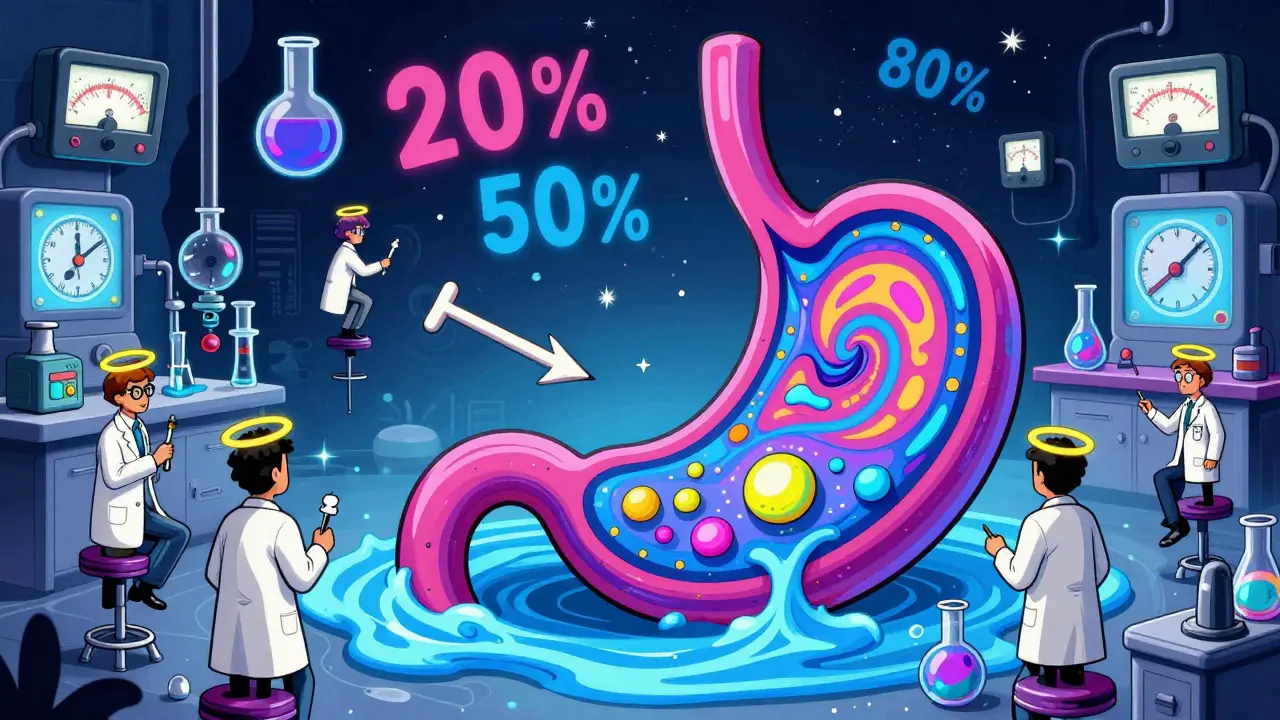
Dissolution testing checks how quickly a drug releases its active ingredient in a controlled lab environment. Imagine putting a tablet into a liquid that mimics stomach fluid, then watching how fast the medicine dissolves. The FDA doesn’t just want the drug to break apart - it wants it to dissolve at the same rate as the original brand-name product. That’s the only way to guarantee the generic will behave the same way in your body.This isn’t guesswork. The FDA requires specific conditions: the right temperature, the right pH, the right stirring speed (usually 50 to 100 rpm), and the exact volume of fluid - often 500 to 900 mL. For immediate-release pills, the standard rule is that at least 80% of the drug must dissolve within 45 minutes. But for some drugs, like those with high solubility, the test is simpler: just one point at 30 minutes in 0.1N HCl. That’s because if a drug dissolves fast and easily, it’s unlikely to cause problems in the body.
Why This Test Replaces Human Trials
Developing a new drug takes years and millions of dollars. For generics, the FDA doesn’t require the same clinical trials because the active ingredient is already proven safe. But they still need proof the generic works the same. That’s where dissolution testing steps in.For drugs classified as BCS Class I - meaning they’re highly soluble and highly absorbable - the FDA allows a biowaiver. That means no human bioequivalence study is needed if the generic matches the brand-name drug’s dissolution profile. In 2023, over 30% of generic approvals used this shortcut, saving time and money without risking patient safety.
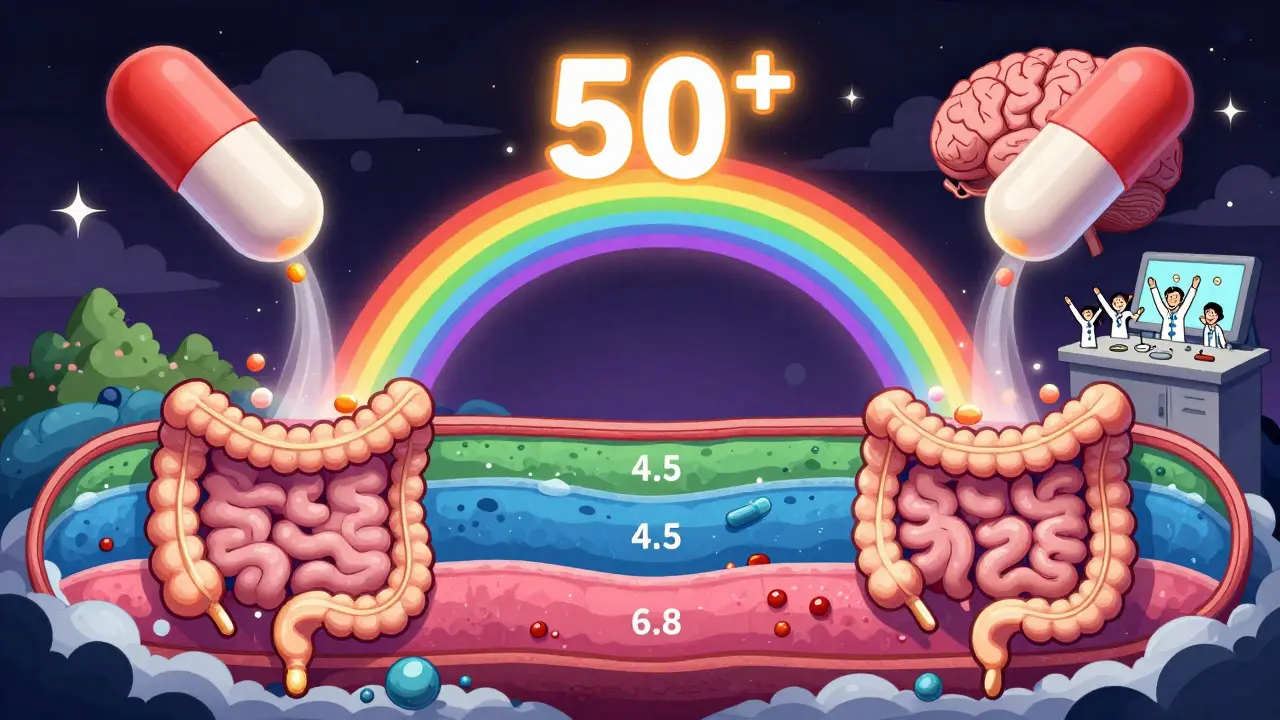
For more complex drugs - like slow-release pills or those with low solubility - the test gets harder. These products need to be tested under multiple pH levels (1.2, 4.5, and 6.8) to simulate different parts of the digestive tract. Some even require alcohol challenge tests. Why? Because if a slow-release pill releases all its drug at once when taken with alcohol, it could cause dangerous overdoses. Dissolution testing catches that risk before the drug ever hits the market.
The f2 Similarity Factor: How FDA Compares Profiles
It’s not enough to just check one time point. The FDA compares the entire dissolution curve of the generic to the brand-name drug. They use a mathematical tool called the f2 similarity factor. If the f2 value is 50 or higher, the two profiles are considered equivalent. That’s not arbitrary - it’s based on statistical analysis showing that when f2 ≥ 50, the drugs behave similarly in the body.For example, if the brand-name drug releases 20% at 15 minutes, 50% at 30 minutes, and 85% at 60 minutes, the generic must follow the same pattern. A small deviation at one point might be okay, but a big shift across the curve? That’s a red flag. The FDA will ask for more data - or reject the application.
What Happens When Dissolution Doesn’t Match
Sometimes, a generic drug passes human bioequivalence studies but fails the dissolution test. That sounds backwards, right? But it happens. The FDA doesn’t automatically approve it. They investigate why. Maybe the generic uses a different excipient that slows dissolution slightly, but the body still absorbs it fully. In those cases, the FDA may set custom dissolution limits for that specific product - not the standard 80% in 45 minutes. This flexibility shows the FDA isn’t just checking boxes. They’re evaluating science.Manufacturers know this. That’s why they spend 6 to 12 months developing dissolution methods for each product. They submit 50 to 100 pages of method validation data in their ANDA application. They test the method under different conditions: different machines, different operators, different batches. They prove it’s reliable. If they don’t, the FDA will ask for more - and delay approval by months.
The FDA’s Dissolution Methods Database
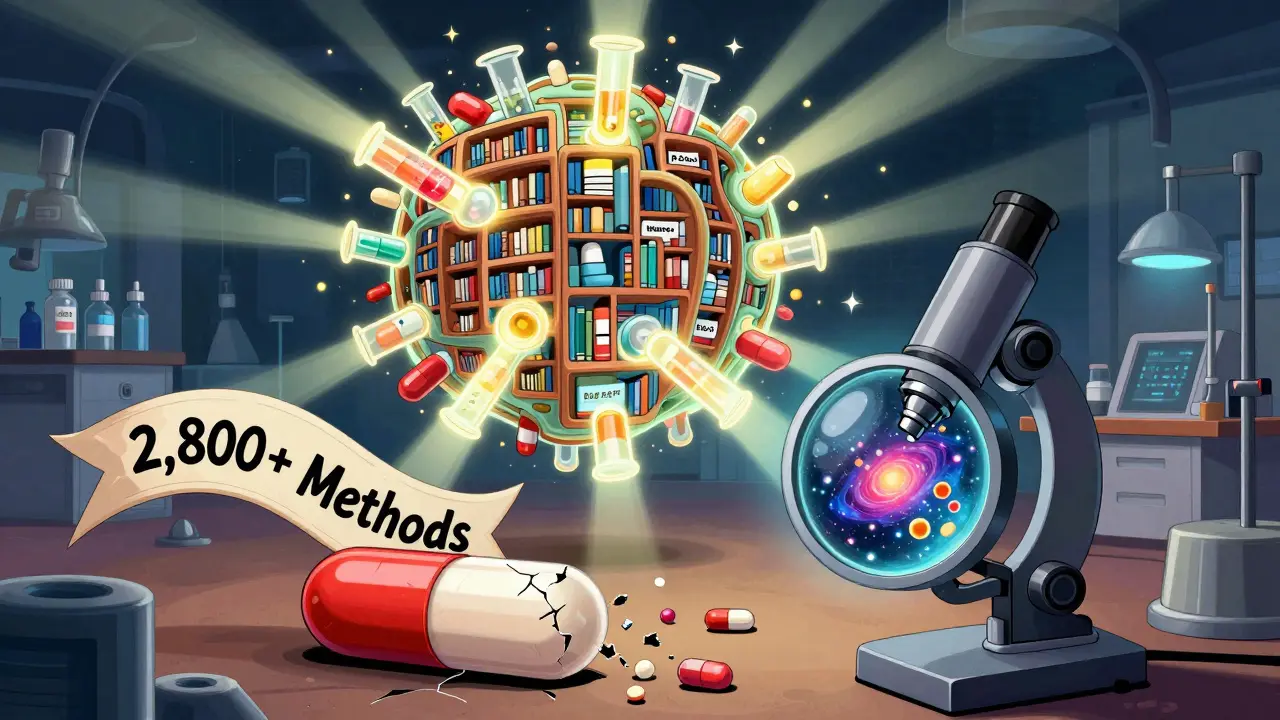
You won’t find this database on the FDA’s public website, but every generic drug maker uses it. It’s a living library of over 2,800 approved dissolution methods for specific drugs. If your generic is based on a drug already in the database, you don’t start from scratch. You follow the same method - same apparatus, same buffer, same time points. This saves years of development.But if your drug isn’t listed? You have to build your own method from scratch. And you have to prove it can tell the difference between a good formulation and a bad one. That’s called discriminatory power. For low-solubility drugs, this is especially hard. A method that dissolves 90% of the drug in 10 minutes won’t help if two different formulations both hit 90% - but one works in the body and the other doesn’t. The FDA needs a method that can catch those subtle differences.
Post-Approval Changes and the SUPAC Rules
Even after approval, the FDA doesn’t stop watching. If a manufacturer changes the factory, switches suppliers, or tweaks the formula - even slightly - they must prove the dissolution profile hasn’t changed. That’s part of the SUPAC-IR guidelines (Scale-Up and Post-Approval Changes for Immediate Release products).One company changed the size of a tablet’s coating granule. It didn’t affect the pill’s appearance or weight. But dissolution testing showed the drug released 10% slower. The FDA required a new bioequivalence study. The company had to pull the batch. That’s how serious this is.
What’s Changing in 2025
The FDA is pushing for more physiologically accurate testing. Right now, most dissolution tests use simple buffers. But the human gut isn’t simple. It has enzymes, mucus, varying flow rates. New methods are being tested that add bile salts or simulate intestinal movement. Early results show these methods predict real-world performance better.Also, the FDA is exploring biowaivers for BCS Class III drugs - those with high solubility but low absorption. If a drug dissolves quickly but doesn’t get absorbed well, maybe a generic that dissolves even faster could help. This could open the door for more generics to reach the market faster.
By 2025, the FDA expects nearly 35% of generic approvals to use standardized dissolution methods, up from 25% in 2020. That’s not just efficiency - it’s smarter regulation. Less testing on people. More testing on science.
Why This Matters to You
You might never see a dissolution test. You might never hear the word. But every time you take a generic pill and it works exactly as expected, this is why. The FDA doesn’t trust manufacturers to say their drug is good. They demand proof - in numbers, in curves, in data. And that’s what keeps you safe.Dissolution testing is the invisible gatekeeper between a cheap pill and a reliable one. It’s not flashy. It doesn’t make headlines. But without it, the entire system of affordable generics would collapse.
What is dissolution testing in generic drugs?
Dissolution testing is a lab-based method that measures how quickly a drug releases its active ingredient under controlled conditions. For generic drugs, it ensures the product releases the medicine at the same rate as the brand-name version, proving it will work the same way in the body without requiring human trials.
Why does the FDA use dissolution testing instead of human studies for generics?
The FDA uses dissolution testing because it’s a reliable, cost-effective way to predict how a drug will behave in the body. For many drugs - especially those with high solubility and absorption - matching the dissolution profile of the brand-name product means the generic will be bioequivalent. This avoids unnecessary human testing while still ensuring safety and effectiveness.
What is the f2 similarity factor?
The f2 similarity factor is a statistical tool the FDA uses to compare the dissolution profiles of two drug products. An f2 value of 50 or higher means the two profiles are similar enough to be considered equivalent. It’s calculated using data points across multiple time intervals, not just one.
Do all generic drugs need dissolution testing?
Yes, all oral solid dose, oral semi-solid, and oral suspension generics require dissolution testing. The FDA exempts only drugs already in solution, like oral liquids or topical creams, because their active ingredients are already dissolved and available for absorption.
What happens if a generic drug fails dissolution testing?
If a generic fails, the FDA will reject the application or request more data. Even if human bioequivalence studies show the drug works, the FDA may still require the dissolution profile to match the brand-name product. In some cases, the agency may set custom dissolution limits based on the data, but the generic must still prove consistent performance.
Can a generic drug be approved with different dissolution criteria than the brand?
Yes, in rare cases. If the generic performs well in human studies but has a slightly different dissolution profile due to formulation differences, the FDA may approve it with adjusted dissolution limits. This only happens when there’s strong scientific justification and full data transparency.
How often does the FDA update dissolution testing guidelines?
The FDA updates guidelines as science evolves. The most recent major update was in September 2023, which clarified requirements for method development and validation. The agency also regularly adds new methods to its Dissolution Methods Database, which currently includes over 2,800 approved methods for specific drugs.
What role does the BCS play in dissolution testing?
The Biopharmaceutics Classification System (BCS) groups drugs by solubility and permeability. For BCS Class I drugs (high solubility, high permeability), the FDA allows biowaivers - meaning no human studies are needed if dissolution profiles match. This speeds up approval and reduces costs without compromising safety.
Meghan O'Shaughnessy 16.12.2025
Dissolution testing is the unsung hero of generic drugs. No one talks about it, but without it, we'd be taking pills that might as well be sugar cubes with a fancy label.
It’s wild how much science goes into something so invisible.
Love that the FDA actually has data behind it, not just guesses.
Kaylee Esdale 16.12.2025
My grandma takes generics every day and never even knows this is happening behind the scenes. She just knows her blood pressure stays down. That’s the real win.
Science quietly keeping people alive.
Brooks Beveridge 16.12.2025
This is the kind of thing that makes me believe in institutions again.
Not flashy, not viral, not sexy-but deeply, profoundly responsible.
They didn’t cut corners. They built a smarter system.
And it works. People live longer because of this.
Thank you, FDA, for doing the boring thing right.
Also, f2 ≥ 50 is such a quiet little victory. Like a math haiku.
:-)
Anu radha 16.12.2025
I work in pharmacy in India. We see so many generics. This explains why some work and some don’t.
Good to know someone is watching.
Jigar shah 16.12.2025
The f2 similarity factor is a statistically validated metric with robust sensitivity to profile deviations, ensuring bioequivalence without in vivo studies for BCS Class I compounds.
It is an elegant application of pharmacokinetic principles to regulatory science.
Sachin Bhorde 16.12.2025
Bro, the FDA doesn’t just wing it. They got 2800+ methods in their database like a drug nerd’s Netflix queue.
Some of these tests are wild-alcohol challenges? Like, you take a pill with a beer and see if it explodes? 😳
And they test it on 50 different machines? That’s next level.
My cousin’s startup tried to skip this and got slapped hard. Lesson learned.
Respect the grind.
Joe Bartlett 16.12.2025
Yanks and their over-engineering. We just test the bloody pill in water and call it a day.
Why so many numbers? Why so many rules?
It’s just a pill.
But hey, if it keeps you safe, I guess it’s fine.
Still, overkill.
Marie Mee 16.12.2025
Wait so the FDA is secretly controlling what we take?
What if they’re lying about the dissolution data?
What if the real drug is being held back so Big Pharma can keep selling brand names?
They say it’s science but it’s all just smoke and mirrors.
They don’t want you to know how much control they have.
They’re watching you right now.
Check your pills. Are they the same color as last time?
They’re watching.
Naomi Lopez 16.12.2025
It’s fascinating how the FDA has elevated dissolution testing from a crude lab procedure to a sophisticated, statistically grounded pillar of regulatory science.
Truly, the pinnacle of pharmaceutical governance.
Though I must say, the BCS classification system remains underappreciated in mainstream discourse.
One wonders why more people don’t understand the elegance of permeability-solubility interplay.
It’s not just science-it’s art.
Salome Perez 16.12.2025
This is why I trust American regulatory science more than any other system in the world.
It’s not perfect, but it’s rigorous, transparent, and grounded in measurable outcomes.
The Dissolution Methods Database? A masterpiece of public infrastructure.
2,800+ methods, each validated, each documented, each serving the public good.
Compare that to countries that still approve generics based on paperwork.
We don’t just regulate-we elevate.
Thank you, FDA.
You’re quietly saving millions.
Kent Peterson 16.12.2025
Why do we even need this? Why not just let the market decide?
Look, I get it-‘safety,’ blah blah.
But how many times have generics been recalled because of ‘dissolution issues’?
Zero. Not once.
Meanwhile, the brand-name companies are raking in billions while the FDA makes small businesses jump through 100 hoops.
It’s not science-it’s protectionism.
And don’t get me started on the ‘f2 factor’-sounds like a made-up metric to justify bureaucracy.
Who even decided 50 is the magic number? Some guy in a lab coat?
It’s all a racket.
Josh Potter 16.12.2025
THIS IS THE MOST COOL THING I’VE READ ALL WEEK.
THEY TEST PILLS WITH ALCOHOL?!
LIKE A DRUNK TEST FOR MEDS?!
AND THEY HAVE A DATABASE OF 2800 METHODS?!
IMAGINE BEING THE GUY WHO BUILT THE FIRST ONE.
THEY’RE LIKE PHARMACEUTICAL DETECTIVES.
AND WE JUST TAKE PILLS LIKE IT’S MAGIC.
WE OWE THESE PEOPLE A LOT.
GO FDA.
GO SCIENCE.
GO DO THE THING.
Evelyn Vélez Mejía 16.12.2025
The elegance of dissolution testing lies not in its complexity, but in its fidelity to physiological reality.
It transforms empirical observation into predictive science.
By anchoring bioequivalence to kinetic release profiles rather than population-based pharmacokinetics, the FDA avoids the ethical and economic inefficiencies of redundant clinical trials.
This is not mere regulation-it is epistemological maturity.
The f2 metric, though mathematical, is philosophically profound: it quantifies similarity without demanding identity.
It acknowledges variation while preserving therapeutic equivalence.
It is, in essence, a model of humility in science.
Where other systems demand perfection, this system demands precision-and that is wisdom.
Victoria Rogers 16.12.2025
Yeah sure the FDA says it’s science but have you seen their budget?
They’re just trying to keep the brand names alive.
Generic companies get stuck with impossible tests while the big pharma guys get a free pass.
And don’t even get me started on the database-probably full of outdated junk.
They don’t care if it works they just care if it looks right on paper.
It’s all just a cover-up.
They’re scared of real competition.
And you think you’re saving money? You’re just paying for bureaucracy.