

When your nose runs, your chest tightens, or you wake up gasping at night because of allergies, you might be dealing with something deeper than just a runny nose or a cough. For many people with allergic asthma or allergic rhinitis, the real problem isn’t pollen or dust alone-it’s what your body does in response. That’s where montelukast comes in. It doesn’t block allergens. It doesn’t dry up mucus. Instead, it shuts down a specific chemical signal in your airways that turns mild irritation into full-blown breathing trouble.
What Exactly Is Montelukast Doing in Your Airways?
Montelukast, sold under the brand name Singulair and as generics, is a leukotriene receptor antagonist. That’s a fancy way of saying it blocks a group of chemicals called cysteinyl leukotrienes-LTC4, LTD4, and LTE4-that your body releases when exposed to allergens. These aren’t just random byproducts. They’re powerful drivers of inflammation in the airways.
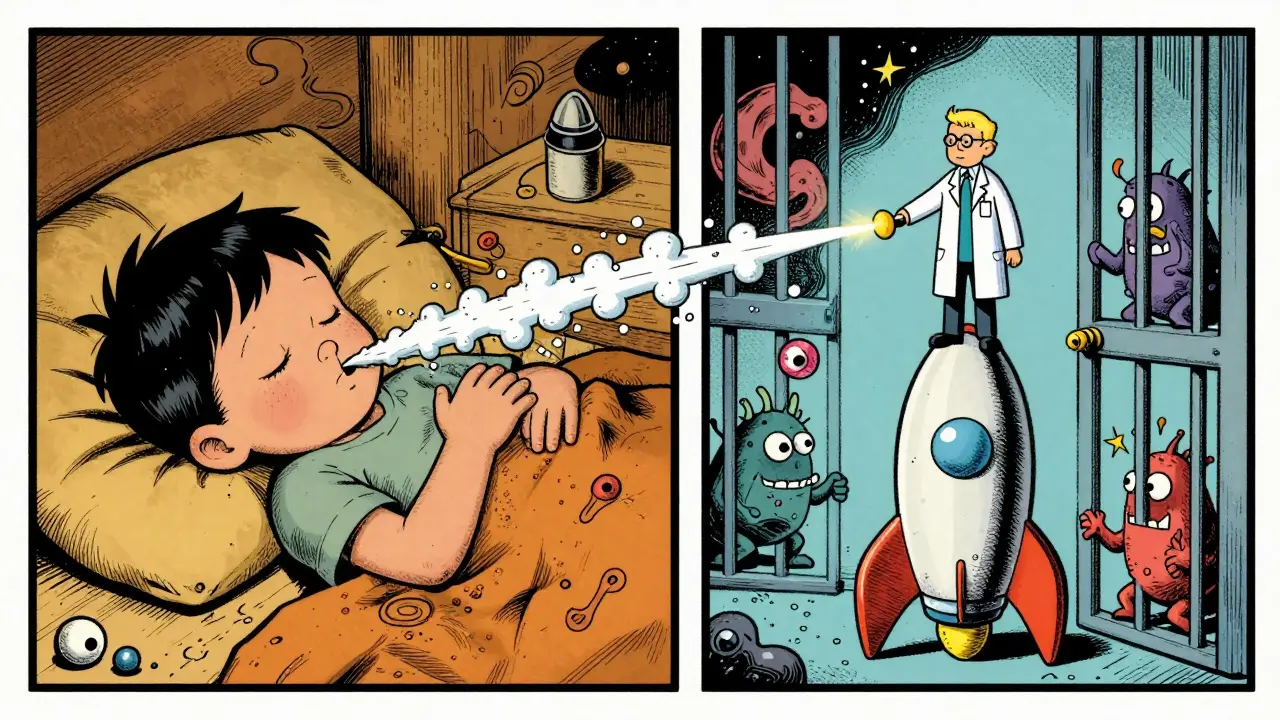
When you breathe in pollen or dust, immune cells in your lungs and nasal passages go into overdrive. They release these leukotrienes, which then bind to receptors on smooth muscle cells, blood vessels, and mucus glands. The result? Airway muscles clamp down, blood vessels leak fluid into tissues, and thick mucus clogs your nose and bronchi. This is what causes wheezing, congestion, and nighttime coughing.
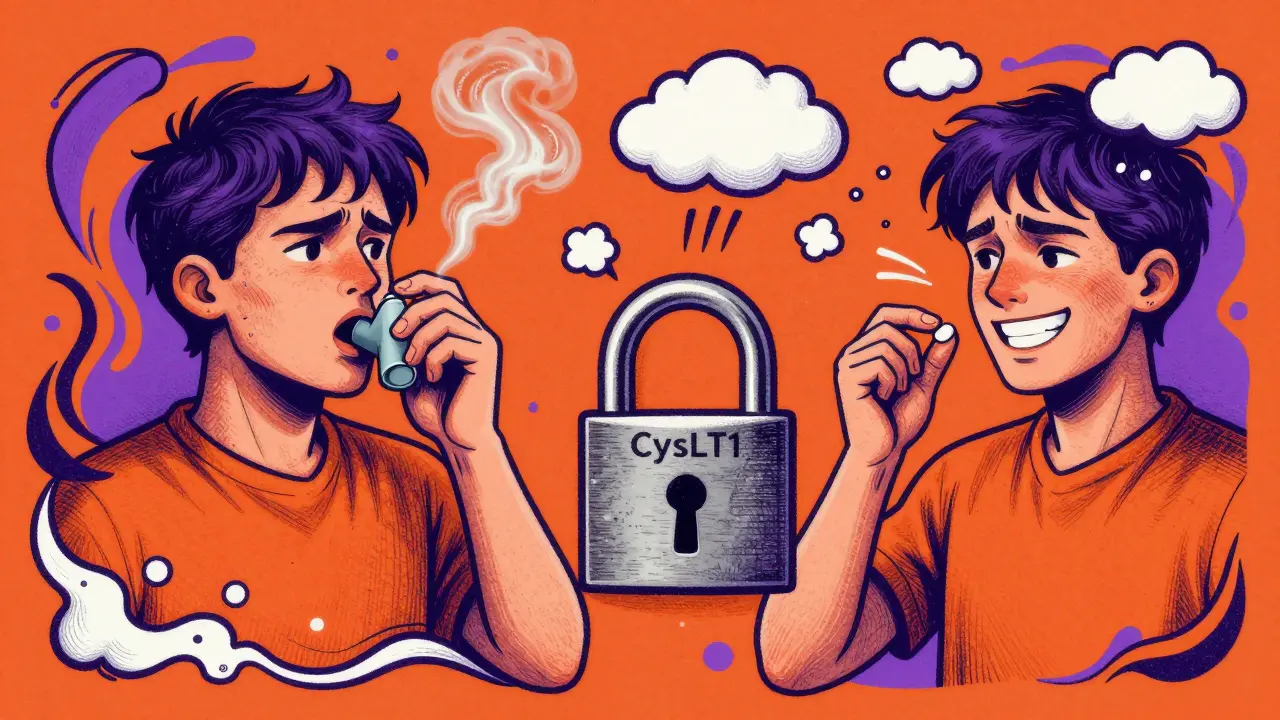
Montelukast steps in by latching onto the CysLT1 receptor-the main doorway these leukotrienes use to trigger trouble. It doesn’t activate the receptor. It doesn’t even slightly stimulate it. It just sits there, blocking the leukotrienes from getting in. Think of it like a lock that only accepts one key. Montelukast is the fake key that fits perfectly, so the real key (LTD4) can’t turn the lock.
This mechanism is why montelukast works for both asthma and allergic rhinitis. The same leukotrienes that narrow your bronchi also swell your nasal passages. That’s one pill for two problems.
How Effective Is It Really?
Studies show montelukast reduces asthma symptoms by about 30-40% on average. It cuts down on rescue inhaler use, improves morning peak airflow, and lowers blood eosinophils-markers of airway inflammation. In allergic rhinitis, it reduces nasal congestion, sneezing, and runny nose better than placebo. But here’s the catch: it’s not as strong as the first-line treatments.
For asthma, inhaled corticosteroids (ICS) like fluticasone or budesonide are the gold standard. They cut inflammation at the source, and they’re more effective than montelukast. The Global Initiative for Asthma (GINA) guidelines say ICS should come first. Montelukast is the backup plan-for people who can’t use inhalers, won’t use them, or still have symptoms after using them.
For allergic rhinitis, second-generation antihistamines like loratadine (Claritin) or cetirizine (Zyrtec) are faster and more reliable. Montelukast works, but it’s slower. One patient review summed it up: “It cut my allergy symptoms by half, but Zyrtec wiped them out.” That’s the pattern. It helps, but it rarely replaces the first choice.
Still, it has real value. A 2022 meta-analysis found that montelukast reduces nasal symptom scores significantly compared to placebo. In children under 5, where using an inhaler correctly is hard, montelukast is often the go-to controller. One parent reported their 6-year-old went from using a rescue inhaler daily to once a week after adding montelukast to their daily steroid inhaler.
Who Benefits Most From Montelukast?
Not everyone. But for certain groups, it’s a game-changer.
- Young children (2-5 years) who can’t coordinate inhaler use. Montelukast granules can be mixed into food or formula.
- People with both asthma and allergic rhinitis. Most drugs treat one or the other. Montelukast tackles both.
- Those who can’t tolerate steroids. If you get thrush, hoarseness, or fear long-term steroid side effects, montelukast offers a non-steroid alternative.
- Patients with exercise-induced bronchoconstriction. While not as fast as albuterol, montelukast taken daily reduces the severity of exercise-triggered symptoms.
It’s also popular because it’s simple. One pill, once a day. No inhaler technique. No rinsing your mouth. No remembering to use it twice daily. For people who struggle with adherence, that’s huge. Studies show 87% of users praise the convenience.
What Are the Downsides?
Montelukast isn’t magic. It doesn’t work for everyone. And it has limits.
- Slow to work. You won’t feel better the next day. It takes 24-48 hours to start, and up to a week for full effect. That’s why it’s useless for sudden attacks.
- Not for emergencies. If you’re wheezing or panicking because you can’t breathe, grab your albuterol inhaler. Montelukast won’t help. It’s for prevention, not rescue.
- Side effects. Headaches, stomach pain, and cough are common. More concerning are reports of mood changes: anxiety, depression, irritability, vivid dreams, or even suicidal thoughts. The FDA added a boxed warning in 2020 after reviewing over 1,100 post-marketing cases. These are rare-less than 1% of users-but serious enough that doctors now screen patients before prescribing.
- Inconsistent results. Some people swear by it. Others feel nothing. A Drugs.com user wrote: “I took it for three months. No difference. Zyrtec worked instantly.” That’s normal. Genetics, environment, and allergy triggers all play a role.
How It Compares to Other Options
Here’s how montelukast stacks up against common treatments:
| Treatment | Type | Onset of Action | Best For | Limitations |
|---|---|---|---|---|
| Montelukast | Leukotriene inhibitor | 24-72 hours | Chronic asthma + rhinitis, children, steroid-intolerant | Slow, not for acute attacks, neuropsychiatric risk |
| Inhaled Corticosteroids (ICS) | Anti-inflammatory | 1-2 weeks | Most asthma patients, persistent symptoms | Requires proper technique, throat irritation, oral thrush |
| Second-Gen Antihistamines (e.g., Zyrtec) | Antihistamine | 1-3 hours | Allergic rhinitis, sneezing, itching | Less effective for asthma, drowsiness in some |
| Albuterol (Rescue Inhaler) | Beta-agonist | 5 minutes | Acutely worsening asthma | Doesn’t reduce inflammation, overuse can worsen control |
| Zileuton | Leukotriene synthesis inhibitor | 1-2 weeks | Severe asthma, when receptor blockers fail | Requires liver monitoring, 4x daily dosing |
Montelukast sits in a unique spot: not the strongest, not the fastest, but the most convenient for certain patients. It’s the middle ground between quick fixes and powerful steroids.
Why It Still Matters in 2026
Even with newer biologics like dupilumab and omalizumab targeting specific immune pathways, montelukast hasn’t disappeared. Why?
- Cost. Generic montelukast costs $4-$10 a month. Biologics cost over $1,000 per dose.
- Accessibility. It’s available everywhere. No special clinics. No insurance hurdles.
- Proven safety. Used by millions since 1998. Long-term data shows low risk of organ damage.
- Dual action. Still the only oral drug that helps both nose and lungs.
Global prescriptions hit 14.7 million in the U.S. alone in 2022. Even though generics make up 92% of the market, demand hasn’t dropped. It’s not going away. It’s just being used more wisely-as a tool for specific cases, not a default.
What You Should Know Before Taking It
- Take it at the same time every day. Nighttime dosing is common because leukotriene levels peak at night.
- Don’t expect instant relief. Give it at least 7 days before deciding it’s not working.
- Keep your rescue inhaler handy. Montelukast won’t stop an asthma attack.
- Watch for mood changes. If you feel unusually anxious, depressed, or have strange dreams, tell your doctor.
- It’s safe for kids as young as 2. Granules can be mixed into applesauce or formula.
- It doesn’t interact with most drugs, but avoid alcohol if you’re prone to drowsiness.
Montelukast isn’t a cure. It doesn’t fix allergies. But for many, it reduces the noise in their airways enough to breathe easier-without steroids, without inhalers, without daily sprays. It’s not the first choice. But for the right person, it’s the right choice.
Is montelukast safe for long-term use?
Yes, montelukast is generally safe for long-term use. Studies tracking patients for up to 5 years show no increase in serious side effects like liver damage or immune suppression. The biggest concern is neuropsychiatric effects, which are rare but require monitoring. If mood changes occur, discontinuation usually reverses them. Regular check-ins with your doctor are advised, especially if used for more than a year.
Can I take montelukast with allergy pills like Zyrtec or Claritin?
Yes, montelukast can be safely combined with second-generation antihistamines like cetirizine (Zyrtec) or loratadine (Claritin). In fact, many doctors prescribe them together for patients with both asthma and allergic rhinitis. The two work differently: antihistamines block histamine (which causes itching and sneezing), while montelukast blocks leukotrienes (which cause swelling and mucus). Together, they cover more symptoms than either alone.
Why does montelukast cause strange dreams or sleep issues?
The exact reason isn’t fully understood, but researchers believe it may involve the drug crossing the blood-brain barrier and affecting brain receptors linked to sleep and mood regulation. Leukotrienes are also present in the central nervous system, and blocking them might alter neurotransmitter activity. This effect is rare and usually mild, but it’s serious enough that the FDA requires a boxed warning. If vivid dreams or insomnia persist, talk to your doctor about switching.
Is montelukast better than steroids for asthma?
No, montelukast is not better than inhaled corticosteroids (ICS) for controlling asthma. ICS reduce airway inflammation more effectively and are the first-line treatment for persistent asthma. Montelukast is less effective at preventing flare-ups and doesn’t lower inflammation as much. But it’s a good alternative for people who can’t or won’t use inhalers-especially children, or those who experience side effects like hoarseness or thrush from steroids.
Can montelukast help with exercise-induced asthma?
Yes, montelukast can help reduce symptoms of exercise-induced bronchoconstriction when taken daily. It’s not as fast as albuterol (which works in minutes), but regular use lowers the frequency and severity of exercise-triggered coughing and wheezing. Many athletes and active teens use it as a daily preventive, especially if they can’t use inhalers before every workout. For best results, take it at least 2 hours before exercise if you’re using it for this purpose.
David L. Thomas 10.03.2026
Montelukast is one of those drugs that feels like a secret weapon when it works. The way it jams the CysLT1 receptor like a lockpick that only fits one key? Pure pharmacological elegance. It’s not flashy like biologics, but it’s the quiet guy in the corner who actually gets the job done-especially for kids who can’t coordinate inhalers. I’ve seen 4-year-olds go from nightly wheezing to sleeping through the night. No magic bullet, but damn if it isn’t a damn good bullet.
Mike Winter 10.03.2026
It’s fascinating how such a simple molecular blockade-blocking leukotrienes at the receptor level-can have such a broad clinical impact across both upper and lower airways. The fact that it’s effective for both allergic rhinitis and asthma speaks to a shared pathophysiology we often overlook. I find it ironic that we prioritize inhalers for asthma, yet an oral agent that targets the same inflammatory cascade is considered secondary. Perhaps we need to rethink hierarchy based on patient adherence, not just potency.
Alexander Erb 10.03.2026
Yessss this is why I love montelukast 😌 One pill at night, no rinsing, no shaky hands trying to use an inhaler after a long day. My kid’s asthma went from ‘daily rescue’ to ‘once a week max’ after we added it. And yeah, weird dreams at first? Totally. But they faded. Worth it. Also, pairing it with Zyrtec? Game. Changer. 🙌
Donnie DeMarco 10.03.2026
so like… montelukast is basically the chill uncle of asthma meds. not the loudest, not the fastest, but always there when you need him. i took it for like 6 months and honestly? i felt like i could breathe through a damn hurricane. my doc said ‘it’s not as strong as steroids’ but bro… i didn’t need strong. i needed *consistent*. and it was. also no throat gunk. no weird taste. just… peace. 🤘
Tom Bolt 10.03.2026
THE FDA BOXED WARNING ISN’T A WARNING-IT’S A RED FLAG. I’VE SEEN THREE PEOPLE GO FROM ‘FINE’ TO ‘FALLING APART’ ON MONTELUKAST. ONE KID ATTEMPTED SUICIDE. ANOTHER STOPPED TALKING TO HIS FAMILY. THIS ISN’T ‘VIVID DREAMS’-IT’S NEUROLOGICAL SABOTAGE. WHY IS THIS STILL ON THE MARKET? WHY ARE WE PRESCRIBING A DRUG THAT TURNS PEOPLE INTO STRANGERS TO THEIR OWN LIVES? IT’S NOT ‘RARE.’ IT’S BEING IGNORED.
Adam Kleinberg 10.03.2026
Let me ask you this: if a drug can alter mood and behavior in a way that’s documented in over a thousand cases, why are we still treating it like a minor side effect? Big Pharma doesn’t care about your sleep. They care about your subscription. Montelukast is the perfect corporate drug-cheap, easy to mass-prescribe, and with a side effect profile that’s buried in fine print. Meanwhile, the real solution? Clean air. Less pollution. But that doesn’t make money. So we give you a pill that makes you forget your own name.
Chris Bird 10.03.2026
This drug is okay. Works for some. Not for all. Simple.
Bridgette Pulliam 10.03.2026
Thank you for writing this with such clarity. I’m a nurse who’s seen families struggle with inhaler technique for years-montelukast has been a lifeline. I’ve had parents cry because their child finally slept through the night. And yes, the mood side effects are real. But here’s what I tell them: ‘Monitor. Don’t panic. If something feels off, stop it and call me.’ It’s not perfect. But for children, for those who can’t use inhalers, for people with dual conditions-it’s not just helpful. It’s essential. Let’s not throw the baby out with the bathwater.