
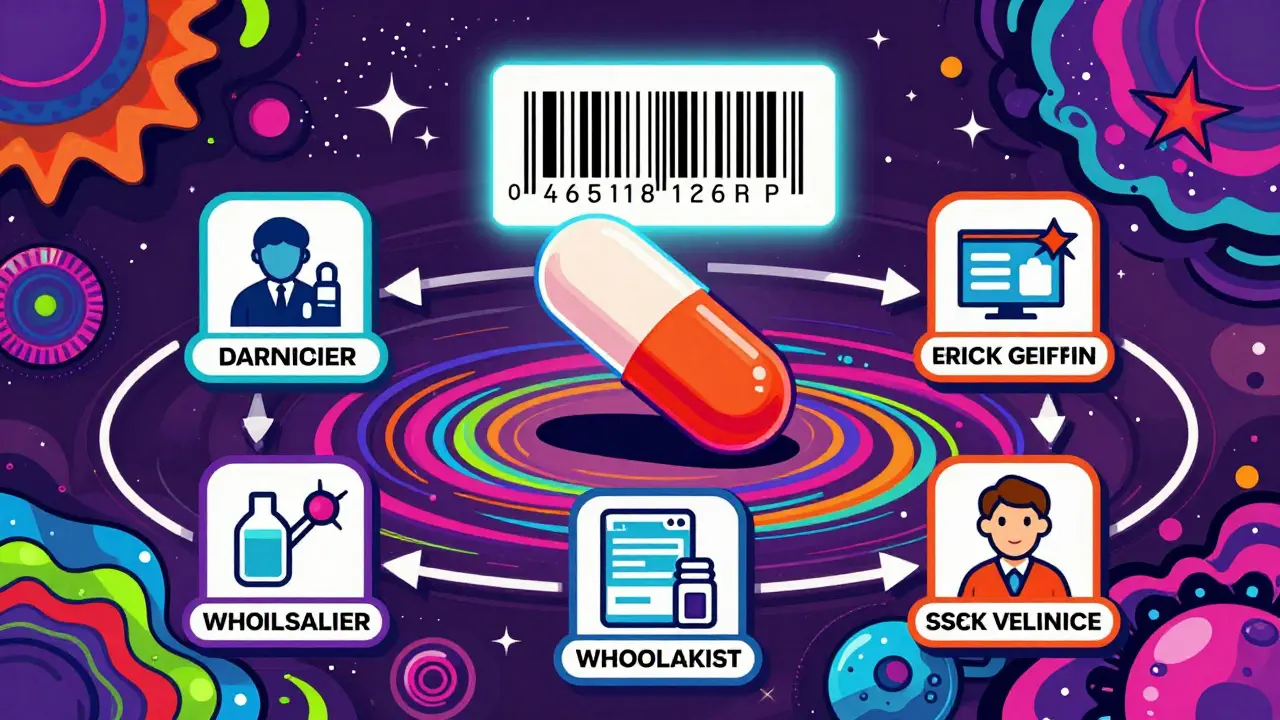
The U.S. pharmaceutical supply chain handles over 5 billion prescription drug transactions every year. For decades, there was no reliable way to know if a pill came from a legitimate manufacturer-or if it was a fake, stolen, or contaminated product. That changed with the Drug Supply Chain Security Act (DSCSA), a federal law designed to stop counterfeit drugs before they reach patients. By November 27, 2024, every pharmacy, wholesaler, and manufacturer in the U.S. must be able to track prescription drugs at the individual package level. This isn’t just bureaucracy. It’s a lifeline.
What the DSCSA Actually Does
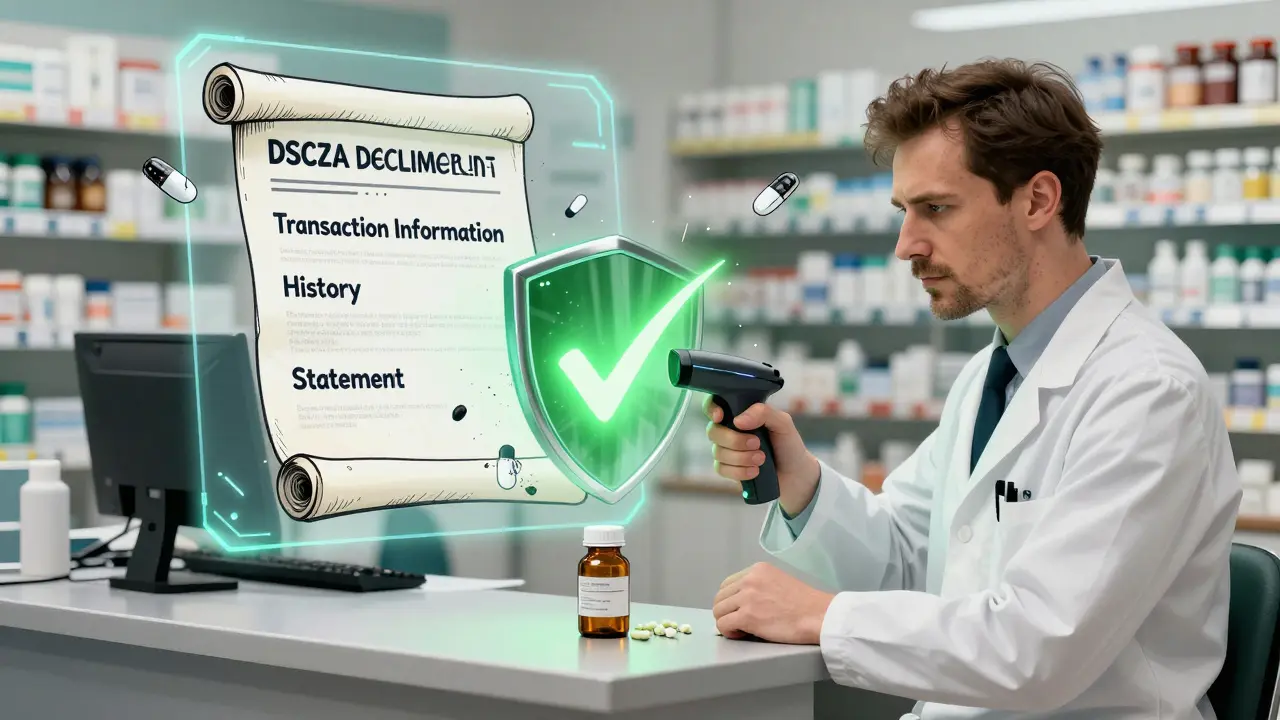
The DSCSA doesn’t just add another layer of paperwork. It builds a digital chain of custody for every prescription drug sold in the U.S. Each package gets a unique serial number, tied to the product’s National Drug Code (NDC), expiration date, and lot number. This information is printed in both human-readable text and a machine-scannable barcode. When a pharmacy receives a shipment, its system scans the barcode, checks the serial number against the manufacturer’s database, and verifies the entire transaction history. If anything doesn’t match-like a wrong lot number or a serial number already reported as stolen-the system flags it instantly.
This system replaces the old patchwork of state laws. Before DSCSA, some states had their own tracking rules, others didn’t. A drug could be legal in one state but flagged as suspicious in another. Now, there’s one national standard. The goal? Make it nearly impossible for counterfeiters to slip fake medications into the supply chain.
How Counterfeit Drugs Enter the System
Counterfeit drugs aren’t just fake pills sold on shady websites. They’re real-looking products that sneak into legitimate channels. Think: stolen medications resold after being stored in a hot warehouse, expired drugs relabeled with new expiration dates, or batches mixed with the wrong active ingredient. In 2021, the FDA reported over 1,000 incidents of suspect products linked to supply chain breaches. Most of these came from unverified distributors or poorly monitored repackagers.
Before DSCSA, if a hospital received a bad batch of insulin, they had to recall every package of that drug-regardless of lot number. That meant throwing away thousands of safe doses just to be safe. With DSCSA, they can pinpoint the exact lot. In 2022, CVS Health reported a 75% drop in unnecessary recalls after implementing automated verification systems. That’s not just cost savings. It’s less waste and more certainty for patients.
The Three Key Pieces of Data
Every transaction under DSCSA must include three electronic documents:
- Transaction Information (TI): This includes the product’s NDC, serial number, lot number, and expiration date. Think of it as the drug’s ID card.
- Transaction History (TH): This shows where the product has been since it left the manufacturer. Did it go from Pfizer to McKesson, then to a regional distributor, then to your local pharmacy? This trail must be complete and accurate.
- Transaction Statement (TS): This is a legal certification that the product wasn’t stolen, counterfeit, or otherwise illegitimate. It’s signed by each party in the chain.
These documents must be exchanged electronically between trading partners. No more paper invoices. No more hand-written logs. If your pharmacy still uses faxed forms, you’re not compliant-and you’re putting patients at risk.
Why the 2024 Deadline Matters
The DSCSA didn’t launch all at once. It rolled out in phases over ten years. By 2017, manufacturers had to start putting serial numbers on packages. By 2023, wholesalers and pharmacies had to verify those numbers. But the final piece-full interoperability-was delayed until November 27, 2024. That’s when every system must be able to talk to every other system, no matter the vendor.
Here’s the catch: many companies still struggle with data mismatches. A serial number might look correct in one system but be formatted differently in another. One vendor uses uppercase letters; another uses lowercase. One system expects the lot number in position 5; another puts it in position 7. These tiny differences cause delays. Pharmacists report verification times stretching to 48 hours, which slows down restocking and puts pressure on inventory.
The FDA gave everyone a one-year grace period starting in November 2023 to fix these issues. That means no enforcement actions during 2024-but only if you’re actively working on fixes. Waiting until the last minute is a gamble. If your system crashes on November 28, 2024, you could be blocked from receiving drugs entirely.
Who’s Compliant-and Who’s Not
The data shows a clear divide. As of mid-2023, 98% of drug manufacturers and 95% of wholesale distributors had implemented serialization. But only 72% of pharmacies were fully compliant. The gap? Cost and complexity.
Big pharmacy chains like Walgreens and CVS spent over $100 million each on system upgrades. They hired teams of IT specialists, bought new scanners, and integrated their inventory software with cloud-based DSCSA platforms. Independent pharmacies? They’re struggling. A 2023 survey by the National Community Pharmacists Association found 68% of small pharmacies considered DSCSA compliance their biggest technology challenge. The average cost? $185,000. Many can’t afford it.
That’s why software vendors like TraceLink, SAP, and Oracle now offer cloud-based solutions that don’t require on-site servers. These platforms let pharmacies pay per transaction instead of buying expensive hardware. It’s a lifeline for small operators. Still, adoption lags. If your pharmacy hasn’t upgraded since 2022, you’re at risk.
The Real Cost of Non-Compliance
It’s not just fines. The real cost is patient safety. In 2022, the FDA issued a warning letter to a regional distributor after it failed to investigate a suspect product. The drug had been resold after being stolen. No one checked the serial number. The product ended up in a nursing home. Thankfully, no one was harmed-but it could have been fatal.
Counterfeit drugs can be deadly. A fake version of metformin was found to contain high levels of NDMA, a known carcinogen. A counterfeit version of blood pressure medication had no active ingredient at all. These aren’t hypotheticals. They’ve happened. And without DSCSA, they’d keep happening.
For manufacturers, the cost of non-compliance is even steeper. A single recall can cost millions. With DSCSA, they can isolate the problem to one lot. That’s a $2.3 billion annual savings projected by PwC by 2027.
What Comes Next?
The DSCSA isn’t done. The FDA is already looking at expanding it to certain over-the-counter (OTC) drugs-especially those with high risk of diversion, like pseudoephedrine or sleep aids. If you’ve ever bought OTC medication from an unverified online seller, you know why.
There’s also talk of adding tamper-evident seals, like the EU’s Falsified Medicines Directive. Right now, DSCSA doesn’t require seals. But if a package is opened and resealed, there’s no way to know. That’s a loophole.
For now, the focus is on making sure the 2024 deadline is met. The FDA says it will monitor systems closely. Vendors are rushing to fix interoperability bugs. Pharmacies are scrambling to train staff. The goal isn’t perfection. It’s protection.
What You Can Do
If you’re a patient: Ask your pharmacy if they’re DSCSA-compliant. Most will tell you yes. But if they hesitate, ask how they verify serial numbers. If they don’t know, it’s worth raising the question.
If you’re a pharmacy owner: Don’t wait. Use the FDA’s free DSCSA Learning Portal. Talk to your software provider. If you’re using an outdated system, upgrade now. The cost of delay is higher than the cost of change.
If you’re in the supply chain: Make sure your data matches. Test your integrations. Run mock verification drills. The system only works if everyone plays by the same rules.
The DSCSA isn’t about surveillance. It’s about trust. Every time a pharmacist scans a package and sees a green checkmark, they know they’re giving a patient something safe. That’s what this law is really for.
What happens if a pharmacy isn’t DSCSA-compliant after November 2024?
After November 27, 2024, non-compliant pharmacies may be blocked from receiving prescription drugs. Wholesalers are required to verify that their trading partners are compliant before shipping. If a pharmacy can’t provide valid transaction data, distributors will refuse delivery. This means the pharmacy can’t restock medications, putting patient care at risk. There are no grace periods after the deadline.
Are all prescription drugs covered by DSCSA?
No. DSCSA applies only to prescription drugs that are dispensed in the U.S. under a prescription. It does not cover over-the-counter (OTC) medications, veterinary drugs, blood products, medical gases, or certain compounded drugs. However, the FDA is evaluating whether to extend the system to high-risk OTC products like pseudoephedrine and sleep aids in the near future.
How does DSCSA differ from the EU’s Falsified Medicines Directive?
The EU’s Falsified Medicines Directive (FMD) requires anti-tamper seals and a centralized European repository where every serialized product is registered. DSCSA doesn’t use a central database. Instead, it relies on electronic data exchange between trading partners. Each company keeps its own records but must be able to verify transactions with others. DSCSA focuses on interoperability; FMD focuses on a single national database.
Can counterfeit drugs still get through DSCSA?
No system is foolproof. DSCSA reduces counterfeit risk by an estimated 95%, according to FDA data. But if a counterfeiter replicates both the serial number and transaction history perfectly, it could slip through. That’s why verification must include checking serial numbers against manufacturer databases in real time. Most counterfeiters can’t replicate that. The system makes large-scale counterfeiting nearly impossible.
Do I need special equipment to comply with DSCSA?
Yes. Pharmacies need barcode scanners capable of reading 2D barcodes (like DataMatrix) and software that can validate serial numbers against manufacturer databases. Many pharmacies use cloud-based platforms that require only a tablet or computer with internet access. You don’t need expensive servers, but you do need modern, integrated technology. Older systems that only read linear barcodes won’t work.
christian jon 10.02.2026
Let me tell you-this isn’t just about tracking pills. It’s about survival. Every time some corner pharmacy skips a scan, they’re gambling with someone’s life. I’ve seen it: grandma’s blood pressure med? Empty bottle. Label? Perfect. Contents? Lactose and hope. DSCSA? It’s the only thing standing between a funeral and a pharmacy receipt. And yet, we’re still arguing about barcodes like it’s 2012.
Manufacturers? They’ve been compliant for years. Wholesalers? Mostly. But the little guys? The ones who actually hand the pill to the patient? They’re drowning in paperwork and $185K invoices. The FDA’s grace period? A Band-Aid on a hemorrhage. We need subsidies. We need grants. We need to stop pretending this is a tech problem-it’s a moral one.
And don’t get me started on the “cloud-based solutions.” Oh, sure-pay-per-transaction! Until your internet goes down during flu season. Then what? You’re out of insulin. No one’s talking about backup systems. No one’s asking how a rural pharmacy in Montana is supposed to verify a serial number when the satellite connection blinks out for three hours. This isn’t innovation. It’s exclusion dressed up in IT jargon.
And the FDA? They’re busy patting themselves on the back while the real crisis unfolds: counterfeit fentanyl-laced tramadol slipping through because someone’s scanner was “calibrated wrong.” No one’s auditing the auditors. No one’s checking if the manufacturers’ databases are even accurate. What if the serial number matches… but the drug was never made by Pfizer? What if the database was hacked? We’re trusting invisible systems to save us. And that? That’s the scariest part.
I’m not anti-tech. I’m pro-survival. And right now, we’re all just waiting for the first kid to die because a barcode was lowercase instead of uppercase. And then? Then we’ll have a press conference. And a new rule. And another year of delay. We’re not fixing a system. We’re just rearranging the deck chairs on the Titanic.
So yes-I’m furious. And I’m not alone.
steve sunio 10.02.2026
so dscsa is like… a barcode for pills? lol
who even cares if a pill is fake if it works? like if i take something that makes my headache go away and it’s not from pfizer… who cares? im not getting sued
also why is everyone so scared of fentanyl? its just another drug…
also i think this is just big pharma’s way to scare small pharmacies into buying their overpriced software
also i dont trust governments
Robert Petersen 10.02.2026
I just want to say-this is one of those rare moments where regulation actually saves lives. No hype. No politics. Just real, quiet heroism happening in backrooms and pharmacy aisles.
I know it’s messy. I know the tech is clunky. But imagine being the pharmacist who catches a fake insulin batch before it reaches a diabetic kid. That’s not a transaction. That’s a miracle. And DSCSA makes those miracles possible.
To every small pharmacy struggling: you’re not alone. There are grants. There are free training modules. There are people who believe in you. Don’t give up. Reach out. Ask for help. We’ve got your back.
This isn’t about compliance. It’s about care. And you’re the ones who show up every day-even when the system doesn’t.
Craig Staszak 10.02.2026
Love how this is finally happening
Barcodes on pills? Of course they should be there
Why did it take 10 years? Because bureaucracy
But now? Now we’re moving
Big pharma had to adapt. Wholesalers had to adapt. Pharmacies? They’re catching up
And honestly? If your pharmacy still uses fax machines in 2024… you’ve got bigger problems than DSCSA
One system. One standard. One chance to stop killers in lab coats
Let’s get it done
Gabriella Adams 10.02.2026
As someone who works in health IT, I’ve seen the inner workings of this. It’s not glamorous. It’s not sexy. But what’s happening behind the scenes? Engineers are working 18-hour days to fix data mismatches between vendors. Pharmacists are running mock drills at 2 a.m. because they know a single error could cost a life.
And yes-the cost is brutal for independent pharmacies. But here’s what no one’s saying: the real savings aren’t in recalls. They’re in trust. When a patient walks in and asks, ‘Is this real?’ and the pharmacist says, ‘Yes, I scanned it. It’s clean.’-that’s worth more than money.
I’ve worked with pharmacies that can’t afford scanners. We donated refurbished ones. One owner cried. Said his daughter has type 1 diabetes. He couldn’t risk giving her a fake. That’s why we do this.
DSCSA isn’t perfect. But it’s the first time the system actually works for the patient, not the corporation. And that? That’s worth every byte of data, every barcode, every late-night call to tech support.
Keep pushing. Keep scanning. You’re not just verifying pills. You’re verifying humanity.
Brad Ralph 10.02.2026
So… we’re spending billions to scan barcodes… so we can be 95% sure a pill isn’t fake?
Meanwhile, 40% of Americans can’t afford their meds.
And we’re worried about lowercase letters in serial numbers?
Plot twist: the real counterfeit is the healthcare system.
¯\_(ツ)_/¯
Pat Mun 10.02.2026
I’ve been in this industry for 22 years. I’ve seen every flavor of fraud: stolen oxycodone repackaged as generic, expired antibiotics sold as new, even a batch of metformin that had traces of rat poison. I’ve sat in rooms with FDA agents, crying because I knew we’d missed something.
DSCSA isn’t magic. But it’s the closest thing we’ve ever had. Before this, if a hospital got a bad batch, they had to throw out every single pill with that lot number-even if 99% were fine. Now? They can isolate the one bottle. One. Bottle.
And yes, the tech is clunky. Yes, some systems still don’t talk to each other. But guess what? We’re fixing it. Every day. In quiet corners, in back offices, in pharmacies with no budget and no help.
I’m not here to sell you optimism. I’m here to say: we’re not giving up. Not now. Not ever.
And if you’re reading this and you’re a small pharmacy owner? You’re not failing. You’re fighting.
Keep going.
Skilken Awe 10.02.2026
Oh wow. So we’re trusting a digital ledger written by pharmaceutical corporations to verify the integrity of drugs that are literally killing people? Let me guess-the same corporations that priced insulin at $300 a vial? The same ones that lobbied against this law for a decade? The same ones who hired 12 lobbyists for every congressman?
This isn’t safety. It’s a monopoly. DSCSA isn’t stopping counterfeits. It’s locking out competitors. Independent labs? Can’t afford the API fees. Small manufacturers? Can’t pass the compliance audit. Only big pharma can play.
And now they’re calling it ‘trust’? Trust? You’re the same people who falsified clinical trials, buried adverse events, and paid doctors to push opioids.
Do you really think a barcode is going to fix that?
It’s not a lifeline. It’s a leash.
andres az 10.02.2026
Okay, but what if the DSCSA database is hacked? What if the serial numbers are spoofed by a foreign government? What if the whole system is a backdoor for the CDC to track every pill you take? What if the barcodes contain microchips? What if this is all just Step 1 of the Great Pharma Surveillance Initiative?
I read on a forum that the 2024 deadline was moved because the FDA found out the system was built on software written by a guy in Belarus who used to work for the KGB.
Also, I think the NDC codes are linked to the Illuminati.
And why is the FDA pushing this now? Election year? Coincidence? I think not.
My cousin’s neighbor’s dog got sick after taking a pill. Coincidence? I think not.
Steve DESTIVELLE 10.02.2026
Think about it deeply. The DSCSA is not about drugs. It is about control. The state has always wanted to know where every pill goes. Now it has the technology. Now it has the justification. But what is the deeper truth? That trust has been replaced by verification. That humanity has been replaced by data. That a life is no longer saved by compassion but by a machine reading a 2D barcode.
And yet…
When a grandmother receives her insulin… and the scanner beeps green…
She does not think of NDCs or transaction histories.
She thinks of her grandson who will come home tonight.
So perhaps… the system is not perfect.
But it is enough.
Gloria Ricky 10.02.2026
Just wanted to say thank you to everyone who’s been working on this. I run a tiny pharmacy in rural Iowa. We had zero IT staff. We spent 3 months just trying to get our scanner to talk to our software. We cried. We yelled. We almost quit.
Then we found the FDA’s free training portal. A volunteer from a big pharmacy chain came out and helped us set it up. We did a mock drill. Our first real scan? A fake lot number. We caught it. We called the wholesaler. They pulled the whole shipment.
That night, I texted my daughter. She’s 18. She’s on anxiety meds. I told her: ‘Your pills are safe tonight. Because we scanned them.’
I don’t care if the system’s imperfect. I don’t care if it’s expensive. We did the right thing. And we’re not alone.
To every small pharmacy out there: you’re doing amazing. Keep going. I believe in you.