
Why Reading Medicine Labels by Age and Weight Saves Lives
Every year, tens of thousands of children end up in emergency rooms because someone gave them the wrong dose of medicine. Not because the medicine was bad - but because the label wasn’t read correctly. The most common mistake? Using age alone to decide how much to give. A 3-year-old who weighs 30 pounds needs a different dose than a 3-year-old who weighs 18 pounds. But most labels list both. If you skip the weight, you’re guessing. And guessing with kids’ medicine is dangerous.
According to the CDC, pediatric medication errors send about 70,000 children to the ER each year. Most of these aren’t accidents - they’re avoidable. The fix? Learn how to read the label like a pro. It doesn’t take a medical degree. Just a few minutes, the right tools, and knowing what to look for.
The Seven Parts of a Children’s Medicine Label (And What They Mean)
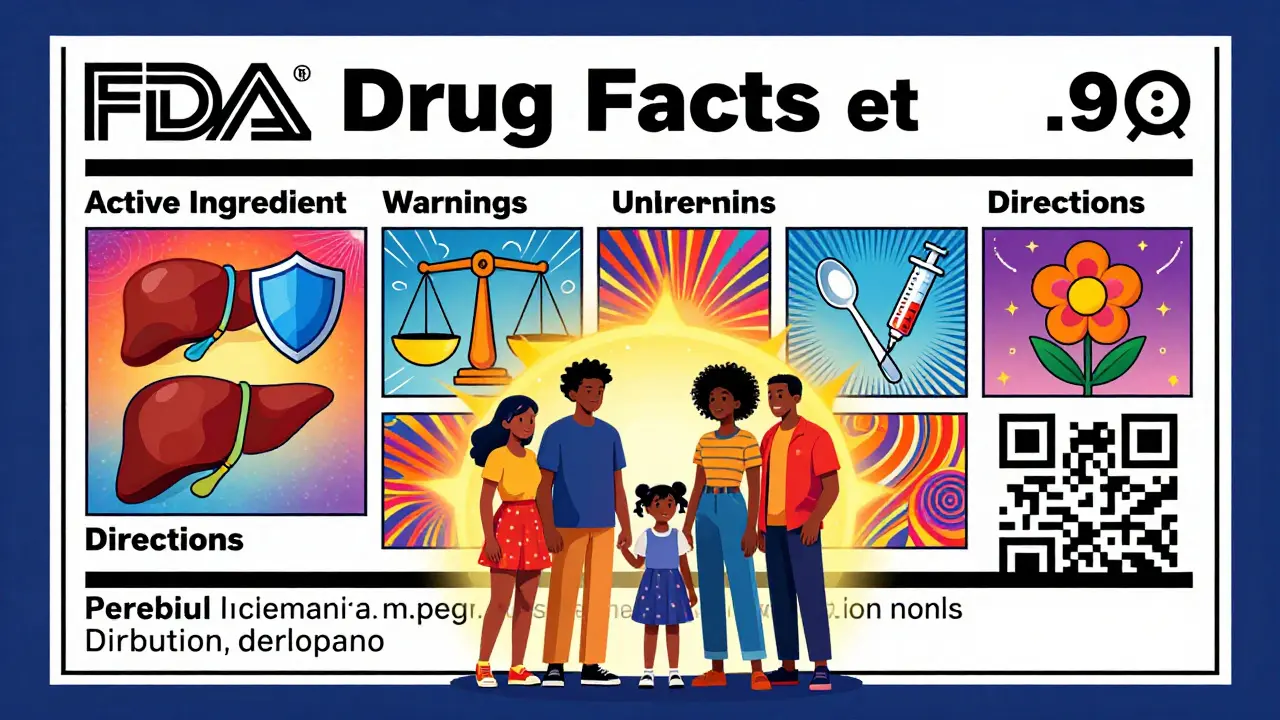
Every over-the-counter children’s medicine in the U.S. has a Drug Facts label. It’s required by the FDA and follows the same format no matter the brand. Here’s what each section really means:
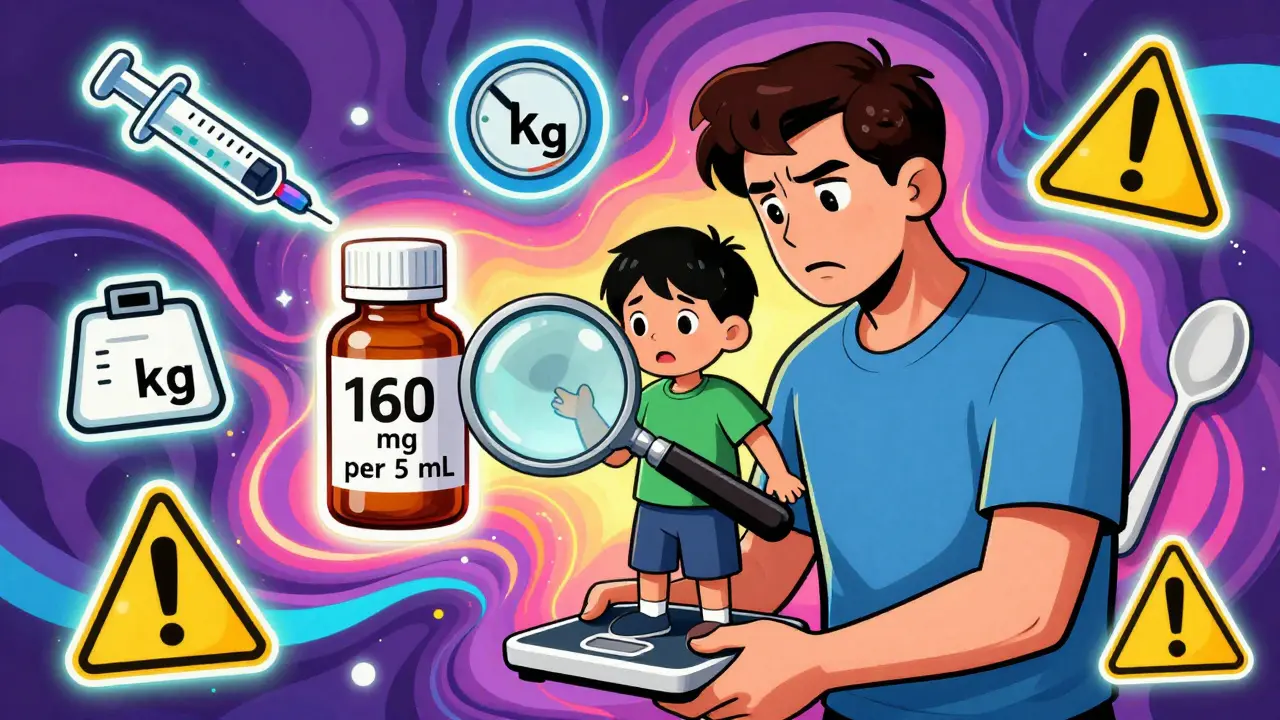
- Active Ingredient: This is the medicine itself - like acetaminophen or ibuprofen. Look for the concentration: "160 mg per 5 mL". This tells you how strong it is. Never assume all liquid medicines are the same.
- Uses: What the medicine treats - fever, pain, cold symptoms. Don’t use it for something not listed.
- Warnings: This is critical. It tells you when NOT to give it - like "Do not use in children under 2 years" or "Call a doctor if fever lasts more than 3 days." It also warns about overdose signs: nausea, vomiting, drowsiness, or yellow skin (signs of liver damage from too much acetaminophen).
- Directions: This is your dosing guide. It lists doses by age AND weight. Always check both. If weight is listed, use it. If not, use age - but get a scale.
- Inactive Ingredients: These are fillers, flavors, dyes. Important if your child has allergies - like to red dye #40 or high-fructose corn syrup.
- Purpose: Just repeats what the medicine does - "pain reliever/fever reducer." Useful for double-checking.
- Other Information: Storage tips. Keep medicines out of heat and light. Don’t store in the bathroom.
Prescription labels add more: your child’s name, the doctor’s name, the pharmacy’s phone number, and how often to give it - like "Take 5 mL every 6 hours." Always compare the prescription label to the OTC label if you’re switching.
Weight Is King - Age Is Just a Backup
Doctors and pharmacists don’t use age as the main guide. They use weight. Why? Because kids grow at different rates. Two 4-year-olds can weigh 15 kg and 22 kg. Giving them the same dose? One gets too little. The other gets too much.
A 2021 study from Penn State found that using weight instead of age cuts dosing errors by almost 38%. The American Academy of Pediatrics says weight-based dosing is the gold standard. For acetaminophen, the right dose is 10-15 mg per kg of body weight, every 4-6 hours. For ibuprofen, it’s 5-10 mg per kg, every 6-8 hours.
Here’s how to find your child’s weight in kilograms:
- Step on a scale with your child. Write down the total weight in pounds.
- Divide that number by 2.2. That’s their weight in kg.
Example: Your child weighs 44 pounds. 44 ÷ 2.2 = 20 kg. So for acetaminophen (160 mg/5 mL), you’d give 200-300 mg total. That’s 6.25-9.375 mL. Round to the nearest 0.5 mL on your syringe.
Don’t guess. Don’t wing it. If you don’t have a scale, ask your pediatrician or pharmacist to weigh your child. Most clinics do it for free.
Never Use Kitchen Spoons - Ever
"Just a teaspoon" sounds harmless. But a kitchen teaspoon holds anywhere from 3 to 7 mL. A tablespoon? It can be 10-20 mL. The label says "5 mL." That’s one measuring spoon - not your regular spoon.
The FDA says 68% of dosing errors happen because parents use spoons. A 2023 study in Pediatrics showed that using an oral syringe reduces errors by more than 40% compared to cups, and over 57% compared to spoons.
Here’s what to use instead:
- Oral syringe (with 0.1 mL or 0.5 mL marks)
- Dosing cup that came with the medicine
- Medicine dropper (for babies)
Always hold the syringe at eye level. Look at the bottom of the liquid curve - the meniscus. Looking from above or below adds up to 23% error. That’s the difference between a safe dose and a dangerous one.
Concentration Confusion - The #1 Mistake
One of the most dangerous mix-ups? Thinking all liquid acetaminophen is the same. Ten years ago, infant drops were 80 mg per 1 mL. Children’s liquid was 160 mg per 5 mL. Parents confused them. They gave 5 mL of infant drops thinking it was children’s - and overdosed by 300%.
That’s why the FDA changed the rules in 2011. Now, all children’s acetaminophen is 160 mg per 5 mL. Infant drops are gone. If you still have old bottles, throw them out. Check the label: if it says "80 mg per 1 mL," it’s outdated and unsafe.
Same goes for ibuprofen. Some brands are 50 mg/mL, others are 100 mg/5 mL. Always check the concentration. Write it down. Compare it to the dosing chart. If it doesn’t match, call your pharmacist.
Abbreviations You Must Know
Medicine labels use shortcuts. If you don’t know them, you’ll misread the dose.
- mL = milliliter (1 teaspoon = 5 mL)
- mg = milligram (the amount of active drug)
- tsp or t = teaspoon (5 mL)
- tbsp or T = tablespoon (15 mL)
- BID = twice a day
- TID = three times a day
- QID = four times a day
- PRN = as needed
Confusing tsp and tbsp causes 16% of all pediatric dosing errors. One tablespoon = 3 teaspoons. If the label says "1 tsp" and you give "1 tbsp," you’ve given three times the dose. That’s an emergency.
When to Call the Doctor - And When to Call the Pharmacist
For children under 2 years old: Always talk to a doctor before giving any medicine. Their bodies process drugs differently. Liver and kidney function aren’t fully developed. Even a "safe" dose can be too much.
For older kids, call the pharmacist if:
- You’re unsure about the dose
- The label says "use with caution"
- Your child has asthma, liver disease, or allergies
- The medicine looks different from last time
Pharmacists are trained to explain labels. They’ll draw lines on your syringe. They’ll write the dose in big letters. They’ll show you the difference between concentrations. Use them. It’s free. And it’s safer than Googling.
What to Do Before You Give Any Medicine
Before you open the bottle, run through this checklist. It takes 30 seconds. It could save a life.
- Is this medicine for MY child? Check the name on the label.
- Is this the right medicine? Compare the active ingredient to what the doctor prescribed.
- Is the dose right for their weight? Use the weight chart, not the age chart.
- Am I using the right measuring tool? Syringe or dosing cup - never a spoon.
- Is it expired? Check the date. Old medicine doesn’t work well - and can be unsafe.
Write down the dose on your phone. Take a picture of the label. Say it out loud: "20 kg child, 160 mg/5 mL, 7.5 mL every 6 hours." Then give it. Double-check before you pour.
Free Tools That Actually Help
You don’t need to memorize everything. Use these trusted, free resources:
- HealthyChildren.org - The AAP’s parent site. Has interactive dosing charts for acetaminophen, ibuprofen, and more.
- FDA’s "Medicine: Play It Safe" Toolkit - Downloadable PDFs with visual guides.
- AAP Safe Dosage Calculator App - Input weight, pick medicine, get exact dose. Downloaded over 1.2 million times.
- CDC’s "Learn the Labels" Website - Interactive quiz to test your knowledge.
Bookmark them. Save them to your phone. Share them with grandparents, babysitters, and caregivers.
What’s Changing in 2026
By the end of 2024, the FDA required every children’s OTC medicine to show both age AND weight dosing on the label. If it doesn’t, it’s been pulled from shelves. That’s good news.
Now, pharmacies are testing smart bottle caps that record when medicine is taken. Some stores are putting QR codes on labels that link to video instructions. These tools help - but they don’t replace reading the label yourself.
The goal? No child should ever get the wrong dose because they didn’t understand a label. You can make that happen. Just take the time to read. Double-check. Ask questions. Your child’s safety depends on it.
Alexandra Enns 23.01.2026
Wow. So you're telling me we've been killing kids with kitchen spoons for decades because nobody bothered to read a label? I'm not even mad, I'm just disappointed. The FDA had to step in because American parents are too lazy to count to five. And don't even get me started on the fact that some of you still have 80mg/mL bottles lying around like they're vintage wine. Throw them out. Burn them. Make a bonfire and dance around it. This isn't rocket science.
Marie-Pier D. 23.01.2026
I just want to say thank you for this. 🙏 My sister-in-law gave my nephew ibuprofen with a spoon last month and I nearly had a heart attack. I printed this out and taped it to the fridge next to the medicine cabinet. Now my whole family knows: weight > age, syringe > spoon, and if you're not sure? CALL THE PHARMACIST. They don't bite. Promise. 💙
Himanshu Singh 23.01.2026
The real tragedy isn't the dosing errors-it's that we treat medicine like it's a recipe you eyeball. You wouldn't build a house without blueprints, but you'll give your child a drug based on a hunch? We need to stop romanticizing intuition when it comes to biology. Science isn't optional. It's the difference between healing and harm.
Jamie Hooper 23.01.2026
so like... i just use the cap that comes with it? is that bad? i mean it has lines right? i dont get why everyone is freaking out about spoons... like i just give it to my kid and they dont cry so its fine right? 🤷♂️
Husain Atther 23.01.2026
This is one of the most practical and well-structured guides I’ve read in years. The emphasis on weight-based dosing is not just correct-it’s essential. Many parents are unaware that pediatric pharmacology is not a one-size-fits-all discipline. The distinction between concentration and volume is critical. Thank you for clarifying this with precision and care.
Marlon Mentolaroc 23.01.2026
Okay but let’s be real-90% of these errors happen because moms are sleep-deprived and juggling three kids while the baby screams and the dog pukes. This guide is great, but it’s written like it assumes you have a PhD in pharmacology and a quiet house at 3 a.m. Real talk: give people the app, the QR code, the smart cap. Don’t blame them for being human.
Gina Beard 23.01.2026
Safety is not a checklist. It’s a mindset. And most people don’t have it.
Don Foster 23.01.2026
I read this whole thing and the only thing I learned is that the FDA is a bunch of overbearing bureaucrats who think we're all idiots. Why not just let parents use their judgment? I gave my kid Tylenol with a teaspoon for 5 years and he turned out fine. Also why is everyone obsessed with kg? Pounds are fine. Just use the chart on the bottle
Phil Maxwell 23.01.2026
I used to think I knew this stuff until I read this. Now I double-check every bottle before I give anything. Even if it’s the same medicine I’ve used before. Turns out I was using the wrong syringe. I didn’t even know the markings were different. Small things matter. Thanks for the reminder.
Juan Reibelo 23.01.2026
I just want to say: I printed this out. I laminated it. I put it in a plastic sleeve next to the medicine cabinet. I showed it to my mom, my sister, my babysitter, and my neighbor who watches my kids on Tuesdays. I even sent it to my brother-in-law in Ontario. Because if you're going to give a child medicine, you don't get to wing it. And if you're going to wing it, you don't get to be a parent. This is non-negotiable.
asa MNG 23.01.2026
OMG I JUST REALIZED I GAVE MY DAUGHTER IBUPROFEN WITH A KITCHEN SPOON LAST WEEK 😭 I THOUGHT IT WAS FINE BECAUSE SHE DIDNT CRY BUT NOW IM SCARED SHE MIGHT HAVE LIVER DAMAGE 😭😭😭 I JUST LOOKED AT THE BOTTLE AND IT SAYS 100MG/5ML BUT I THOUGHT IT WAS 50MG/5ML 😭 I NEED TO CALL THE PHARMACY BUT IM TOO SCARED TO TALK TO THEM 😭😭
Michael Camilleri 23.01.2026
People treat medicine like a game of chance. You roll the dice: age, spoon, guess, hope. But children aren’t lab rats. They’re not statistics. They’re not your next social media post. Every time you skip the weight, you’re betting their life on luck. And luck doesn’t care if you’re tired. Or busy. Or convinced you’re doing fine. You’re not. You’re just lucky so far. The label isn’t there to annoy you. It’s there to keep them alive.