
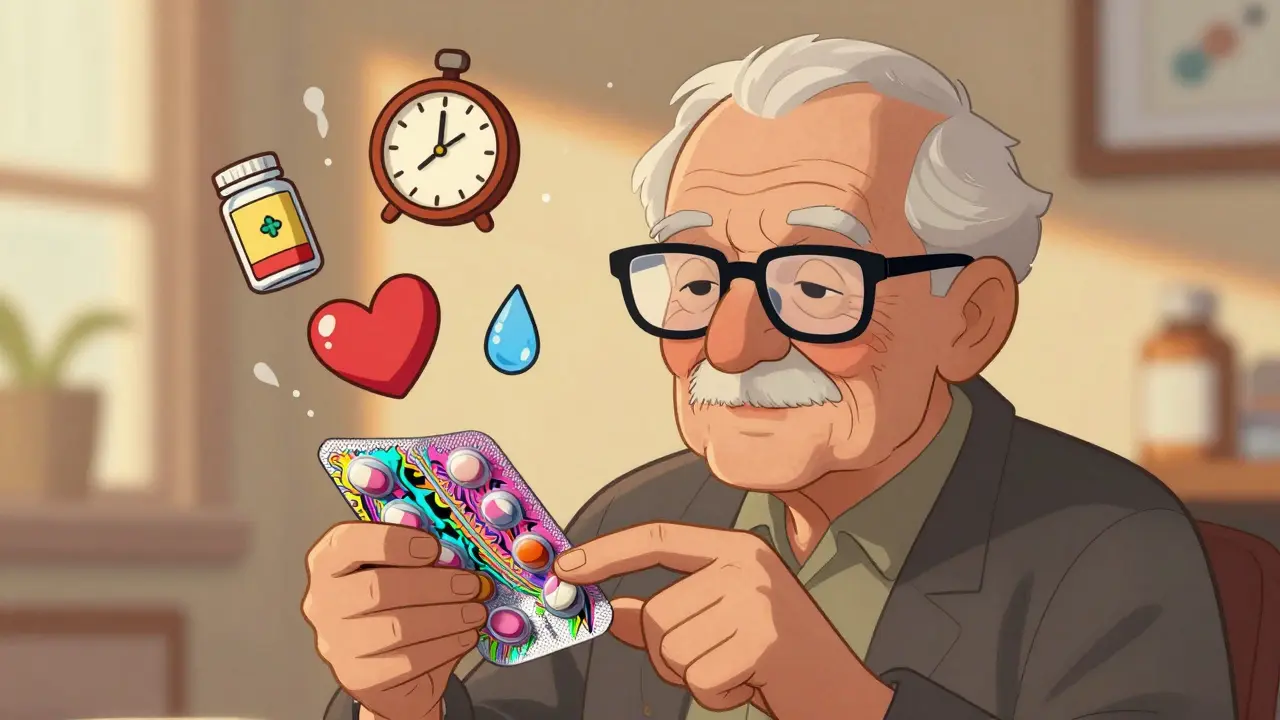
Managing multiple medications every day is one of the biggest challenges seniors face. For many, it’s not just about remembering to take pills-it’s about taking the right pill, at the right time, every single day. Missed doses, double doses, or mixing up medications can lead to hospital visits, dangerous side effects, or even preventable deaths. That’s where pill packs and blister packaging come in. These aren’t fancy gadgets or luxury add-ons. They’re practical, life-saving tools designed specifically for older adults who need help staying on track with their meds.
What Are Blister Packs and Pill Packs?
Blister packs and pill packs are both pre-sorted medication systems made by pharmacies. They look like small plastic trays with foil-covered compartments. Each compartment holds one dose-morning, afternoon, evening, or bedtime-and is labeled clearly with the day and time. You press through the foil to push the pill out. No counting. No sorting. No guessing.
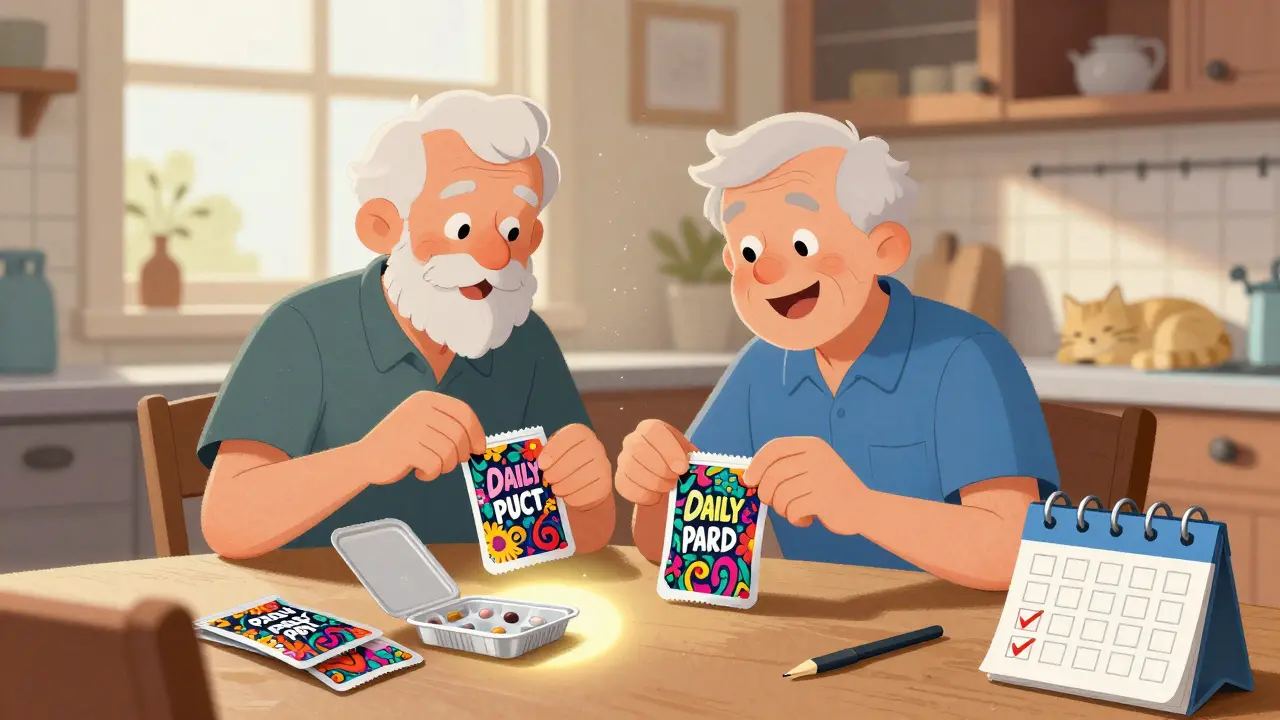
Blister packs are usually one full week in a single unit. Think of it like a calendar for your pills. Pill packs, sometimes called bubble packs or multi-dose pouches, are similar but come as separate daily pouches you can tear off. That small difference matters a lot when you’re traveling or just want to carry only today’s meds.
Both are made by pharmacists who check every medication for interactions, correct dosages, and duplicates. That’s a big deal. If you’re on five or more medications-which 39% of seniors over 65 are-there’s a high chance of dangerous overlaps. Pharmacists catch those before they reach you.
Why Do Seniors Need These Systems?
Half of all seniors miss at least one dose every week. That’s not laziness. It’s not forgetfulness. It’s a system failure. Traditional pill bottles are hard to open if you have arthritis. Labels are too small if your vision is fading. Bottles don’t show you if you’ve already taken your pill. You might shake one and hear nothing-was that yesterday’s dose or today’s?
Blister packs solve that. Each compartment is sealed. If it’s broken, you took it. If it’s still sealed, you didn’t. No doubt. No confusion. That visual cue alone cuts medication errors by nearly half, according to Langford Pharmacy’s 2023 data.
Seniors with memory issues, vision loss, or hand tremors benefit the most. One caregiver in Belfast reported her mother stopped calling her three times a day to ask if she’d taken her pills. The blister pack showed her-clearly-that she had. That peace of mind? Priceless.
Blister Packs vs. Pill Packs: Which Is Better?
It’s not about which is better-it’s about which fits your life.
Blister packs are ideal for home use. They’re sturdy, easy to read, and let you see your whole week at a glance. Most pharmacies make them in standard 6x4 inch trays with bold, high-contrast text. They’re perfect if you take the same meds every day and don’t travel often. But if your meds change mid-week-say, your doctor adds a new antibiotic-you’ll need to get a whole new pack. That takes 3 to 5 business days.
Pill packs are the travel-friendly version. Each day is its own pouch. You can grab just today’s, stick it in your pocket, and go. No carrying a whole week’s worth. That’s huge for trips to the doctor, visiting family, or weekend getaways. They’re also easier for people with weak grip strength to open-some find tearing a pouch easier than pressing through thick foil.
Here’s a quick comparison:
| Feature | Blister Packs | Pill Packs |
|---|---|---|
| Structure | One-piece weekly tray | Separate daily pouches |
| Travel-Friendly | No-carry the whole week | Yes-take just today’s |
| Mid-Week Changes | Requires new pack | Easy to swap out one day |
| Visibility of Missed Doses | Clear-sealed vs. opened | Clear-pouches still intact |
| Opening Difficulty | Hard for some with arthritis | Easier-peel or tear |
| Spill Risk | 68% lower than bottles | 68% lower than bottles |
How to Use Them-Step by Step
Using these systems is simple. Most seniors get the hang of it in just two or three days.
- Get it from your pharmacy. Ask your pharmacist about blister or pill packaging. Most offer it for free or for a small weekly fee-around $5 in Canada, often included in dispensing fees in the U.S.
- Review the pack. When you get it, sit down with a family member or caregiver. Go through each day and time. Make sure the pills match what your doctor prescribed.
- Press through the foil. Place your thumb or finger firmly on the foil backing of the compartment. Push straight through until the pill drops into your hand. Don’t poke or rip the foil-just press.
- Take the pill. Swallow it with water. Then, look at the compartment. If it’s empty, you’re good. If it’s still full, you missed it.
- Don’t skip refills. Blister packs take 3-5 days to prepare. Set a reminder to call your pharmacy a week before you run out.
That’s it. No apps. No alarms. Just a clear, visual system that works even if you forget your phone or can’t read the small print on a bottle.
Who Benefits the Most?
These systems aren’t for everyone-but they’re perfect for:
- Seniors taking 5 or more daily medications
- People with memory problems or early dementia
- Those with arthritis or weak hands
- Individuals who’ve had a hospital stay due to medication errors
- Caregivers who feel overwhelmed by medication reminders
Research from the PMC 8782488 study found that older adults averaging 78.4 years old found these systems easy to use and preferred them over traditional bottles. Users reported less anxiety, fewer mistakes, and more confidence.
One study showed medication-related hospitalizations dropped by 27% in facilities that switched to blister packaging. That’s not just about convenience-it’s about saving lives.

What About Smart Blister Packs?
Technology is catching up. Some newer blister packs now have tiny sensors that track when each compartment is opened. If you miss a dose, a signal goes to your caregiver or pharmacist. These are still rare and expensive, but industry analysts predict 45% of senior medication packaging will include digital monitoring by 2028.
For now, the basic foil-and-plastic version works just fine. You don’t need tech to get results. You just need clarity.
Common Problems and How to Fix Them
Even great systems have hiccups.
Problem: I can’t push the pills through the foil.
Solution: Use a pill opener tool-many pharmacies give them for free. Or try using the edge of a spoon. A little leverage helps. If you still struggle, ask your pharmacist about pill packs instead-they’re easier to tear open.
Problem: My meds changed, but my pack is already made.
Solution: Call your pharmacy right away. You’ll need a new pack. That’s why it’s important to give them 3-5 days’ notice before refills. Plan ahead.
Problem: My pharmacy doesn’t offer this.
Solution: Only 62% of rural pharmacies offer blister packaging, compared to 89% in cities. Ask if they can order it from a partner pharmacy. Some mail-order pharmacies offer it too. Medicare Part D is starting to cover it as part of medication therapy management-ask your plan.
Final Thoughts
Medication management for seniors shouldn’t be a puzzle. It shouldn’t require memory tricks, sticky notes, or constant caregiver checks. Blister packs and pill packs turn a chaotic, high-risk task into a simple, visual routine. They don’t cure illness. But they give seniors back control. They reduce fear. They let people live independently longer.
If you or a loved one is struggling with meds, talk to your pharmacist. Don’t wait for a mistake to happen. Ask about blister or pill packaging today. It’s one of the simplest, most effective ways to stay safe-and stay well.
Are blister packs covered by insurance?
Many Medicare Part D plans now cover blister packaging as part of medication therapy management services. Some private insurers do too. Ask your pharmacy-they can check your plan. In many cases, there’s no extra charge beyond your regular copay.
Can I make my own pill pack at home?
It’s not recommended. Pharmacies review your full list of medications for dangerous interactions. A home organizer can’t do that. You might accidentally mix blood thinners with NSAIDs, or take too much of a sedative. The pharmacist’s verification reduces drug interaction risks by 37%-something you can’t replicate at home.
How long does it take to get a blister pack?
Most pharmacies need 3 to 5 business days to prepare a blister pack. They have to sort, verify, label, and package each medication by hand. Plan ahead-don’t wait until you’re out of pills to request one.
Do blister packs work for people with dementia?
Yes. The visual design-clear labels, sealed compartments, and obvious missed doses-helps people with memory loss stay on track. Many long-term care facilities use them because they reduce confusion. Caregivers report fewer calls and less stress when the system does the tracking.
What if I only need help with a few pills?
You don’t need to package all your meds. Talk to your pharmacist. You can choose to package only the ones you struggle with-say, your blood pressure or diabetes pills. Even one or two key medications can make a big difference in safety and adherence.
Robert Way 14.01.2026
i just use a pillbox from walmart and it works fine why do we need to pay 5 bucks a week for this lol
TooAfraid ToSay 14.01.2026
oh so now pharmacies are the new priests handing out holy pills? next they'll be blessing our toothpaste and telling us when to sneeze. this is just corporate control dressed up as care.
Dylan Livingston 14.01.2026
How quaint. A system that reduces medication errors by nearly half is now a 'luxury add-on'? I suppose the 37% reduction in drug interactions is just a statistical mirage, like the idea that seniors deserve dignity in their healthcare. Truly, the only thing more tragic than forgetting your pills is the delusion that this system is somehow 'too simple' to matter.
And let's not pretend this isn't a class issue-people who can't afford to ask their pharmacist for help are the ones getting left behind. The fact that rural pharmacies offer this at half the rate? That's not inefficiency. That's neglect dressed in a white coat.
And don't even get me started on the 'DIY pill organizer' crowd. You think your Tupperware with sticky notes and a Sharpie is safer than a pharmacist who cross-references your entire med list? That's not independence-that's a death sentence with a side of pride.
says haze 14.01.2026
It’s interesting how we’ve reduced human complexity to a visual cue-sealed compartment = good, broken foil = bad. But what about the person who doesn’t care? Or the one who doesn’t trust the system? The blister pack doesn’t solve the loneliness, the despair, the belief that they’re a burden. It just gives them a better way to die quietly.
We’ve outsourced responsibility to plastic and foil. We’ve turned medication adherence into a puzzle game. And we call it progress. But real care? Real care means someone sitting with them, holding their hand, asking if they’re okay. Not just checking a box.
Andrew Freeman 14.01.2026
why do they make it so hard to pop the pills out like its a military bunker i mean come on
Jason Yan 14.01.2026
I’ve seen this work wonders with my grandma. She was mixing up her blood pressure meds and insulin-terrifying stuff. After switching to blister packs, she stopped calling me three times a day asking if she took her pills. Now she just points to the tray. It’s like she got her independence back. No apps, no alarms, just clear, simple visuals. It’s not high-tech, but it’s high-touch in the best way.
And honestly? The cost is nothing compared to a hospital visit. One ER trip costs more than a year of blister packs. Why are we still arguing about this? This isn’t a luxury-it’s basic safety.
shiv singh 14.01.2026
you think this is helping? this is just another way to make seniors dependent on systems they didn’t ask for. they used to manage their own lives. now they need plastic trays and pharmacy approval just to breathe. this is cultural decay.
Sarah Triphahn 14.01.2026
Let’s be real. This only works if you’re literate, have steady hands, and live near a pharmacy that actually cares. Most seniors I know can’t read the labels, their fingers shake, and their pharmacy charges $20 just to look at them funny. This isn’t a solution-it’s a marketing brochure for people who’ve never met a real elderly person.
Vicky Zhang 14.01.2026
My aunt used this system for three years. She went from being terrified to take anything to confidently saying, 'I got this.' She even started helping her neighbors set up their packs. It gave her purpose. It gave her dignity. This isn’t about convenience-it’s about giving people back their sense of control when everything else is slipping away.
And yes, it’s cheap. And yes, it’s simple. And that’s why it works. You don’t need AI to save a life. You just need clarity.
Allison Deming 14.01.2026
While the utility of blister packaging is undeniable, one must consider the broader sociopolitical context: the commodification of elder care under a profit-driven healthcare system. The fact that this intervention is not universally accessible speaks volumes about the structural inequities embedded in our medical infrastructure. One cannot celebrate a Band-Aid solution while the wound continues to fester.
Susie Deer 14.01.2026
we don't need this in america. we have the best healthcare in the world. this is just europe-style nanny state nonsense
Alvin Bregman 14.01.2026
i think its good but i worry about the foil tearing too easy and pills falling out like in that one video i saw on tiktok
Sarah -Jane Vincent 14.01.2026
you know who’s behind this? Big Pharma. They want you dependent on these packs so they can charge more. The sensors? They’re tracking you. Your data’s being sold. This isn’t safety-it’s surveillance disguised as care. Wake up.
Henry Sy 14.01.2026
my uncle took one look at his blister pack and said 'this looks like a prison meal tray' and threw it in the trash. then he took his meds in a coffee cup with a spoon. he’s 89. he’s still alive. sometimes the dumbest way is the right way.
Anna Hunger 14.01.2026
While the efficacy of blister packaging in reducing medication errors is statistically significant, one must acknowledge the ethical imperative to ensure equitable access. The systemic disparity in rural pharmacy availability, as referenced in the post, constitutes a failure of public health policy, not a gap in individual responsibility. This intervention must be institutionalized, not commodified.