
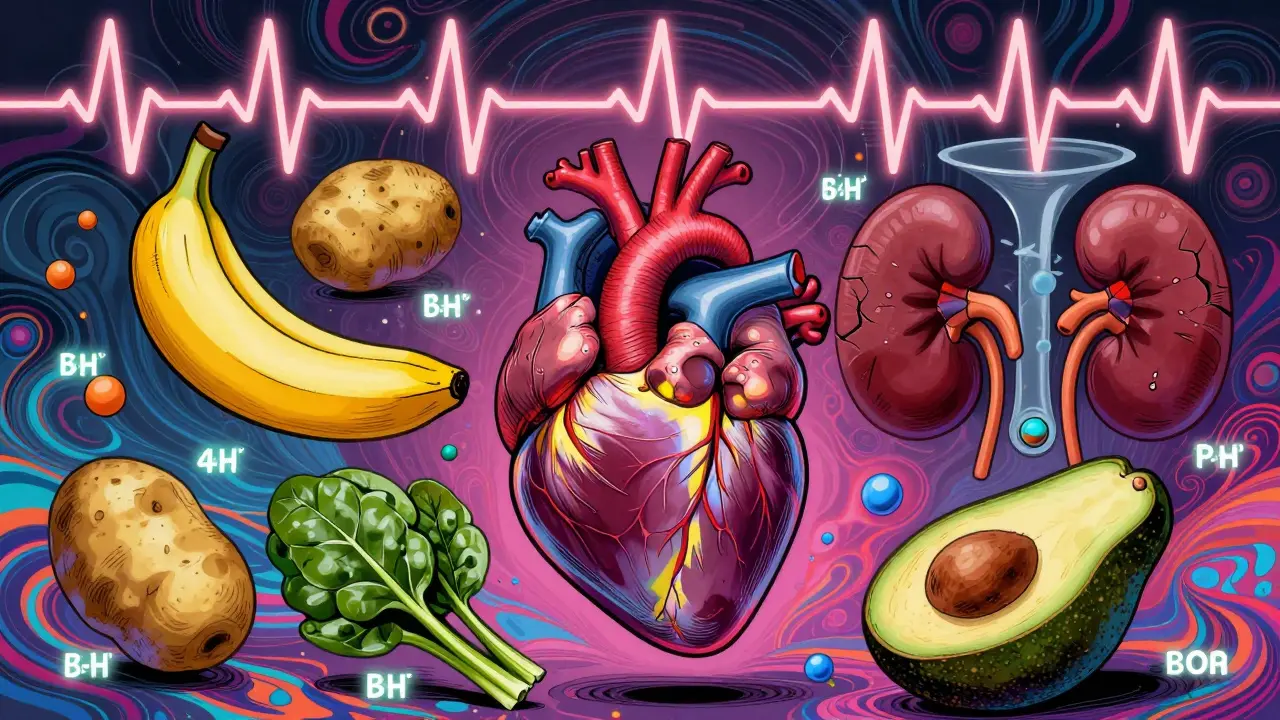
When your kidneys aren't working well, even foods you love can become dangerous. For people with chronic kidney disease (CKD), too much potassium in the blood-called hyperkalemia-can stop your heart. It’s not rare: up to half of those with advanced CKD have it. And it’s not just about avoiding bananas. This is a life-or-death balancing act between protecting your heart and keeping your kidneys stable with essential medications.
Why Hyperkalemia Is So Dangerous in CKD
Your kidneys normally flush out extra potassium. But when kidney function drops below 30% (eGFR <30 mL/min), that system breaks down. Potassium builds up. At levels above 5.0 mmol/L, you’re in danger. At 6.0 mmol/L or higher, your heart rhythm can go haywire. You might feel nothing at first-no pain, no warning. Then, your ECG shows peaked T-waves. Soon after, your QRS complex widens. And then? Cardiac arrest.What’s the Safe Potassium Level?
Doctors now aim for 4.0-4.5 mmol/L, not just below 5.0. Why? Because even mild elevations raise your risk of dying from heart problems. Studies show every 0.5 mmol/L increase above 5.0 mmol/L pushes your death risk up by 18%. That’s why guidelines now say: treat it early, don’t wait for symptoms.Dietary Limits: What You Can and Can’t Eat
Diet is the first line of defense. But it’s not one-size-fits-all.- Stages 1-3a CKD: Keep it sensible. No need to cut out everything. Avoid excessive fruit juices, dried fruit, and salt substitutes.
- Stages 3b-5 (not on dialysis): Stick to 2,000-3,000 mg per day. That’s about half what a healthy person eats.
- Bananas: 422 mg per 100g
- Oranges: 181 mg per 100g
- Potatoes: 421 mg per 100g
- Spinach, tomatoes, avocados, beans, nuts, dairy-all high

Emergency Treatment: What Happens When Potassium Spikes
If your potassium hits 5.5 mmol/L or higher-and especially if your ECG shows changes-you need fast action.- Calcium gluconate (10 mL IV): This doesn’t lower potassium. It protects your heart muscle from the chaos. Works in 1-3 minutes. Lasts about an hour. Used when ECG changes are present.
- Insulin + glucose (10 units insulin + 50 mL of 50% dextrose): This shoves potassium into your cells. Lowers levels by 0.5-1.5 mmol/L in 15-30 minutes. But watch out-10-15% of patients get dangerously low blood sugar. Always give glucose with it.
- Sodium bicarbonate (50-100 mmol IV): Only if you’re acidotic (HCO3 <22). Helps shift potassium into cells. Works in 5-10 minutes.
Chronic Management: The New Generation of Potassium Binders
For years, the only option was sodium polystyrene sulfonate (SPS)-a powder you took orally. It worked poorly and could cause serious colon damage. Today, two better options exist.- Sodium zirconium cyclosilicate (SZC, brand Lokelma): Starts working in under an hour. Lowers potassium by 1.0-1.4 mmol/L quickly. But it adds sodium-about 1.2 grams per day. That’s a problem if you have heart failure or swelling.
- Patiromer (brand Veltassa): Slower. Takes 4-8 hours to work. But it’s sodium-free. Better for heart failure patients. Side effects? Constipation in 14% and low magnesium in 19%.
Why You Can’t Just Stop Your Kidney Medications
Many patients get scared when their potassium rises. They stop taking ACE inhibitors, ARBs, or MRAs-medications that protect kidneys and hearts. Big mistake. Data shows: Stopping these drugs increases your risk of heart attack by 28% and kidney failure by 34%. These drugs save lives. The goal isn’t to stop them-it’s to manage potassium so you can keep taking them. One clinic in Boston raised RAASi continuation from 52% to 81% just by checking potassium every 3 months and acting fast. That’s the power of routine monitoring.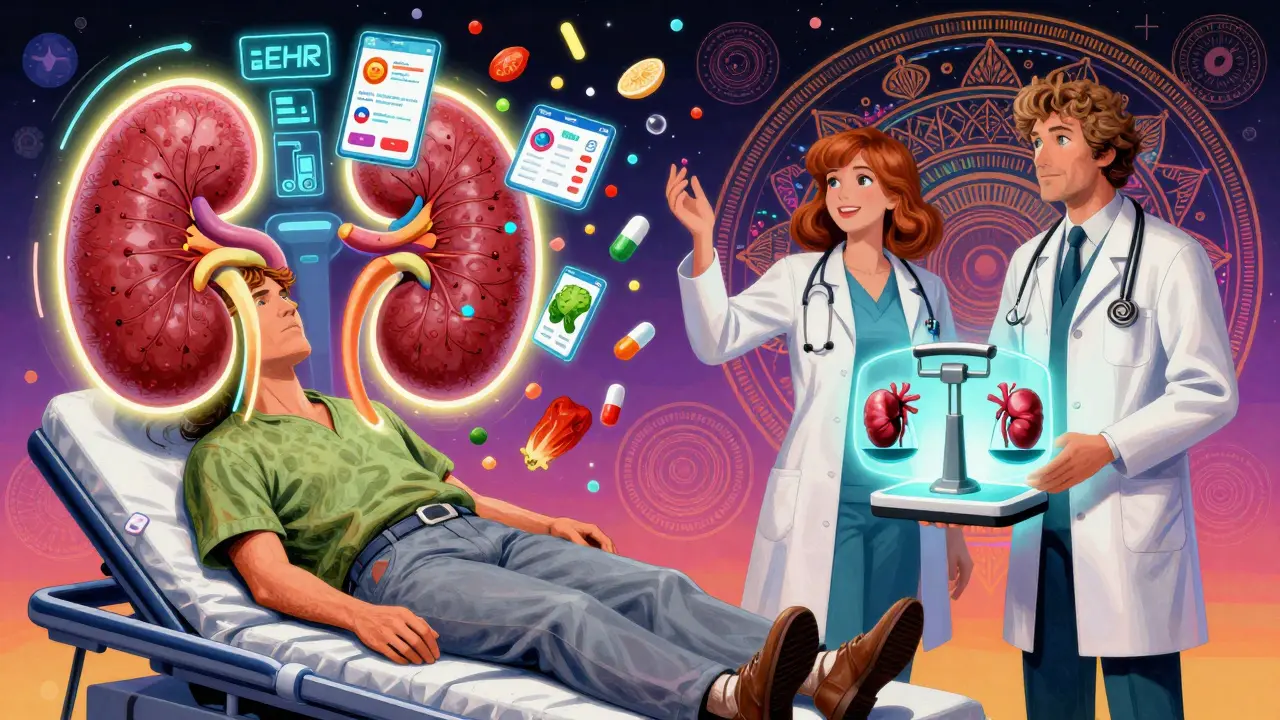
Real Problems with Treatment
Even with better drugs, things get messy.- Cost: SPS costs $47 a month. Patiromer? $635. Many patients can’t afford it. Some skip doses. Others stop entirely.
- Taste and texture: Patiromer is chalky. One study found 22% of patients quit because they couldn’t stomach it.
- Drug interactions: Patiromer can block thyroid medicine (levothyroxine) if taken too close together. You need to space them 3 hours apart.
- Diet adherence: Only 37% of patients stick to low-potassium diets long-term. Social events, family meals, convenience foods-they all get in the way. One survey found 45% of CKD patients felt isolated because of their diet.
What Works Best in Real Life?
The best approach combines three things:- Diet: Work with a renal dietitian. Learn to boil, rinse, and portion. Use apps that scan barcodes and show potassium content.
- Monitoring: Check potassium every 3 months if stable. Check within 1-2 weeks after starting or changing RAASi meds.
- Binders: Use the right one for the situation. SZC for acute spikes. Patiromer for daily control. Avoid SPS unless cost forces your hand.
The Future: Precision and Tech
New tools are coming. Trials are testing urine potassium tests to personalize diet plans-no more guessing. Apps that track food intake in real time are showing 32% better diet adherence in early tests. By 2027, experts predict 75% of CKD patients on heart-protective drugs will also be on potassium binders. That’s the new standard. It’s not about fear. It’s about control.Hyperkalemia isn’t a reason to give up your meds. It’s a signal to get smarter about your care. With the right tools, you don’t have to choose between a healthy heart and a healthy kidney. You can have both.
What is hyperkalemia in chronic kidney disease?
Hyperkalemia in chronic kidney disease (CKD) means your blood potassium level is too high-usually above 5.0 mmol/L-because your kidneys can’t remove it. This is common in advanced CKD and can cause dangerous heart rhythms or even cardiac arrest if not treated.
How much potassium should I eat if I have CKD?
If you have mild-to-moderate CKD (stages 1-3a), aim for a balanced diet without excessive high-potassium foods. If you have advanced CKD (stages 3b-5, not on dialysis), limit intake to 2,000-3,000 mg per day. That’s about 51-77 mmol daily. Work with a renal dietitian to personalize this.
What foods should I avoid with high potassium?
Avoid or limit bananas (422 mg/100g), oranges (181 mg/100g), potatoes (421 mg/100g), spinach, tomatoes, avocados, beans, nuts, dairy products, salt substitutes, and dried fruit. Boiling vegetables and discarding the water can reduce potassium by up to 50%.
What are the emergency treatments for high potassium?
If potassium is ≥5.5 mmol/L with ECG changes, emergency treatment includes: calcium gluconate IV to protect the heart, insulin with glucose to move potassium into cells, and sodium bicarbonate if you’re acidotic. These work fast but don’t remove potassium from your body-they buy time for longer-term treatments.
Are potassium binders safe long-term?
Patiromer and sodium zirconium cyclosilicate (SZC) are approved for long-term use and are much safer than older binders like SPS, which can cause colon damage. Patiromer may cause constipation or low magnesium; SZC can increase sodium retention. Both are well-tolerated with monitoring. Long-term safety beyond 12 months is still being studied, but current data supports their use.
Can I stop my blood pressure meds if my potassium is high?
No. Stopping ACE inhibitors, ARBs, or MRAs increases your risk of heart attack by 28% and kidney failure by 34%. These drugs protect your heart and kidneys. Instead of stopping them, use potassium binders and diet changes to manage high potassium so you can keep taking them safely.
How often should I check my potassium levels?
Check within 1-2 weeks after starting or changing kidney-protective medications like ACE inhibitors. If stable, check every 3-6 months. If you have symptoms like muscle weakness, palpitations, or irregular heartbeat, check immediately.
What’s the difference between patiromer and SZC?
Patiromer works slowly (4-8 hours), is sodium-free, and is better for long-term use, especially in heart failure. SZC works faster (within 1 hour), making it better for emergencies, but adds sodium, which can worsen swelling. Patiromer causes constipation; SZC may cause edema. Choose based on your situation and other health conditions.
ryan Sifontes 28.01.2026
they say avoid bananas but i ate one last week and my heart did a little dance. who even knows what's real anymore
Eli In 28.01.2026
this is so important 🙏 i have a cousin with CKD and we switched to low-potato meals. she’s been stable for 8 months now! 🌱❤️
Megan Brooks 28.01.2026
The physiological implications of potassium homeostasis in renal insufficiency are profoundly complex. It is imperative that patients be educated not merely on food avoidance, but on the nuanced interplay between pharmacologic agents and dietary intake.
Ryan Pagan 28.01.2026
Look, if you’re on ACEi or ARBs and still chowing down on spinach smoothies and avocado toast like it’s a yoga retreat, you’re basically playing Russian roulette with your left ventricle. Potassium doesn’t care if you ‘feel fine’ - your heart’s got a deadline.
Paul Adler 28.01.2026
I appreciate how this post highlights the tension between medication necessity and dietary restriction. Many patients are left in limbo without clear guidance - this kind of clarity matters.
Kristie Horst 28.01.2026
Oh wow. So we’re supposed to just... stop eating *everything* that tastes good? Brilliant. Next you’ll tell me oxygen is dangerous if you have COPD.
Laia Freeman 28.01.2026
OMG YES!! I was eating 3 bananas a day and my legs were cramping like crazy!! Then my nephrologist was like ‘YOU’RE A TIKTOKER NOT A BANANA’ and i switched to apples and cabbage and my potassium dropped like it owed me money 💪🍎
rajaneesh s rajan 28.01.2026
In India, we use soaked and boiled vegetables to reduce potassium. Also, no one here eats avocado - too expensive and too weird. Simple solutions exist if you stop treating this like a sci-fi thriller.
kabir das 28.01.2026
I bet the pharmaceutical companies are behind this... they don’t want you eating natural foods... they want you on pills... they’re poisoning the water supply too... I know things...
Keith Oliver 28.01.2026
You missed the point entirely. The real issue is that most doctors don’t even check potassium levels until the patient is in cardiac arrest. It’s not about diet - it’s about systemic negligence. You think bananas are the problem? Try the healthcare system.
Kacey Yates 28.01.2026
I had a potassium level of 6.8 last year. They rushed me to ER. I didn't even know i was eating too much spinach. Now i use a potassium tracker app. Life saver.
Laura Arnal 28.01.2026
You got this! 💕 Small changes add up - swap that sweet potato for white rice, try leaching veggies, and keep your med schedule tight. You’re not alone in this fight!