
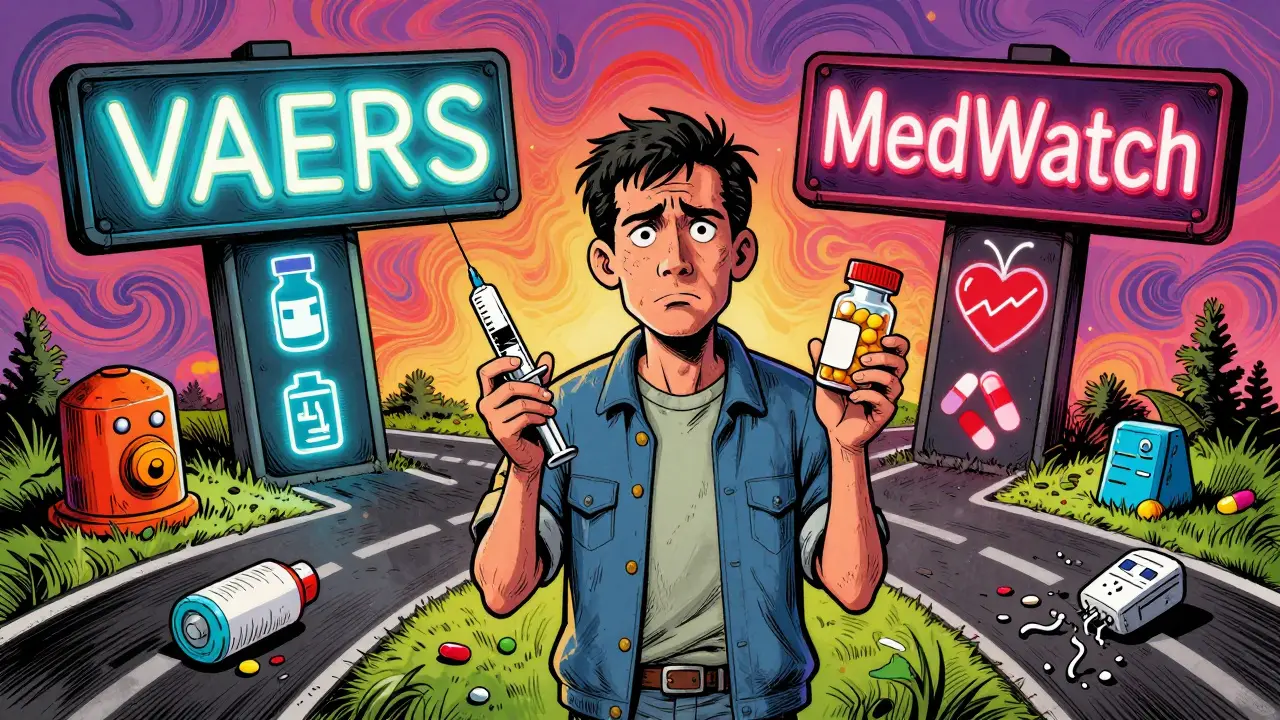
Vaccine & Drug Reporting System Selector
Which System Should You Use?
This tool helps you determine whether to report a side effect to VAERS (vaccines) or MedWatch (drugs, devices, supplements).
Please select product type and provide details to see your result.
Every year, millions of people take prescription drugs or get vaccinated. Most do fine. But some don’t. When something goes wrong, who do you tell? And does it even matter which system you use?
If you report a bad reaction to a vaccine on MedWatch, it won’t get where it needs to go. If you send a drug side effect to VAERS, it might get lost. These aren’t just two forms with different names-they’re two completely separate systems with different rules, different goals, and different consequences if you use them wrong.
What is VAERS, and why does it exist?
VAERS stands for Vaccine Adverse Event Reporting System. It’s run jointly by the CDC and FDA. Its only job: track problems that happen after someone gets a vaccine.
It doesn’t prove vaccines caused the problem. It doesn’t need to. Its purpose is to catch patterns. If 50 people report severe headaches after getting the same flu shot from the same batch, that’s a red flag. That’s when scientists dig deeper-using other systems like the Vaccine Safety Datalink-to see if there’s a real connection.
Anyone can file a VAERS report. Parents. Teachers. Nurses. You. You don’t need to be a doctor. You don’t even need to be sure the vaccine caused it. If something unusual happened after a shot, report it. That’s the whole point.
VAERS collects details like: what vaccine was given, what lot number, when the reaction started, what symptoms appeared, and whether the person was hospitalized or had a life-threatening event. Serious events-like death, paralysis, or long-term disability-are flagged for follow-up. Sometimes, VAERS staff will call the doctor for medical records.
But here’s the hard truth: VAERS misses most reactions. Studies show less than 1% of vaccine side effects are ever reported. Why? Because people don’t know about it. Because they think it’s not serious enough. Because they assume someone else already reported it.
And that’s okay. VAERS isn’t meant to be perfect. It’s meant to be fast. It’s the early warning system. Like a smoke alarm. You don’t wait for the house to burn down before you check the alarm. You check it the moment you hear a beep.
What is MedWatch, and how is it different?
MedWatch is the FDA’s system for everything else: pills, patches, inhalers, medical devices, even over-the-counter drugs. If it’s not a vaccine, it goes here.
MedWatch handles reports of heart attacks from a new blood pressure drug. It tracks broken hip implants. It logs liver damage from a supplement sold as a "natural remedy." It’s the catch-all for non-vaccine medical products.
Unlike VAERS, MedWatch has mandatory reporting rules. Drug makers, device manufacturers, and hospitals must report serious adverse events to the FDA. If a patient dies after taking a prescription drug, the company has to file a report within 15 days. That’s not optional. That’s the law.
But the public can still report too. If you had a rash after taking a new antibiotic, or your insulin pump stopped working, you can file a MedWatch form online. You don’t need a prescription to report. You just need to know what product you were using and what happened.
MedWatch reports go to the right FDA center: drugs go to CDER, devices to CDRH, biologics to CBER. That’s important. A faulty defibrillator and a bad batch of metformin are handled by different teams with different expertise.
The big difference? VAERS is open to everyone and built for speed. MedWatch is more structured, with legal obligations on manufacturers, and designed for regulatory action-like issuing warnings, changing labels, or pulling products off the market.
Why you can’t mix them up
Here’s a real example: A woman gets the new RSV vaccine and develops Guillain-Barré syndrome two weeks later. She’s scared. She goes online and finds MedWatch. She fills out the form. It gets logged. But because it’s a vaccine, it’s not processed by the team that monitors vaccine safety.
Meanwhile, her doctor files the same event in VAERS. That report gets pulled into the CDC’s vaccine safety dashboard. Within days, analysts notice a spike in Guillain-Barré cases after this specific RSV vaccine. They compare it to past vaccines. They check the lot numbers. They call hospitals. They run statistical models. Within weeks, they find a small but real increased risk-enough to update the vaccine’s warning label.
If the woman had only used MedWatch, that signal might have been buried. The vaccine safety team doesn’t monitor MedWatch. They only look at VAERS.
Same thing in reverse: If someone has a bad reaction to a new cholesterol drug and reports it to VAERS, it won’t be seen by the drug safety team. It’ll sit there, ignored. The FDA won’t know about it. The drug won’t get flagged. Someone else could get hurt.
It’s not about who’s right or wrong. It’s about who’s listening. VAERS listens for vaccines. MedWatch listens for everything else. Mix them up, and the system breaks.
What gets reported to each system?
Let’s make this simple. Use this as your quick guide:
- Report to VAERS: Fever, fainting, swelling, allergic reaction, seizures, or any serious health issue after any vaccine-flu, COVID, shingles, HPV, tetanus, RSV, you name it.
- Report to MedWatch: Nausea from a new antidepressant, liver damage from a herbal supplement, a broken insulin pump, a faulty pacemaker, a drug interaction that caused a stroke, or a skin rash from a topical cream.
What about biologics? Like monoclonal antibodies? If it’s given as a shot to treat cancer or autoimmune disease, and it’s not a vaccine, it goes to MedWatch. If it’s a vaccine (like the flu shot made with recombinant DNA), it goes to VAERS.
And what about side effects from clinical trials? Those go to the sponsor, not VAERS or MedWatch. Those are handled under different rules.
One more thing: supplements. If you take a vitamin D pill and get a heart rhythm problem, report it to MedWatch. Supplements aren’t vaccines. They’re regulated as food, not drugs-but the FDA still needs to know when they cause harm.
What happens after you report?
After you file a report, you get a confirmation number. That’s it. You won’t get a call back. You won’t get a diagnosis. You won’t be told if your report made a difference.
That’s not because they don’t care. It’s because they can’t. VAERS and MedWatch don’t give medical advice. They don’t diagnose. They don’t treat. They collect data. That’s it.
But here’s what actually happens behind the scenes:
- A report comes in. It’s added to a database of millions.
- Software looks for clusters-same drug, same symptom, same time frame.
- If something unusual pops up, experts dig deeper.
- They cross-check with hospital records, insurance claims, or lab data.
- If the signal holds up, the FDA might issue a safety alert, update the label, or require more studies.
It’s slow. It’s messy. It’s not perfect. But it’s how we find out that a drug causes sudden cardiac death in young men, or that a new flu vaccine increases the risk of narcolepsy in teens. Those discoveries save lives.
Every report matters-even if you think it’s "just a headache." One report is noise. Ten thousand reports? That’s a pattern.
Common mistakes people make
People mess this up all the time. Here are the top three:
- Reporting vaccines to MedWatch. It’s the most common error. People see "FDA" and assume it’s one system. It’s not.
- Waiting to report. If you wait a month, you might forget details. Report it while it’s fresh.
- Thinking one report won’t matter. One report might not change anything. But 500 reports? That’s how we find out that a vaccine causes a rare nerve disorder. You might be the 487th person who reported it. Your report could be the one that triggers the investigation.
And here’s a myth that needs to die: "If I report this, I’ll get in trouble." No. You won’t. Reporting side effects is encouraged. It’s your civic duty. The FDA wants you to report. They need you to report.
How to report correctly
Here’s how to do it right:
- Is it a vaccine? If yes → go to VAERS.
- Is it a drug, device, or supplement? If yes → go to MedWatch.
- Write down the details: Product name, lot number (if available), date of use, symptoms, when they started, and whether you saw a doctor.
- Submit online. Both systems have simple forms. Takes 10 minutes.
- Keep a copy. Save the confirmation number. You might need it later.
Need help? Call VAERS at 1-800-822-7967. Call MedWatch at 1-800-FDA-1088. They’ll walk you through it.
Why this system still works
People think modern medicine is flawless. It’s not. Drugs fail. Devices break. Vaccines, while incredibly safe, aren’t perfect.
What keeps us safe isn’t the FDA’s approval process. It’s what happens after approval. That’s where MedWatch and VAERS come in.
They’re not flashy. They don’t make headlines. But they’re the quiet backbone of drug and vaccine safety. Every time a dangerous drug gets pulled, every time a vaccine warning gets added, every time a child is spared from a side effect because a doctor knew to check the label-it started with a report.
You don’t need to be a scientist. You don’t need to understand statistics. You just need to notice something strange-and speak up.
Because if you don’t, someone else might have to pay the price.
Travis Craw 15.01.2026
man i thought vaers and medwatch were the same thing till i read this. my cousin reported her rash from the new migraine pill on vaers and nothing happened. now i get why.
Bianca Leonhardt 15.01.2026
of course the government has two separate systems that no one understands. brilliant. just brilliant. you’d think they’d want people to report side effects, not confuse them into silence.
Christina Bilotti 15.01.2026
so let me get this straight - the FDA can’t even manage one form? wow. i’m shocked. totally shocked. next they’ll tell us ‘vaccines’ and ‘drugs’ are different categories. what a revelation. my PhD in bureaucratic inefficiency just got a new chapter.
Samyak Shertok 15.01.2026
ah yes, the classic ‘report it to the right place’ sermon. because clearly the problem isn’t that the system is designed to ignore you until it’s too late. you report, they archive, and then some kid in a cubicle in Maryland checks it when the lawsuit hits. nice.
Allen Davidson 15.01.2026
the real tragedy isn’t that people mix them up - it’s that the system expects laypeople to navigate bureaucratic silos just to report a life-threatening reaction. if you need a flowchart to report a side effect, the system is broken. not the user.
Ryan Hutchison 15.01.2026
if you’re not reporting to the right system, you’re not just being careless - you’re endangering your fellow americans. this isn’t a suggestion, it’s a patriotic duty. get it right or get out of the way.
Stephen Tulloch 15.01.2026
lol so medwatch is for drugs and vaers for vaccines… so if i get a rash from a biologic antibody infusion that’s technically a ‘drug’ but given like a vaccine… do i cry? or just pick one and hope for the best? 🤷♂️
evelyn wellding 15.01.2026
thank you for this!! i just reported my son’s fever after his flu shot to vaers and felt so useless before. now i know i did the right thing 😊💪
Joie Cregin 15.01.2026
i used to think these systems were just bureaucratic noise… but then my aunt had that weird reaction to her shingles shot and i spent three hours trying to figure out where to send it. turns out she was the 12th person that month to report it. two weeks later, the label changed. so yeah… i’m a believer now.
Corey Sawchuk 15.01.2026
my doc told me to report my bad reaction to the new blood thinner to medwatch but i accidentally used vaers. i didn’t even know it mattered till i read this. thanks for the clarity
Rob Deneke 15.01.2026
you don’t need to be a scientist to make a difference. just be the person who reports it. that’s enough
Melodie Lesesne 15.01.2026
i used to think reporting was pointless… but now i get it. it’s like leaving a note in a bottle. you don’t know who’ll find it, but someone might. and that’s enough to make you do it
john Mccoskey 15.01.2026
the entire framework is a performance of accountability. VAERS is a theater of data collection - a digital altar where citizens sacrifice their anecdotal suffering to the gods of bureaucracy. MedWatch is the same, but with more legal jargon and slightly better funding. Neither system is designed to heal. Both are designed to absolve. The FDA doesn’t need your report to prevent harm - they need it to prove they tried. And that’s the real tragedy. We’re not participants in safety. We’re props in a PR ritual.
vivek kumar 15.01.2026
as someone from india, i’ve seen how weak our reporting systems are. here in the us, even with these flaws, you still have a chance. don’t waste it. if you see something weird after a shot or pill - report it. even if you’re not sure. someone else might be the 487th person too.