
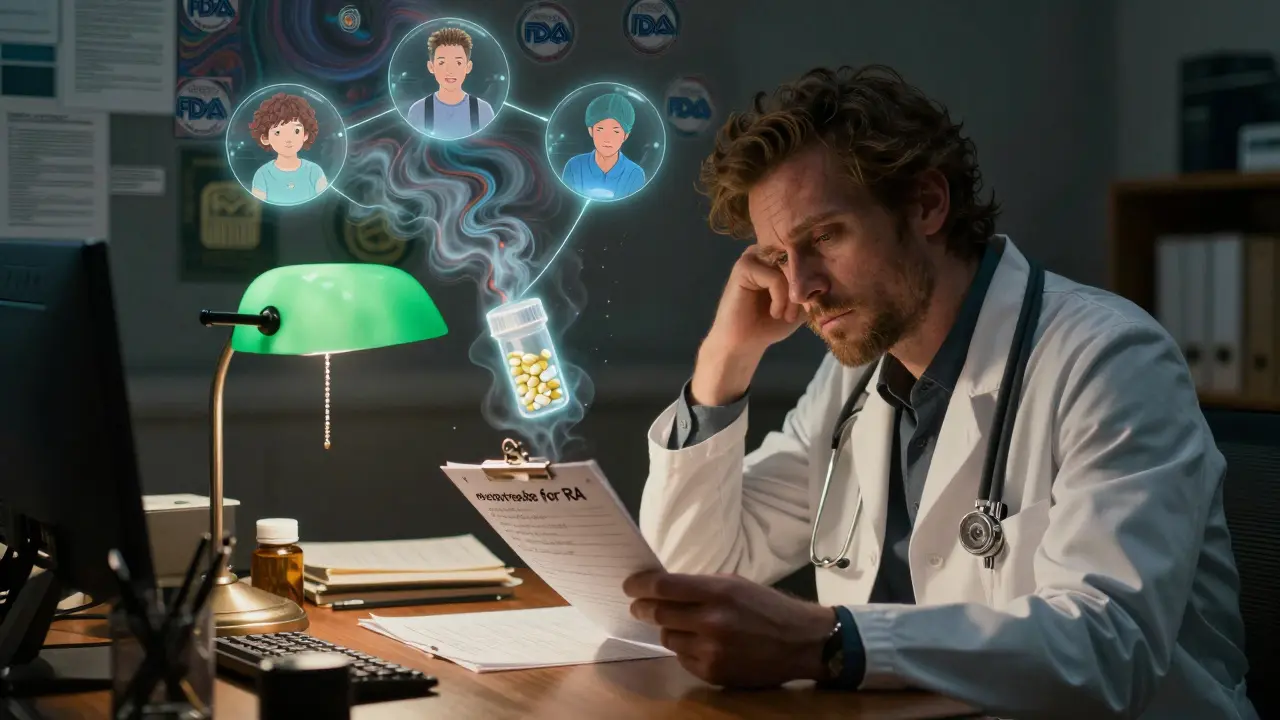
Off-Label Prescription Coverage Calculator
This calculator helps you understand if your doctor's off-label prescription is likely to be covered by insurance. Based on data from the article about off-label drug use, this tool analyzes coverage likelihood for different conditions and age groups.
Important Note:
Insurance coverage for off-label prescriptions depends on evidence quality. Most insurers require proof from recognized sources like NCCN guidelines, peer-reviewed studies, or similarity to FDA-approved uses.
Every year, millions of people in the U.S. take medications that weren’t originally approved for their condition. A child with autism gets an antipsychotic for irritability. A cancer patient receives a drug approved for lung cancer to treat a rare sarcoma. An adult with chronic insomnia is prescribed an antidepressant not labeled for sleep. These aren’t mistakes. They’re off-label drug use-and it’s more common than most people realize.
What Exactly Is Off-Label Drug Use?
Off-label drug use means prescribing a medication for a purpose, age group, dosage, or route that hasn’t been officially approved by the FDA. The drug itself is legal and approved-for something else. For example, fluoxetine (Prozac) is FDA-approved for depression and OCD, but doctors often prescribe it off-label for anxiety, PTSD, or even premature ejaculation. Methotrexate, originally for cancer and psoriasis, is now routinely used off-label for rheumatoid arthritis and other autoimmune diseases. The FDA approves drugs based on clinical trial data submitted by manufacturers. Those trials focus on specific conditions, populations, and doses. But once a drug is on the market, the FDA doesn’t control how doctors use it. That’s because the agency regulates drugs, not the practice of medicine. A 1996 court case in Ohio made this clear: off-label prescribing is a matter of medical judgment.How Common Is It?
About 1 in 5 prescriptions in the U.S. are off-label. That’s over 20% of all medications prescribed. But the numbers jump sharply in certain areas:- **Pediatrics**: 62% of prescriptions for children are off-label. Why? Only 20-30% of drugs have been tested and labeled for kids. Doctors have to guess doses and effects based on adult data.
- **Psychiatry**: 31% of prescriptions are off-label. Antidepressants, antipsychotics, and mood stabilizers are frequently used for conditions beyond their approved labels-like using quetiapine (Seroquel) for insomnia or anxiety.
- **Oncology**: Up to 85% of cancer drugs are used off-label. Tumors don’t care about FDA labels. If a drug targets a specific genetic mutation, it might be used across multiple cancer types-even if only one was tested in trials.
Why Do Doctors Do It?
There’s a simple reason: sometimes, it’s the only option. In pediatrics, there’s no drug labeled for a newborn with a rare seizure disorder. In oncology, a patient’s tumor has a mutation that matches a drug approved for a different cancer. In psychiatry, multiple medications have failed, and the only remaining option is an off-label one with promising case studies. It’s also about cost and speed. Getting a new indication approved by the FDA costs $50-100 million and takes 5-7 years. For many drugs-especially older, generic ones-companies have no financial incentive to do the extra trials. So doctors step in. They rely on published studies, clinical experience, and guidelines like the National Comprehensive Cancer Network (NCCN) compendium, which Medicare uses to decide whether to cover off-label cancer drugs.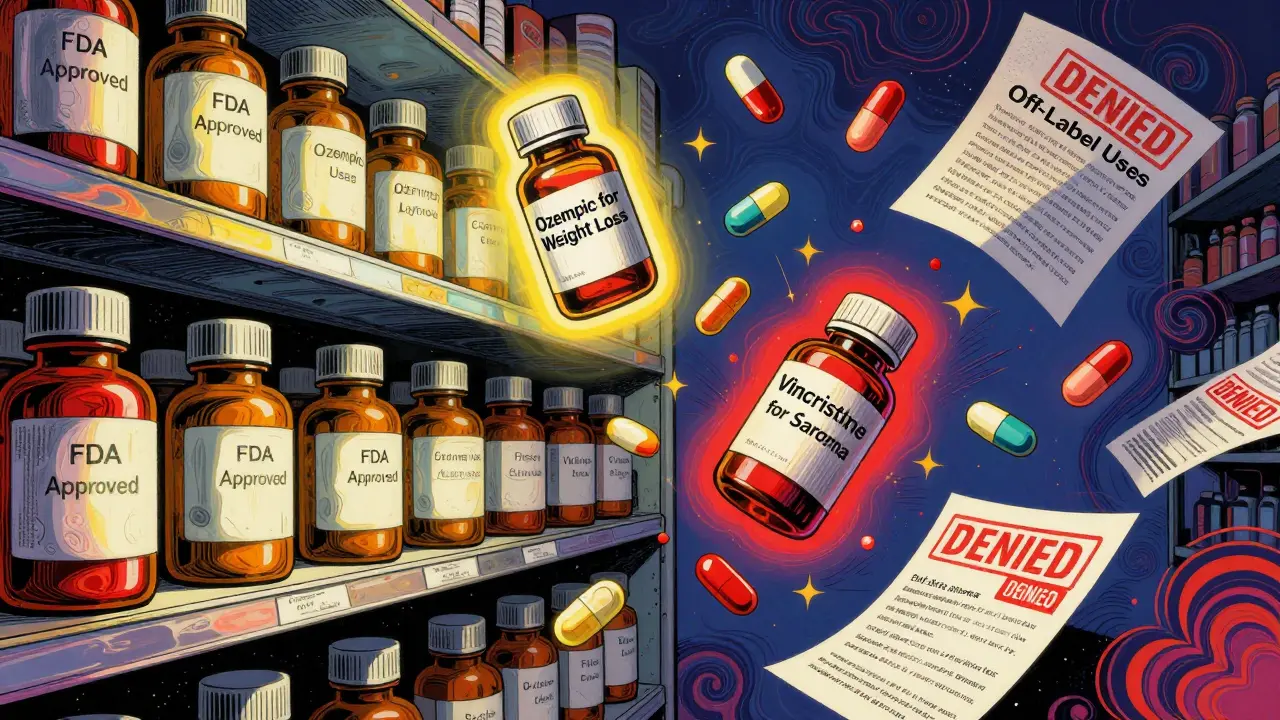
The Risks: When Off-Label Goes Wrong
Off-label doesn’t mean unsafe. But it does mean less certainty. The FDA hasn’t reviewed the drug for that specific use. Side effects might be unknown. Interactions might be untested. One infamous example is Fen-Phen. Fenfluramine and phentermine were prescribed together for weight loss-a common off-label use in the 1990s. Years later, researchers linked the combo to severe heart valve damage. The drugs were pulled from the market. Thousands of patients were harmed. Another case: GLP-1 agonists like semaglutide (Ozempic) are now widely prescribed off-label for weight loss. The drug was approved for type 2 diabetes. But now, millions are using it to lose weight. Long-term safety data for this use? Still lacking. What happens after 10 years? We don’t know. In one Reddit post from a pediatric oncologist, a child with a rare sarcoma was treated with vincristine at a higher frequency than approved. The outcome was better-but every time, the doctor had to fight insurance for prior authorization.Who Pays? Insurance and Access Barriers
Just because a doctor prescribes it doesn’t mean insurance will cover it. UnitedHealthcare, Medicare, and other insurers require off-label uses to meet strict criteria:- It must be listed in a recognized compendium (like NCCN or DRUGDEX)
- It must be supported by peer-reviewed studies
- Or, it must be similar to an FDA-approved use
Marketing vs. Medicine: The Dark Side
Pharmaceutical companies are strictly forbidden from promoting off-label uses. Violations come with massive fines. GlaxoSmithKline paid $3 billion in 2012. Pfizer paid $2.3 billion in 2012. These aren’t isolated cases-since 2009, drugmakers have paid over $14 billion in settlements for illegal promotion. But pressure still exists. Sales reps may drop hints. Free samples may be given for unapproved uses. A 2018 JAMA study found that 78% of off-label uses lacked strong scientific backing. That’s not just risky-it’s dangerous.
How Do Doctors Decide?
Good off-label prescribing isn’t random. It’s based on evidence:- High-quality evidence: Systematic reviews, randomized trials
- Moderate evidence: Case series, expert consensus
- Low-quality evidence: Anecdotes, single case reports
The Future: Real-World Evidence and Faster Approvals
The FDA is starting to catch up. The 21st Century Cures Act (2016) allows the use of real-world data-like electronic health records and patient registries-to support new drug indications. In 2023, the FDA released draft guidance to make it easier to use this data for label expansions. Imagine this: a drug is used off-label for 5 years. Tens of thousands of patients are tracked. The data shows consistent benefit and manageable side effects. Instead of waiting a decade for a formal trial, the FDA can approve it faster. This could reduce off-label use over time-not by banning it, but by turning good off-label practices into approved ones.What Should Patients Know?
If your doctor prescribes a drug off-label:- Ask: “Is this FDA-approved for my condition?”
- Ask: “What’s the evidence behind this?”
- Ask: “Are there side effects I might not know about?”
- Ask: “Will my insurance cover it?”
Off-label prescribing isn’t a loophole. It’s a lifeline. For patients with no other options, it’s often the only path forward. But it demands responsibility-from doctors, insurers, regulators, and patients alike.
Is off-label drug use legal?
Yes. Off-label prescribing is legal in the U.S. and many other countries. The FDA approves drugs for specific uses, but it doesn’t regulate how doctors prescribe them. Physicians can legally prescribe any approved drug for any condition they believe is medically appropriate. However, pharmaceutical companies are strictly prohibited from marketing or promoting drugs for off-label uses.
Why don’t drug companies get drugs approved for more uses?
Getting a new FDA approval costs $50-100 million and takes 5-7 years. For older, generic drugs, there’s no financial incentive-no patent protection means no profit. Even for newer drugs, if the market is small (like rare diseases), companies often skip the process. Doctors fill the gap by using the drug off-label instead.
Can I be harmed by off-label drug use?
Possibly. While many off-label uses are safe and effective, they haven’t been reviewed by the FDA for that specific use. Side effects, drug interactions, or long-term risks may be unknown. The Fen-Phen case and the rise in GLP-1 agonist use for weight loss show that without rigorous testing, harm can occur. Always ask your doctor about known risks and evidence quality.
Will my insurance cover off-label prescriptions?
It depends. Most insurers require proof that the off-label use is supported by credible evidence-like inclusion in the NCCN Compendium, peer-reviewed studies, or similarity to an approved use. Without that, you may have to pay full price. Always check with your insurer before starting treatment.
Are there tools to help doctors decide if an off-label use is valid?
Yes. Doctors use databases like the Off-Patent Drugs Database (NHS), UpToDate, Micromedex, and the NCCN Compendium. These tools rate the strength of evidence for off-label uses. Medicare and many private insurers rely on these same resources to determine coverage. Physicians are encouraged to consult them before prescribing off-label.
Christina Bilotti 16.01.2026
Oh wow, another ‘medical miracle’ piece that treats off-label prescribing like some noble act of heroism. Let’s ignore the fact that 78% of these uses lack strong evidence, shall we? The FDA isn’t some bureaucratic overlord-it’s the only thing standing between patients and pharmaceutical snake oil. And yet, here we are, glorifying doctors as rogue saviors while insurance companies scramble to cover the fallout. Classic.
brooke wright 16.01.2026
I had a friend on off-label gabapentin for anxiety and it literally saved her life after SSRIs failed-she went from suicidal to functioning in 3 weeks. But her insurance denied it for 4 months. She paid $800 out of pocket just to get a 30-day supply. Doctors aren’t playing God-they’re playing chess with a broken board and no rulebook.
vivek kumar 16.01.2026
Off-label prescribing is not a loophole-it is a symptom of systemic failure. The FDA approval process is designed for blockbuster drugs, not niche applications. Yet, when a drug is repurposed based on real-world evidence, we call it ‘experimental.’ Meanwhile, pharmaceutical companies profit from off-label demand while avoiding the cost of validation. This is not medicine. It is capitalism with a stethoscope.
Nick Cole 16.01.2026
I’ve seen this firsthand in oncology. A 12-year-old with a rare mutation got a drug approved for melanoma. No FDA label for her cancer. No clinical trial. Just a doctor who dug through journals, found a case study from Japan, and fought insurance for 6 weeks. She’s in remission now. This isn’t reckless. It’s responsible innovation under constraints.
Henry Ip 16.01.2026
My dad got off-label memantine for Alzheimer’s and it stabilized him for two years. We didn’t know it was off-label until the bill came. Insurance said no. We paid. No regrets. Doctors aren’t guessing-they’re connecting dots others ignore. The system is broken, not the practice.
waneta rozwan 16.01.2026
Let me tell you about the time my psychiatrist prescribed Seroquel for my insomnia because ‘it works better than Ambien and doesn’t make you sleepwalk into traffic.’ I was skeptical. Then I slept through the night for the first time in 7 years. I’m not mad. I’m grateful. But why does it have to be this hard? Why can’t we just fix the system instead of making patients into medical detectives?
Nicholas Gabriel 16.01.2026
Off-label use isn’t just common-it’s essential. But let’s be clear: it’s not ‘free medicine.’ It’s high-stakes medicine. Doctors spend hours researching, documenting, and fighting insurers. And patients? They’re left holding the bag-literally. I’ve seen people skip doses because they can’t afford the co-pay on a $1,200/month off-label script. This isn’t innovation. It’s a moral crisis dressed in white coats.
Cheryl Griffith 16.01.2026
I work in a pediatric clinic. 60% of our prescriptions are off-label. We use weight-based dosing, peer-reviewed guidelines, and clinical judgment. We’re not winging it. But every time we prescribe, we’re also asking parents to trust us without FDA backing. That’s a heavy burden. We need better data-not more restrictions.
Kasey Summerer 16.01.2026
So… we’re praising doctors for playing doctor when the pharma companies are the ones who should’ve done the trials? 😒 Meanwhile, Ozempic is being handed out like candy at a carnival. ‘Oh, it’s off-label for weight loss? Cool, here’s your script, have a nice day!’ 🤡
Samyak Shertok 16.01.2026
Is off-label prescribing ethical? Or is it just the last gasp of a medical system that refuses to evolve? We treat drugs like sacred relics-approved for one thing, and then we pray they’ll work for ten others. What if we stopped pretending that biology obeys bureaucratic categories? What if we accepted that medicine is messy, and that the FDA is a relic of 1960s industrial thinking? The real scandal isn’t off-label use-it’s that we still think a single agency can define truth for 330 million bodies.
Stephen Tulloch 16.01.2026
Off-label = free-market medicine. The FDA is a cartel that protects Big Pharma’s profits. Why should a $2 generic drug need $100M in trials to treat a rare pediatric condition? Doctors are the real innovators. The system punishes them for saving lives. 🚀💊
Joie Cregin 16.01.2026
I love how this post doesn’t just list facts-it tells stories. That kid with the sarcoma? That’s the kind of thing that keeps me up at night. Not because it’s scary, but because it’s beautiful. People helping people, even when the rules say ‘no.’ That’s medicine. Not paperwork. Not insurance forms. Just… humanity.
Melodie Lesesne 16.01.2026
My mom’s rheumatoid arthritis was under control because of methotrexate-off-label for years before it got approved. She’s been on it for 15 years. No side effects. No complaints. Just relief. Why does it take so long to catch up? It’s not magic. It’s just… slow.
Corey Chrisinger 16.01.2026
Off-label prescribing is the quiet rebellion of science against bureaucracy. The FDA didn’t invent truth-it just tried to label it. But biology doesn’t care about labels. A drug that binds to a receptor binds to it whether the FDA says ‘yes’ or ‘no.’ The real question isn’t legality-it’s wisdom. Are we using evidence? Are we tracking outcomes? Are we honest with patients? If yes, then we’re not breaking rules-we’re rewriting them.