
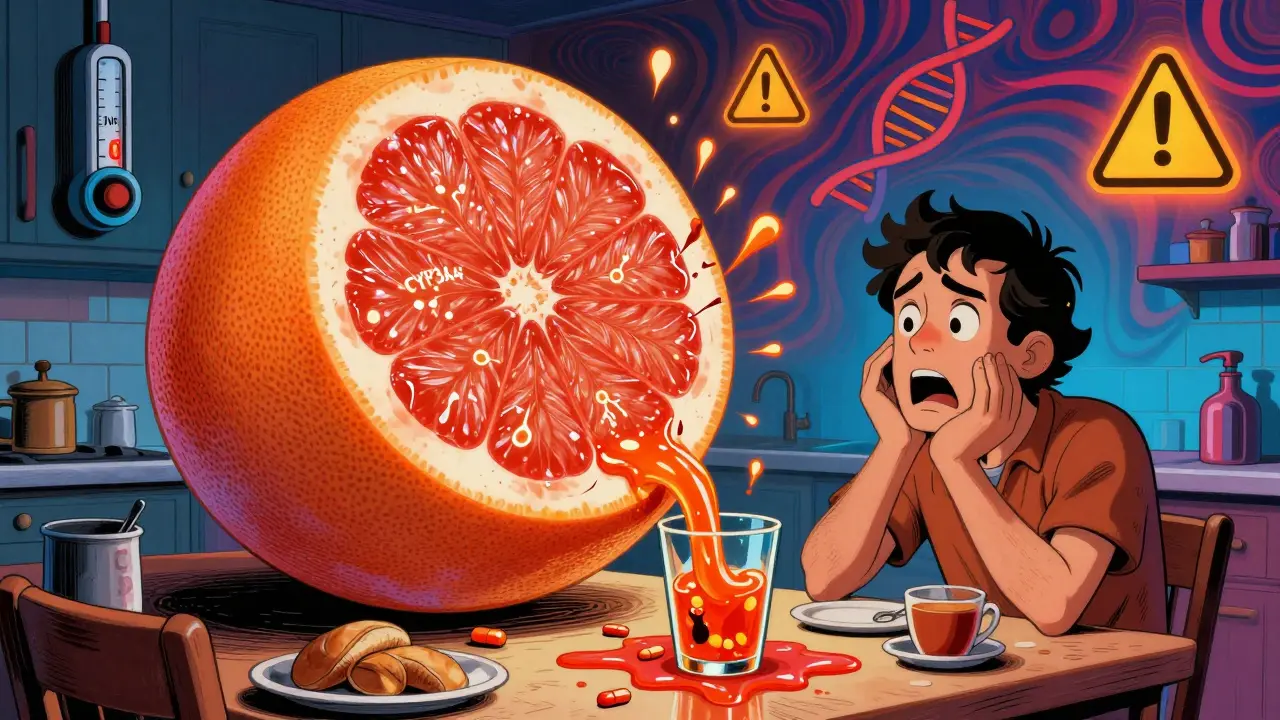
Every year, thousands of people end up in the hospital not because of a mistake by their doctor, but because they ate a grapefruit with their morning pill. It sounds harmless - maybe even healthy. But when it comes to CYP450 interactions, grapefruit isn’t just fruit. It’s a silent drug amplifier. And when mixed with medications like warfarin or certain SSRIs, the consequences can be serious - or even deadly.
How Grapefruit Changes Your Medication
Grapefruit doesn’t just taste tangy - it changes how your body handles drugs. The problem isn’t the sugar or the vitamin C. It’s a group of chemicals called furanocoumarins, mainly bergamottin and DHB. These compounds don’t just block one enzyme. They wreck it. Specifically, they target CYP3A4, an enzyme in your gut that normally breaks down about half the pills you swallow before they even enter your bloodstream.
Unlike most drug interactions - where two substances compete for attention - grapefruit doesn’t just slow things down. It permanently disables CYP3A4. Once the enzyme is knocked out, your gut can’t rebuild it fast enough. That means more of your drug gets absorbed. A single 8-ounce glass of grapefruit juice can knock out 47% of your intestinal CYP3A4 for up to 72 hours. No matter when you take your pill after drinking it - 2 hours later, 6 hours later - the damage is already done.
This isn’t a theory. It’s been proven in labs and clinics. In one study, people who drank grapefruit juice with a common blood pressure drug saw their blood levels jump by 300%. That’s not a side effect. That’s an overdose waiting to happen.
Warfarin and Grapefruit: A Risk You Can’t Ignore
Warfarin is one of the most dangerous drugs to mix with grapefruit - not because grapefruit directly boosts warfarin levels dramatically, but because it plays a dangerous game of chance with your genetics.
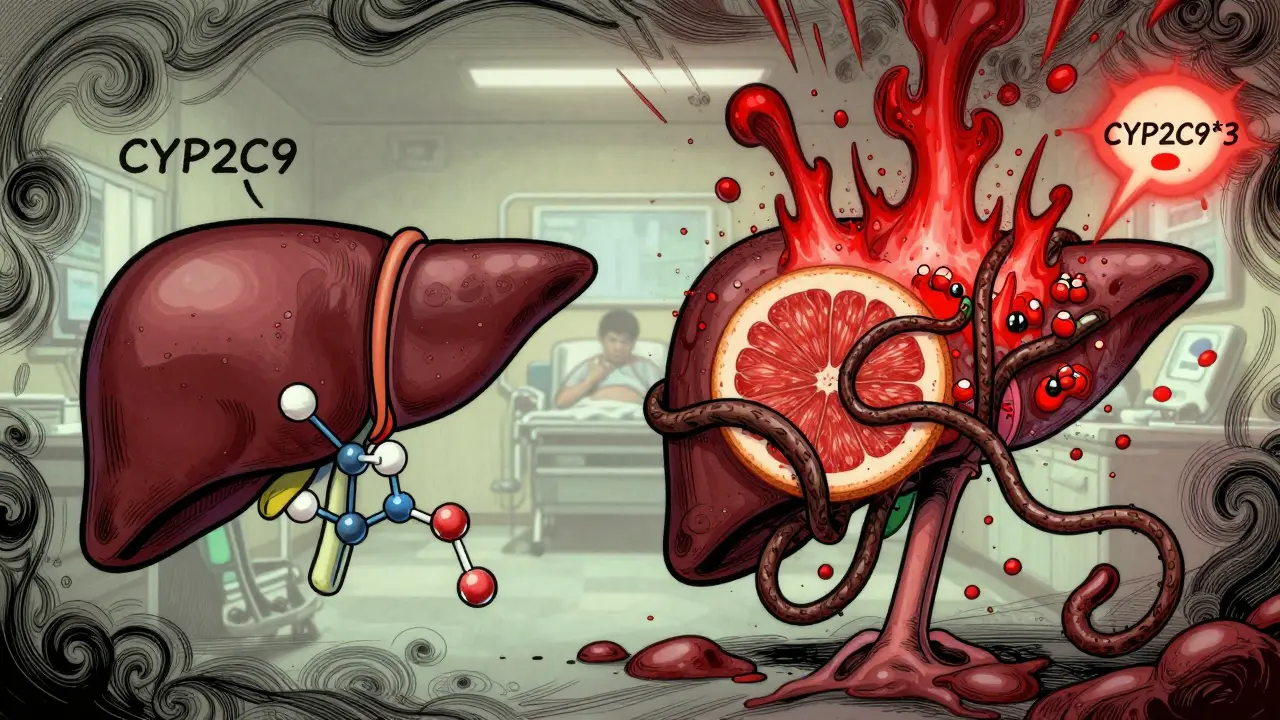
Warfarin doesn’t rely on just one enzyme. About 85% of it is broken down by CYP2C9. Grapefruit doesn’t strongly inhibit CYP2C9 - but it does. Research from 1998 showed bergamottin can reduce CYP2C9 activity in human liver samples. That’s enough to matter, especially if you carry a genetic variant like CYP2C9*2 or CYP2C9*3. These variants are common in white and Asian populations. People with them already break down warfarin slowly. Add grapefruit, and your INR can spike by 15-25% - enough to cause bleeding.
Real-world data backs this up. A 2023 Mayo Clinic pharmacy report found that 32% of warfarin patients who accidentally consumed grapefruit reported abnormal INR levels. That’s not a small number. And it’s not random. Patients with known CYP2C9 variants had a 4x higher chance of dangerous INR spikes. The Clinical Pharmacogenetics Implementation Consortium (CPIC) now recommends avoiding grapefruit entirely for these patients.
Here’s the scary part: Most people on warfarin don’t know their CYP2C9 status. Genetic testing costs $250-$400. Only 18% of warfarin prescriptions in 2023 included a warning about grapefruit. That means most patients are flying blind.
SSRIs and Grapefruit: The Myth vs. The Reality
When you search for grapefruit and antidepressants, you’ll find conflicting advice. Some sites say avoid it. Others say it’s fine. The truth? It depends on which SSRI you’re taking.
Fluoxetine and paroxetine are broken down by CYP2D6. Grapefruit barely touches CYP2D6. So unless you’re drinking gallons of juice daily, these are low-risk. Citalopram and escitalopram are metabolized by CYP2C19 and CYP3A4. A 2024 study in Clinical Pharmacology & Therapeutics gave escitalopram with grapefruit juice to 24 healthy volunteers. No significant change in drug levels. No side effects.
But sertraline? That’s the one to watch. About 30% of sertraline is broken down by CYP3A4 - the same enzyme grapefruit destroys. A 2015 case series found that people who drank grapefruit juice daily saw their sertraline blood levels rise by 27-39%. Some reported increased dizziness, nausea, and sleepiness. One patient had to reduce their dose after switching to grapefruit juice.
Here’s the catch: Most SSRIs are taken in doses that have a wide safety margin. Even if levels rise 30%, you might not notice anything. That’s why only 2.3% of SSRI users in Drugs.com reviews mention avoiding grapefruit - compared to 8.7% of warfarin users. But for older adults, people with liver disease, or those taking other meds that also affect CYP3A4, even a small rise in sertraline can be dangerous.
Who’s at Risk? And Who’s Not?
Not everyone needs to stop eating grapefruit. But you need to know if you’re in the small group that does.
High-risk group: Anyone taking warfarin, especially if they’re older, have liver issues, or carry CYP2C9*2 or *3 variants. Also anyone taking sertraline who’s on other CYP3A4 inhibitors like clarithromycin or diltiazem. If you’re on more than three medications, your risk goes up.
Low-risk group: People taking escitalopram, citalopram, fluoxetine, or paroxetine. Even if you drink grapefruit juice daily, the interaction is either nonexistent or clinically insignificant. Same goes for most statins, blood pressure meds, and anti-anxiety drugs that aren’t metabolized by CYP3A4.
Still unsure? Look at your pill bottle. If it says “may interact with grapefruit,” pay attention. If it doesn’t, but you’re on warfarin or sertraline - still be cautious. Many drug labels haven’t caught up with the science.
What Should You Do?
Don’t panic. Don’t throw out your orange juice. But do this:
- If you take warfarin: Avoid grapefruit completely. Talk to your doctor about genetic testing for CYP2C9. It’s not expensive, and it can save your life.
- If you take sertraline: Skip grapefruit juice. If you love grapefruit, eat the whole fruit - the furanocoumarins are mostly in the juice and peel. But even then, keep it rare.
- If you take any other SSRI: You’re probably fine. But if you notice new dizziness, nausea, or confusion after drinking grapefruit juice, stop and call your doctor.
- Check all your meds. Over 85 drugs have serious grapefruit interactions. It’s not just SSRIs and warfarin. It’s also some statins, calcium channel blockers, and even some anti-cancer drugs.
- Don’t assume “natural” means safe. Grapefruit is a natural product. So is poison ivy.
Pharmacists at Mayo Clinic spend an average of 3.2 minutes per patient counseling on grapefruit interactions. Most of that time is spent on warfarin. But here’s the problem: Patients rarely bring it up. They don’t think it matters. They think it’s just fruit. That’s the biggest danger of all.
The Bigger Picture
More than 42% of U.S. adults take at least one medication that can interact with grapefruit. SSRIs are taken by 4.7 million people. Warfarin by 1.2 million. And grapefruit consumption has gone up 17% since 2019. More people are eating it. More people are on meds. The gap between knowledge and action is widening.
The FDA is finally starting to act. In 2024, they released draft guidance requiring drug makers to test for CYP inhibition early in development. That means future drugs will come with clearer warnings. But for the millions already on warfarin or sertraline? The advice is simple: When in doubt, leave it out.
It’s not about fear. It’s about control. You can’t control your genes. You can’t control how your liver works. But you can control whether you drink grapefruit juice with your pills. And that small choice might be the one that keeps you out of the hospital.
Can I eat grapefruit if I’m on warfarin?
No. Even small amounts of grapefruit or grapefruit juice can increase your INR and raise your risk of bleeding. This risk is higher if you have certain genetic variants (CYP2C9*2 or *3). Avoid grapefruit entirely if you take warfarin.
Are all SSRIs affected by grapefruit?
No. Only sertraline has a clinically relevant interaction because it’s partly broken down by CYP3A4, the enzyme grapefruit disables. Fluoxetine, paroxetine, escitalopram, and citalopram have minimal or no interaction risk. Still, if you notice new side effects after eating grapefruit, stop and ask your doctor.
How long does grapefruit affect CYP3A4?
Up to 72 hours. One glass of grapefruit juice can knock out nearly half your intestinal CYP3A4 enzyme. Your body can’t replace it fast enough. That’s why timing your pill and juice hours apart doesn’t work. The enzyme stays disabled until your gut cells make new ones.
Is orange juice safe to drink with my meds?
Yes. Regular orange juice doesn’t contain furanocoumarins. It’s safe with warfarin, SSRIs, and most other medications. But avoid Seville oranges, pomelos, and tangelos - they’re closely related to grapefruit and can cause the same interaction.
Can I take grapefruit juice if I’m on a low dose of sertraline?
Even low doses of sertraline can be affected. Grapefruit increases sertraline levels by 27-39% in regular users. That’s enough to cause dizziness, nausea, or serotonin-related side effects. It’s not worth the risk. Stick to water or orange juice instead.
Constantine Vigderman 14.12.2025
bro i just drank grapefruit juice with my sertraline and now i feel like a robot who forgot how to blink 😅 why is no one talking about this??
Cole Newman 14.12.2025
lol you guys are overreacting. I’ve been eating grapefruit with my warfarin for 5 years and my INR’s been stable. Your doctor’s just scared of liability. Also, orange juice is fake news-Seville oranges are worse, duh.
Casey Mellish 14.12.2025
As an Aussie who grew up on grapefruit for breakfast, I can confirm this is real. We had a pharmacist in Melbourne get sued because a patient mixed grapefruit with simvastatin. The enzyme inhibition isn’t myth-it’s molecular sabotage. Don’t gamble with your liver. Stick to orange juice. And yes, pomelos are the evil cousins. 🍊❌
Tyrone Marshall 14.12.2025
There’s something deeply human about how we treat medicine like it’s just another ingredient in the pantry. We’ll read a recipe for 20 minutes but ignore the warning label on a pill bottle because ‘it’s just fruit.’ But the body doesn’t care if it’s natural or synthetic-it only cares about chemistry. Grapefruit doesn’t ‘interfere’ with your meds. It hijacks them. And we’re the ones who left the door open.
Emily Haworth 14.12.2025
I think Big Pharma knows about this and hides it. Why do you think they don’t put big red warnings on grapefruit? 🤔 They want us to get sick so we buy more meds. Also, I heard the FDA got bribed by citrus corporations. I’m not paranoid-I’m informed. 🍉💀
Tom Zerkoff 14.12.2025
The data presented in this post is methodologically sound and clinically significant. The pharmacokinetic disruption of CYP3A4 by furanocoumarins is well-documented in peer-reviewed literature, including studies published in the Journal of Clinical Pharmacology and Clinical Pharmacology & Therapeutics. It is imperative that patients be educated not only on specific drug interactions but also on the irreversible nature of enzyme inhibition. I recommend disseminating this information through primary care pathways.
Yatendra S 14.12.2025
we are all just atoms dancing in a cosmic pharmacy. grapefruit? warfarin? sertraline? all illusions. the real interaction is between your fear and the idea of control. 🌌🌀 maybe the fruit isn’t the enemy... maybe we are.
Himmat Singh 14.12.2025
The assertion that grapefruit inhibits CYP3A4 is oversimplified. While furanocoumarins do exhibit inhibitory activity, the clinical relevance is context-dependent. The cited 300% increase in blood pressure drug concentration was observed under controlled pharmacokinetic conditions, not real-world dietary intake. Moreover, interindividual variability in enzyme expression renders population-wide warnings statistically unsound. One should not generalize risk based on case series.
kevin moranga 14.12.2025
Hey, just wanted to say thank you for writing this. I’m 68 and on warfarin, and I had no idea grapefruit could mess with me like that. My grandkid brought me some grapefruit the other day-I ate half and thought, ‘eh, it’s healthy.’ Now I’m gonna call my doc tomorrow and ask about that CYP2C9 test. Honestly, I feel like I just got a second chance. Don’t let your ‘healthy habits’ sneak up on you. Water and orange juice are your new best friends. And if you’re on sertraline? Yeah, skip the juice. Your brain will thank you. 💪❤️