
Exercise Intensity Calculator for Medication Users
Your Medication
Your Results
Select your medication and activity to see your safe exercise intensity range.
How This Works
When on beta-blockers or similar medications, your heart rate response is limited. Traditional heart rate monitoring becomes inaccurate. This calculator uses the Borg RPE scale (Rating of Perceived Exertion) to determine your safe exercise intensity.
Important Note
Do not use heart rate monitors for intensity guidance while on beta-blockers. Your heart rate won't respond normally to exercise. This tool uses the talk test and RPE scale as safer alternatives.
Red Flag Warnings
- Resting heart rate below 45 bpm with dizziness
- Systolic blood pressure drops below 90 mmHg during exercise
- Dry mouth and no sweat during mild activity
If you experience these symptoms, stop exercising immediately and contact your doctor.
Why You Feel So Tired When Exercising on Beta-Blockers
It’s not laziness. It’s not lack of effort. If you’re on beta-blockers and find yourself gasping after a slow walk or unable to keep up with your old pace, your medication is the likely culprit. Beta-blockers like metoprolol, atenolol, and propranolol are designed to slow your heart rate-especially during stress or physical activity. That’s great for your heart, but it makes exercise feel harder than it should.
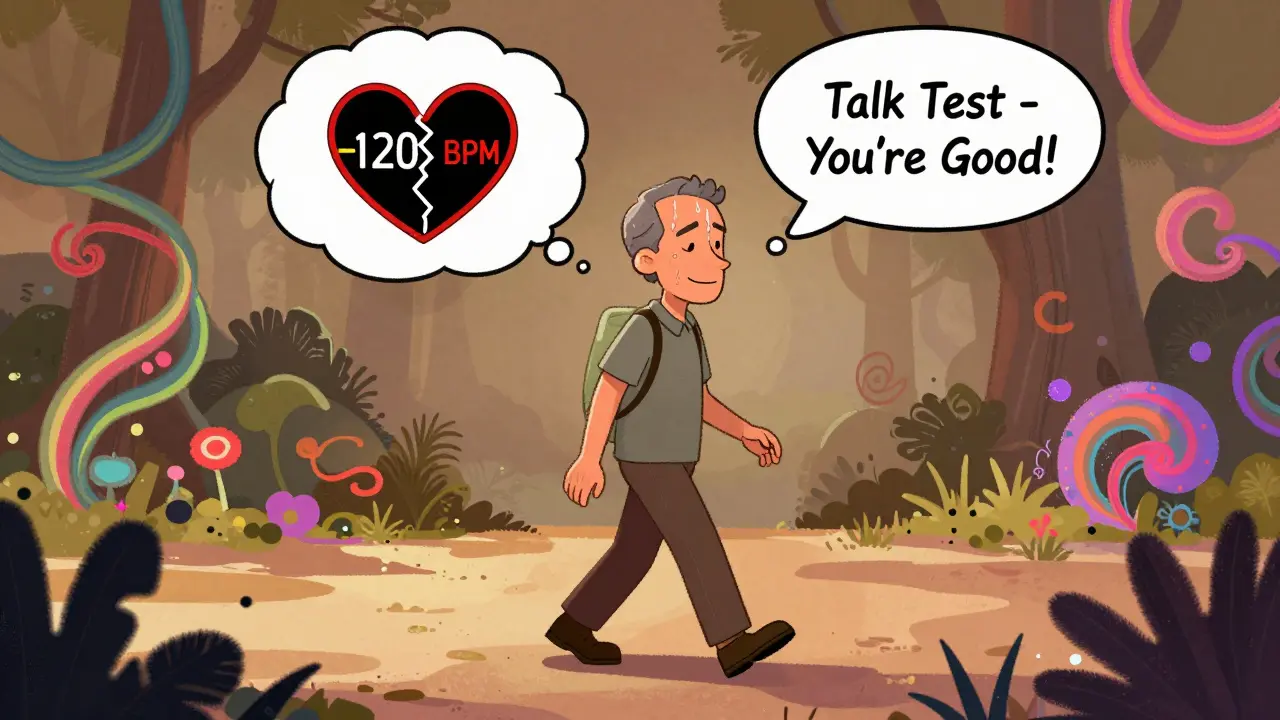
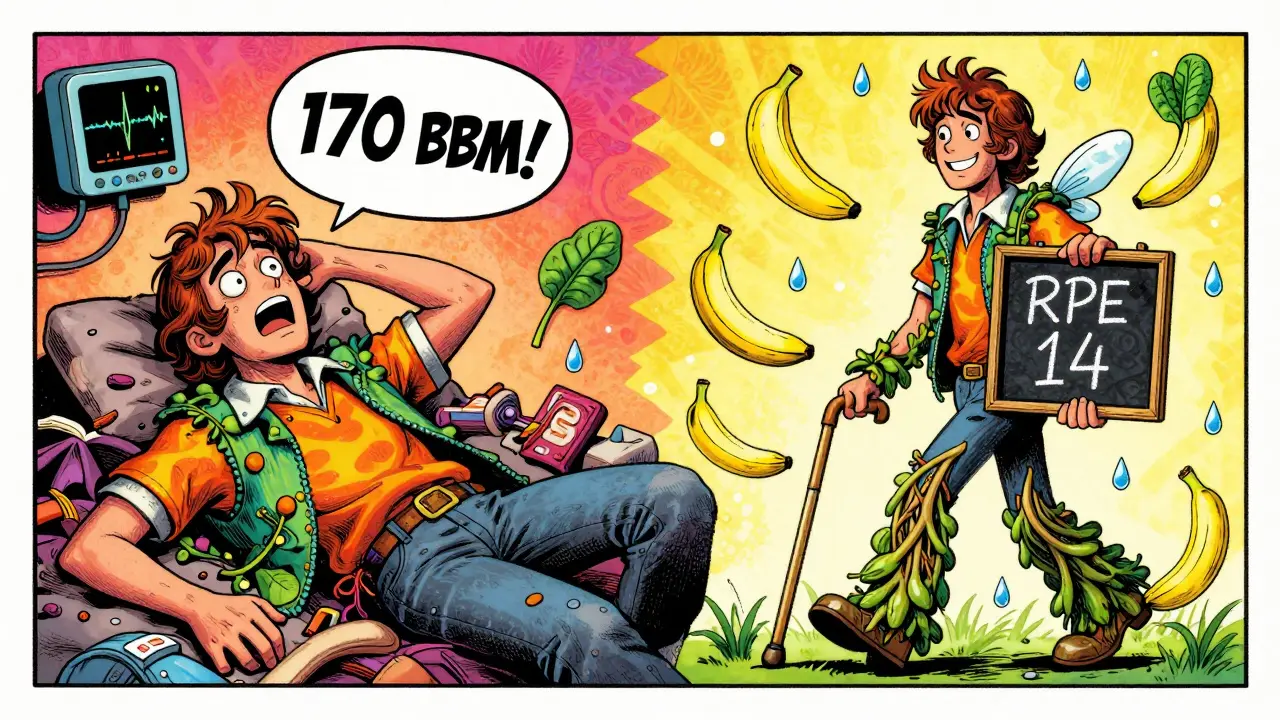
Here’s the science behind it: these drugs block adrenaline, which normally tells your heart to beat faster when you move. Without that signal, your heart can’t ramp up like it used to. Studies show your max heart rate drops by 20-30%. If you used to hit 170 bpm during a run, you might now max out at 120-130. That means less oxygen gets delivered to your muscles. Your body tries to compensate by pulling more oxygen out of each beat, but it’s not enough. Result? You hit fatigue fast-even at low effort.
This isn’t just in your head. Research from the American Heart Association confirms that people on beta-blockers typically see a 10-15% drop in VO₂ max-the gold standard for measuring aerobic fitness. That’s like losing a full level of fitness overnight. And it’s worse with older drugs like propranolol. Users report 78% more fatigue compared to 63% with metoprolol. The drug isn’t broken. Your body’s just working with one hand tied behind its back.
Why Heart Rate Monitors Don’t Work Anymore
If you’ve been tracking your heart rate during workouts for years, you’re probably confused. You’re doing the same workout, but your numbers are way lower. You feel like you’re slacking. But here’s the truth: your target heart rate zones are now useless.
Traditional formulas like “220 minus your age” assume your heart can still respond normally. On beta-blockers, it can’t. Trying to hit those old targets means you’ll push too hard, risk overexertion, and end up exhausted. The Mayo Clinic warns explicitly: “Don’t exercise to reach an expected heart rate while on beta-blockers.” Doing so doesn’t improve fitness-it just drains you.
Instead of watching your watch, start listening to your body. The American Heart Association recommends switching to the “talk test.” If you can talk comfortably but not sing, you’re in the right zone. That’s moderate intensity. If you can only say a few words before gasping, you’re pushing too hard. No numbers needed. Just breath.
How to Use the Borg RPE Scale Instead
If the talk test feels too vague, try the Borg Rating of Perceived Exertion (RPE) scale. It’s a 6-20 point system where 6 means “no exertion at all” and 20 means “maximal effort.”
Here’s what to aim for on beta-blockers:
- Light effort: 11-13 (you’re barely breaking a sweat)
- Moderate effort: 14-16 (you’re breathing harder but still talking)
- Vigorous effort: 17-19 (you can’t say more than a few words)
Most people on beta-blockers should stay in the 12-14 range for daily activity. That’s the sweet spot for safety and benefit. A 2022 study in the Journal of the American College of Cardiology found that patients who used RPE instead of heart rate improved their exercise tolerance without increasing risk. You’re not guessing-you’re measuring effort the way your body actually feels it.
How to Adjust Your Workout Routine
Don’t quit. Just change how you do it.
Warm up longer. Skip the 5-minute stretch and go for 10-15 minutes. Your heart needs time to adjust. Walk slowly, move your arms, do light leg swings. This helps your body ease into activity without sudden strain.
Extend your workout time. Since you can’t go as hard, you need to go longer to get the same benefit. The American Heart Association recommends 180-188 minutes of moderate activity per week instead of the standard 150. That’s about 30-35 minutes a day, five days a week. It’s not more intense-it’s more consistent.
Swap HIIT for intervals. High-intensity interval training (HIIT) is tough on beta-blockers. Your heart can’t spike fast enough. Instead, try 2:1 work-to-rest ratios. Walk hard for two minutes, then slow down for one. Repeat six times. A 2021 study in Circulation showed this method improved endurance in beta-blocker users better than steady-state walking.
Lower weights, keep reps. Resistance training is still safe. Beta-blockers don’t weaken muscles-they just limit blood flow. Reduce your weights by 15-20%, but keep doing the same number of reps. You’ll maintain strength without overloading your heart.
Red Flags: When to Stop and Call Your Doctor
Not all fatigue is normal. Some signs mean something’s wrong.
- Resting heart rate below 45 bpm with dizziness or lightheadedness. This happens in about 5% of users and can signal dangerous bradycardia.
- Systolic blood pressure drops below 90 mmHg during exercise. That’s a red flag for possible cardiogenic shock, especially if you feel cold, clammy, or confused.
- Dry mouth and no sweat during mild activity. This occurs in 12% of users and signals dehydration risk. Beta-blockers reduce sweat production, so you might not realize you’re losing fluids.
If you experience any of these, stop exercising immediately. Sit down, drink water, and call your doctor. These aren’t side effects to push through-they’re warnings.
Other Medications That Cause Exercise Fatigue
Beta-blockers aren’t the only drugs that make you feel sluggish. But they’re the worst for heart rate control.
ACE inhibitors (like lisinopril) and calcium channel blockers (like amlodipine) cause less fatigue. They may cause swelling in the legs or dizziness, but they don’t block your heart’s ability to speed up. VO₂ max drops only 3-5% with these drugs-much less than beta-blockers.
Diuretics (water pills) can drain your electrolytes. That leads to muscle cramps and weakness. If you’re on a diuretic, make sure you’re getting enough potassium and magnesium. Bananas, spinach, and nuts help.
The key difference? Beta-blockers limit your heart’s response. Other drugs affect your muscles, fluids, or blood pressure-but not your heart’s ability to pump faster. That’s why switching from propranolol to nebivolol (Bystolic) can help. Nebivolol causes 8-10% less reduction in VO₂ max, making it a better choice for active patients.

What’s New in 2026: Wearables and Personalized Plans
Technology is catching up. Apple Watch’s latest software (version 9.1, released in 2023) now includes beta-blocker-adjusted heart rate zones. It doesn’t calculate your real max HR-it estimates your effort based on your medication and past data. It’s not perfect, but it’s a step forward.
More advanced tools are available too. Cardiopulmonary exercise testing (CPET) is now offered at 65% of U.S. hospitals with cardiac rehab programs. This test measures exactly how your lungs and heart respond to exercise while you’re on medication. It gives you a personalized workout prescription-not a guess.
If you’re serious about staying active, ask your cardiologist about CPET. It’s not routine yet, but it’s becoming the gold standard for people on beta-blockers who want to exercise safely.
Real People, Real Results
One user on Reddit, CardioRunner87, said his 5K time went from 25:30 to 29:15 on metoprolol. He was frustrated-until he stopped chasing his old heart rate. He switched to the talk test and started walking 45 minutes a day instead of running 25. He lost 12 pounds, his blood pressure improved, and he stopped feeling wiped out after every walk.
Another user, HeartWarrior42, on the American Heart Association’s forum, said switching from heart rate tracking to the talk test let her keep walking every morning on atenolol. She didn’t get faster. But she got stronger. And she stayed consistent.
Consistency beats intensity every time when you’re on these meds. You don’t need to run a marathon. You just need to move every day without crashing.
Final Takeaway: You Can Still Be Active
Beta-blockers don’t mean you have to sit still. They mean you have to rethink how you move. Stop chasing numbers. Start listening to your breath. Use the talk test. Use RPE. Walk longer. Lift lighter. Rest more. Drink water. And don’t ignore the red flags.
The goal isn’t to be the fastest or strongest. It’s to keep your heart healthy-and your body moving-for the long haul. That’s still possible. It just looks different now.
rachel bellet 17.01.2026
The article is fundamentally flawed because it ignores the neuroendocrine cascade triggered by beta-blockade. You can't just replace HR monitoring with the 'talk test'-that’s anecdotal pseudoscience. VO₂ max isn't some mystical metric; it's quantifiable physiological output. If your patient can't hit 70% of their pre-med max HR, they're not 'adapting'-they're compensating with sympathetic overdrive and peripheral vasoconstriction. The AHA's guidelines are outdated. We need CPET-guided individualized thresholds, not feel-good platitudes.
Pat Dean 17.01.2026
So now we're telling Americans they can't even walk fast without being on some drug-induced leash? This is why our country's falling apart. Back in my day, you just pushed through. No one cared if your heart rate was 'too low.' You got up, moved, and didn't whine. This article is just another excuse for lazy people to sit on the couch and blame Big Pharma.
Jay Clarke 17.01.2026
Look, I get it. Beta-blockers turn your body into a slow-motion movie. But here's the truth no one wants to admit: you're not broken. You're just relearning how to be alive. I used to run marathons. Now I do 90-minute walks with my dog, listening to podcasts. I don't care about BPM. I care about sunrise. I care about not collapsing after the bathroom. That's victory. The numbers were never the point. The point was showing up. And you're still here. That's everything.
Zoe Brooks 17.01.2026
This is the most helpful thing I've read in years. I was ready to quit working out because I felt like a failure. Now I know it's not me-it's the meds. I switched to RPE and started doing 30-minute walks with my neighbor. We talk about books. I don't even check my watch anymore. I feel like myself again. Thank you for saying this so clearly. 🙏
Aysha Siera 17.01.2026
They don't want you to know this but beta-blockers are part of a larger mind control program. The FDA and Big Pharma are suppressing the truth that these drugs are designed to make you docile. Low energy = less activism. Less movement = less rebellion. The talk test? It's a distraction. CPET? A trap. They want you to think you're adapting when you're actually being pacified. Wake up.
Ryan Otto 17.01.2026
While the article presents a superficially plausible framework for exercise modification, it lacks rigorous epistemological grounding. The reliance on perceived exertion scales, which are inherently subjective and culturally contingent, undermines any claim to clinical objectivity. Furthermore, the invocation of anecdotal Reddit testimonials as evidentiary support constitutes a logical fallacy of appeal to authority-albeit a populist one. A properly designed RCT would be required to validate these assertions.
Max Sinclair 17.01.2026
I really appreciate how practical this is. I’ve been on metoprolol for 5 years and thought I was just getting old. The talk test changed everything. I started walking 40 minutes every morning, and now I actually look forward to it. No more guilt. No more chasing numbers. Just movement. Thank you for writing this. It’s the kind of info I wish my cardiologist had given me instead of a pamphlet.
Praseetha Pn 17.01.2026
Wait wait wait-so you’re telling me I’m not lazy? That my heart’s just been sabotaged by Big Pharma’s chemical leash? And now I’m supposed to walk longer but slower? And that’s okay? I’ve been feeling like a zombie since I started atenolol. My husband says I’m ‘too quiet’ now. But you’re saying it’s not me? It’s the damn pills? I’ve been crying in the shower for 2 years thinking I was weak. This is the first time I feel seen. I’m gonna start RPE tomorrow. I’m not giving up. I’m reprogramming.
Nishant Sonuley 17.01.2026
Let’s be real for a sec-this whole thing is a classic case of medical paternalism disguised as empowerment. The article tells you to ditch heart rate monitors and use the talk test, which sounds nice, but here’s the kicker: most people don’t even know what ‘moderate effort’ feels like anymore. We’ve been trained by Fitbits and Apple Watches to obsess over digits. Now you’re asking us to trust our guts? That’s like telling a diabetic to guess their blood sugar. The real solution isn’t just RPE-it’s education. We need community programs, certified coaches trained in cardiac pharmacology, and peer support circles. This isn’t a personal adjustment-it’s a systemic overhaul. And yeah, I’m gonna start a Reddit group for this.
Emma ######### 17.01.2026
I’m so glad someone finally said this. I’ve been too scared to talk about it, but I’ve been crying after walks because I felt so defeated. I didn’t think anyone else felt this way. I’m trying the Borg scale now. I’m at 13 most days. It’s not glamorous. But I’m still here. And that’s enough.
Andrew McLarren 17.01.2026
While the recommendations presented herein are generally aligned with current clinical consensus regarding exercise prescription in patients receiving beta-adrenergic blockade, the informal tone and reliance on anecdotal evidence may undermine the credibility of the message among more scientifically literate audiences. A more rigorous approach, incorporating peer-reviewed literature and explicit citation of guidelines (e.g., ACC/AHA 2022), would enhance both clinical utility and public trust.
Andrew Short 17.01.2026
Of course you're tired. You're on a drug that turns your heart into a turtle. You think this is normal? This isn't 'adapting'-this is surrender. And now you're being told to just walk slower and call it progress? That's not health. That's resignation. The real problem isn't the medication-it's that we've let pharmaceutical companies dictate how we live. If you want to move like a human again, get off the beta-blockers. Or at least demand a better drug. Nebivolol? That's not a cure-it's a downgrade with a fancy name.
christian Espinola 17.01.2026
Typical. Another article that makes you feel better by lowering your standards. You're not 'still active'-you're compromised. You're not 'listening to your body'-you're accepting defeat. And calling walking 35 minutes a day 'exercise' is a joke. That's not fitness. That's maintenance. And maintenance is just slow decay with a wellness hashtag.
Chuck Dickson 17.01.2026
Hey-you’re not alone. I was on propranolol for 8 years. Lost 30 lbs of muscle. Thought I’d never lift again. Then I started doing bodyweight circuits at 12 RPE. 10 reps, 3 sets, 3x a week. No weights. Just control. Breathing. Patience. Now I can do 50 push-ups. Not because I’m strong. Because I didn’t quit. You don’t need speed. You need rhythm. And rhythm? That’s forever. Keep going. You’ve got this. 💪