
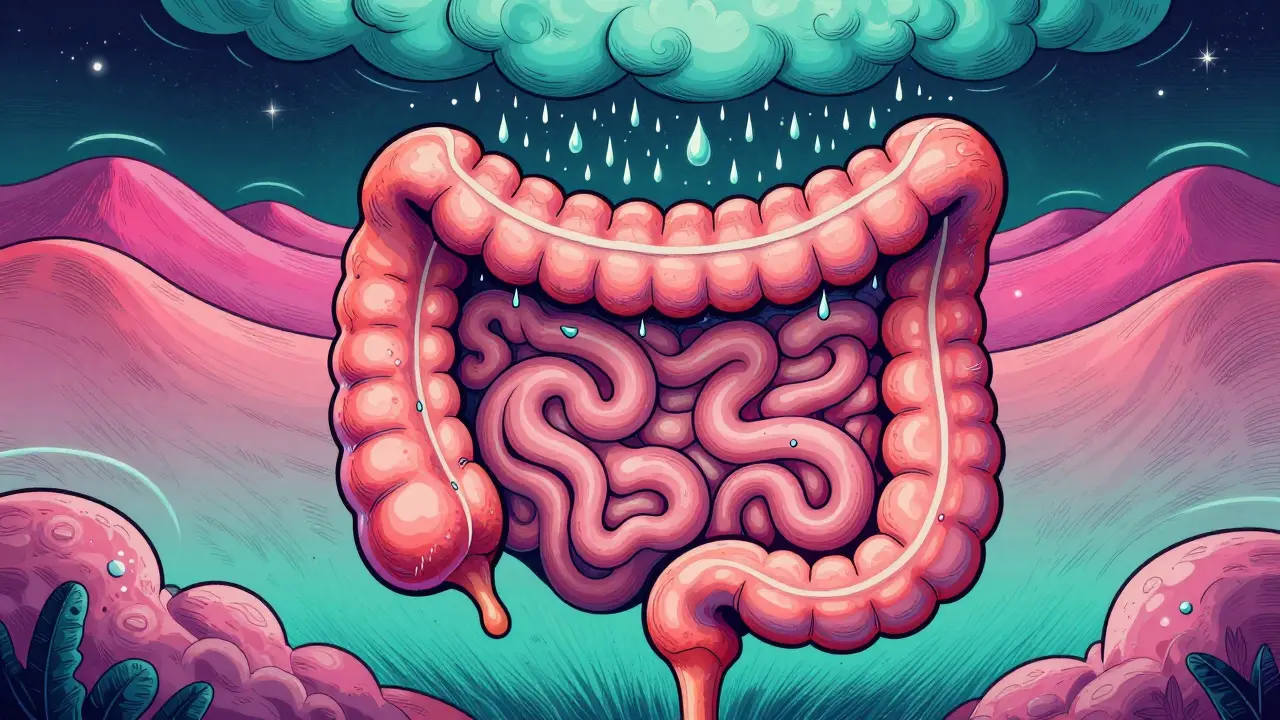
Chronic heartburn isn’t just annoying-it can change the lining of your esophagus in ways that put you at risk for something far more serious. If you’ve had acid reflux for more than 10 years, especially if you’re a man over 50, you could be developing Barrett’s esophagus without knowing it. This isn’t cancer. But it’s the most common precursor to esophageal adenocarcinoma, a cancer that’s hard to catch early and even harder to survive. The good news? You can find it before it turns dangerous-if you know what to look for and when to ask for a test.
What Exactly Is Barrett’s Esophagus?
Barrett’s esophagus happens when the normal tissue lining your esophagus-soft, pink, and made of squamous cells-gets replaced by a different kind of tissue. This new tissue looks more like the lining of your intestines. It’s called intestinal metaplasia. This change doesn’t happen overnight. It takes years of stomach acid constantly burning the esophagus. That’s why it’s almost always tied to long-term GERD, especially if you’re having symptoms like heartburn or regurgitation more than three times a week.
It was first described in 1950 by a British doctor named Norman Barrett. Since then, we’ve learned that this isn’t just a random change. It’s your body’s attempt to protect itself from acid. But this protection comes with a cost. The new tissue is more vulnerable to further damage, and over time, it can develop abnormal cells called dysplasia. That’s the turning point where things start to get dangerous.
Barrett’s esophagus affects about 5.6% of the U.S. population. Among people with chronic GERD, that number jumps to 10-15%. And while only about 5% of people with Barrett’s will ever develop esophageal cancer, the survival rate for those who do is grim-fewer than 1 in 5 survive five years after diagnosis. That’s why catching it early matters more than treating the heartburn.
Who’s at Risk?
This isn’t a condition that affects everyone with GERD equally. Certain factors stack the odds heavily against you:
- Men are three times more likely to develop it than women.
- White men over 50 with long-standing GERD have the highest risk.
- Smoking doubles your risk.
- Obesity, especially belly fat, increases pressure on the stomach and pushes acid upward.
- If you’ve had frequent heartburn for more than 20 years, your risk is 40 times higher than someone without chronic reflux.
And here’s the thing: if you’re a woman, under 50, or don’t have other risk factors, your chances are low enough that routine screening isn’t recommended. That’s not because it can’t happen-it’s because the cost and risk of unnecessary endoscopies outweigh the benefit for low-risk groups.
Can You Feel It?
No. That’s the scary part.
Barrett’s esophagus doesn’t cause its own symptoms. You won’t suddenly feel a lump. You won’t lose weight. You won’t know unless you get tested. Most people only find out because they’ve been dealing with GERD for so long that their doctor suggests an endoscopy.
But if you’ve had any of these for years, you’re likely already in the danger zone:
- Heartburn that wakes you up at night
- Feeling like food is stuck in your chest
- Chronic cough, hoarseness, or asthma-like symptoms
- Regurgitating sour liquid, especially when lying down
- Chest pain that feels like a heart attack
Many people dismiss these as "just indigestion." The Esophageal Cancer Action Network found that 68% of people with Barrett’s had symptoms for over five years before being diagnosed. They didn’t connect the dots. Don’t make that mistake.

How Is It Diagnosed?
The only way to know for sure is through an upper endoscopy. This isn’t a simple blood test or X-ray. A thin, flexible tube with a camera is passed down your throat. The doctor looks for patches of salmon-colored tissue instead of the normal pale pink lining. But even that’s not enough.
They have to take biopsies. Not just one or two. The standard is the Seattle protocol: four tissue samples every 1 to 2 centimeters along the abnormal area. That’s usually 12 to 24 samples total. Why? Because dysplasia can be patchy. One missed spot could mean missing cancer before it starts.
The pathologist then grades what they find:
- Non-dysplastic Barrett’s (NDBE): No abnormal cells. Most common.
- Indefinite for dysplasia: Unclear if cells are abnormal. Needs repeat testing.
- Low-grade dysplasia (LGD): Early signs of abnormal growth. Needs close monitoring.
- High-grade dysplasia (HGD): Cells are severely abnormal. This is the last step before cancer.
High-grade dysplasia carries a 6-19% chance of turning into cancer each year. That’s why it’s treated aggressively-not watched.
What Happens After Diagnosis?
It depends on the grade.
If you have non-dysplastic Barrett’s, you’ll likely need an endoscopy every 3 to 5 years. That’s it. No treatment needed unless something changes.
If you have low-grade dysplasia, things get more serious. The American Gastroenterological Association updated its guidelines in 2022 to recommend treatment for all confirmed LGD cases-not just surveillance. Why? Because the AIMS-2 trial showed that after five years, 94% of patients who had ablation therapy had no trace of dysplasia left. That’s a game-changer.
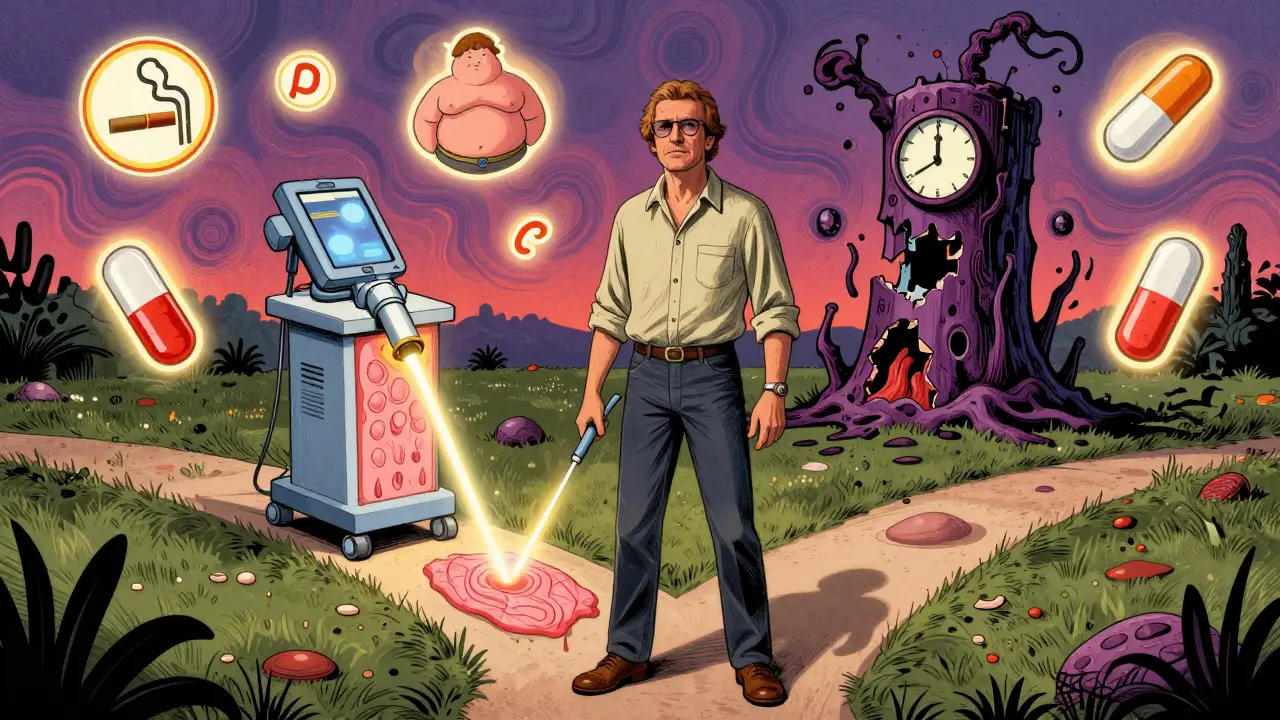
For high-grade dysplasia, ablation is standard. You don’t wait. The two main treatments are:
- Radiofrequency ablation (RFA): Uses heat to burn off the abnormal tissue. Works in 90-98% of cases.
- Cryotherapy: Freezes the tissue off. Also highly effective.
After treatment, you still need follow-up endoscopies-every 3 to 6 months at first-to make sure it doesn’t come back. But many patients never see dysplasia again.
Does Taking PPIs Fix It?
No. And this is where most people get confused.
Proton pump inhibitors (PPIs) like omeprazole or esomeprazole reduce acid and help your heartburn. But they don’t reverse Barrett’s. They don’t eliminate the risk of cancer. Studies show that even with daily PPIs, many patients still have acid reflux at night-just without the burning feeling.
Dr. Philip O. Katz from Temple University Hospital says it plainly: "Symptom control is not the same as esophageal protection." You can feel fine and still be at risk.
That’s why treatment isn’t just about popping pills. It’s about:
- Using high-dose PPIs (like 40mg omeprazole twice daily) to suppress acid as much as possible
- Never eating within 3 hours of bedtime
- Elevating the head of your bed by 6-8 inches
- Avoiding fatty foods, chocolate, caffeine, and spicy meals
- Losing weight if your BMI is above 25
- Quitting smoking
These aren’t "nice to haves." They’re part of your treatment plan.
Is There a Better Way Than Endoscopy?
Endoscopies are invasive, expensive, and uncomfortable. And most people with Barrett’s will never develop cancer. That’s why researchers are working on alternatives.
One promising tool is the TissueCypher Barrett’s Esophagus Assay. It’s a lab test that analyzes biopsies for molecular patterns linked to cancer risk. It got Medicare coverage in 2021 after a study showed a 96% negative predictive value-meaning if the test says you’re low risk, you almost certainly are.
Another big project is underway in Texas, funded by the Cancer Prevention Research Institute. They’re testing DNA methylation markers to predict which patients are most likely to progress. If it works, we could cut unnecessary endoscopies by 40%.
For now, endoscopy is still the gold standard. But change is coming.
What Should You Do?
If you’ve had GERD symptoms for more than five years-especially if you’re a man over 50, white, overweight, or a smoker-talk to your doctor about screening. Don’t wait until you’re in pain. Don’t wait until you’re diagnosed with cancer.
Even if you’re on PPIs and feel fine, you might still have Barrett’s. The only way to know is to get checked.
If you’ve already been diagnosed, follow your surveillance schedule. Don’t skip endoscopies because you "feel okay." And if you have dysplasia, don’t hesitate to ask about ablation. It’s not a last resort-it’s your best chance to stop cancer before it starts.
Barrett’s esophagus isn’t a death sentence. It’s a warning sign. And like any warning, it’s only dangerous if you ignore it.
Can Barrett’s esophagus go away on its own?
No, Barrett’s esophagus doesn’t reverse itself without treatment. The intestinal metaplasia that defines it is a permanent change in the tissue. However, with treatments like radiofrequency ablation, the abnormal tissue can be destroyed and replaced with healthy esophageal lining. In many cases, patients achieve complete eradication of Barrett’s tissue and remain cancer-free for years.
Is Barrett’s esophagus the same as esophageal cancer?
No. Barrett’s esophagus is a precancerous condition, not cancer. It’s a change in the lining of the esophagus that increases your risk of developing esophageal adenocarcinoma. Only about 5% of people with Barrett’s will ever develop cancer, but because the cancer is aggressive and often caught late, early detection of Barrett’s is critical to prevent it.
Do I need to get screened if I only have heartburn once a week?
If you’ve had heartburn once a week for less than five years and have no other risk factors (male, over 50, white, obese, smoker), screening isn’t routinely recommended. But if your symptoms have lasted more than 10-20 years, or you have multiple risk factors, you should discuss screening with your doctor-even if your symptoms seem mild.
Can I stop taking PPIs if I get treated for Barrett’s esophagus?
Usually not. Even after successful ablation, most patients need to continue taking proton pump inhibitors long-term. The goal isn’t just to treat the abnormal tissue-it’s to prevent further acid damage to the esophagus. Stopping PPIs increases the chance of Barrett’s returning or new damage forming.
Are there any side effects from radiofrequency ablation?
Radiofrequency ablation is generally safe. The most common side effects are temporary chest discomfort, difficulty swallowing, and minor bleeding. Serious complications like esophageal narrowing (stricture) happen in less than 5% of cases and can usually be treated with dilation. The benefits of preventing cancer far outweigh these risks for patients with dysplasia.
How often do I need follow-up after treatment?
After ablation, you’ll need endoscopies every 3 months for the first year to confirm the Barrett’s tissue is gone. If everything looks good, follow-ups move to every 6 months for the second year, then annually. If dysplasia returns, you’ll need another treatment. Lifelong monitoring is usually necessary, even after successful eradication.
Can Barrett’s esophagus be inherited?
There’s no direct genetic mutation that causes Barrett’s esophagus. But family history does play a role. If you have a close relative with Barrett’s or esophageal cancer, your risk increases slightly. This may be due to shared lifestyle factors like diet, weight, or GERD habits rather than genes. Still, it’s worth mentioning your family history to your doctor.
What’s the difference between dysplasia and cancer?
Dysplasia means cells look abnormal under the microscope but haven’t invaded deeper layers of tissue. Cancer means those abnormal cells have broken through the basement membrane and started spreading into surrounding tissue. Dysplasia is reversible with treatment; cancer is not. That’s why catching dysplasia early is the whole point of screening.
Ryan Riesterer 21.01.2026
Barrett’s esophagus is a classic example of metaplastic adaptation gone awry. The transition from squamous to columnar epithelium is driven by chronic acid exposure, activating NF-κB and STAT3 pathways that promote intestinal differentiation. The Seattle protocol remains gold standard for biopsy sampling due to the patchy nature of dysplasia. Recent data from the AIMS-2 trial supports early ablation for LGD, reducing progression risk by 94%. PPIs suppress acid but don’t reverse metaplasia-this is critical to emphasize.
Akriti Jain 21.01.2026
So let me get this straight… Big Pharma wants us to get 24 biopsies, pay $5k for an endo, then take PPIs forever… but if we just eat more kale and chant ‘I am not my reflux’… it’ll magically disappear? 🤡✨ #BarrettScare #BigGastroIsWatching
Mike P 21.01.2026
Listen, I’ve had heartburn since I was 25 and I’m 58 now-white, male, overweight, smoked for 30 years. I’ve been on PPIs since 2010. You’re telling me I need to get cut open with a camera just because I’m a statistic? Nah. I’m not some lab rat for the medical-industrial complex. My dad lived to 89 with GERD and never had an endoscopy. You think your fancy ‘Seattle protocol’ is gonna save you? I’ve seen more real medicine in a Walmart parking lot than in your whole GI department. Stop scaring people with jargon and start treating them like humans.
Jasmine Bryant 21.01.2026
Wait-so if you have low-grade dysplasia, you’re supposed to get ablation now? I thought it was just watchful waiting? I read something about this in a 2023 meta-analysis but I’m not sure if it’s been widely adopted yet. Also, does cryo work as well as RFA for people with strictures? I’ve got a cousin who had trouble swallowing after RFA and I’m trying to figure out options…
Margaret Khaemba 21.01.2026
I’m from Kenya and we don’t have endoscopes in most rural clinics, but I’ve seen people here with chronic heartburn for decades. They drink ginger tea, sleep sitting up, and avoid spicy food-no PPIs, no biopsies. It’s not ideal, but survival rates aren’t always tied to tech. Maybe we need to think about prevention at the community level, not just screening the ‘high-risk’ few. Also, I love that you mentioned family history-my uncle had esophageal cancer, and now we all get checked. Small things matter.
Malik Ronquillo 21.01.2026
So you’re saying I’ve been popping omeprazole like candy for 15 years and I still might have pre-cancer in my throat and I didn’t even know it? Jesus. I just thought I was being responsible. Now I’m gonna have to get a camera shoved down my throat and maybe get burned alive with heat? That’s not medicine, that’s horror movie stuff. I’m gonna wait till I start vomiting blood. That’s when I’ll call my doctor. Until then, I’m good.
Brenda King 21.01.2026
Thank you for writing this. I’m a nurse and I see so many patients who think PPIs fix everything. They don’t. I had a patient last month-62, male, smoker, 20+ years of reflux, felt fine-turns out he had HGD. He cried when he found out. He thought he was fine because he wasn’t in pain. We need more people like you speaking up. Please keep sharing this info. Also, if you’re reading this and you’re over 50 and have had heartburn for years-please just get checked. It’s not scary, it’s empowering.
Keith Helm 21.01.2026
Recommendation: Screen all GERD patients over 50 with chronic symptoms. No exceptions. Evidence-based. Cost-effective in long term. Endoscopy is minimally invasive. Delay increases mortality. Compliance is low. Education is critical.
Daphne Mallari - Tolentino 21.01.2026
One must question the epistemological foundations of the Seattle protocol in light of emerging molecular biomarkers. The reliance on histopathological sampling, while historically robust, is inherently limited by sampling error and inter-observer variability. The TissueCypher assay, with its 96% negative predictive value, represents a paradigm shift toward risk-stratified surveillance, rendering the current standard increasingly anachronistic. One must advocate for a transition toward evidence-based molecular diagnostics in lieu of antiquated mechanical biopsy protocols.
Neil Ellis 21.01.2026
Man, this whole thing hits different when you realize your body’s just trying to survive the acid storm you’ve been feeding it for decades. It’s like your esophagus put on a bulletproof vest made of intestine and whispered, ‘I’m doing my best.’ And now we’re gonna burn it off with lasers? Wild. But hey-if that’s the price to not die of cancer, I’ll take it. I’m getting my endo next week. No more ‘I’ll get to it.’ Life’s too short for ‘maybe.’
Rob Sims 21.01.2026
Oh wow, so if you’re a white guy over 50 and you didn’t die in a car crash by now, you’re just a walking cancer incubator? Real compassionate. Meanwhile, my Black friend who’s 60 and has had GERD for 30 years? Not worth screening? Thanks for the racism baked into the guidelines. And PPIs don’t work? Then why are they the #1 prescribed drug in America? You’re just selling fear to make endoscopies profitable. Classic.
Chiraghuddin Qureshi 21.01.2026
Barrett’s is like a silent storm. You don’t feel the wind till the roof’s gone. I got mine at 54-no symptoms, just a routine endo after a stomach bleed. Now I’m cancer-free after RFA. PPIs? Still taking them. Every. Single. Day. Don’t wait till you’re choking on regret.